Perspectives on the Peruvian campaign
ProHass projections for the Peruvian campaign 2027
The industry expects to publish its estimate between March and April. Europe would remain the top destination, followed by the United States and Chile.
November 18, 2026
Due to the uncertainty generated by the El Niño phenomenon in Peru, José Antonio Castro, president of ProHass, points out that they do not yet have an estimate of how much avocado Peru will export in 2027.
The executive says they expect to have the figures between March and April, when producers will have more information available. In this context, initial assessments point to atypical flowering and weak fruit set in much of the producing region.
“There is no good fruit set in most of the country’s producing areas,” Castro points out.
In an interview with Avobook, he points out that this stage has already occurred in most orchards, but it is still too early to estimate how much fruit will be harvested and how much avocado can be exported.
Europe would maintain the largest proportion of shipments
In the event of a reduction in exportable supply, the president of ProHass expects Europe to continue receiving the largest share of Peruvian volume. The United States and Chile would follow .
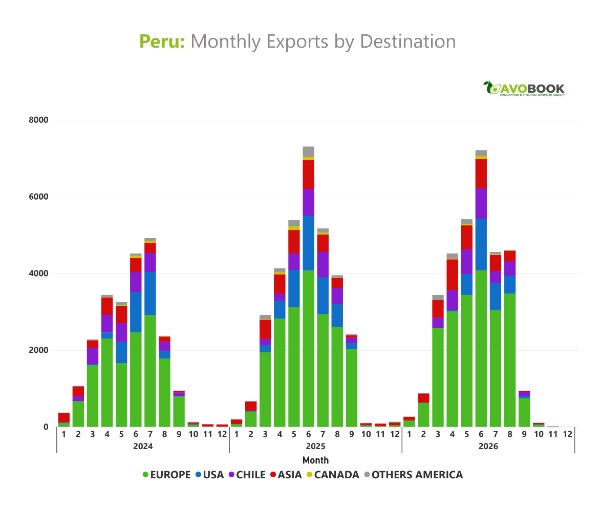
Avobook's data analysis shows that, between 2024 and 2026, Peruvian shipments were concentrated between March and September. Within this same context, the peak months occurred in July during 2024 and in June in both 2025 and 2026.
During the three years analyzed, Europe received most of the fruit during the campaigns, while the United States, Chile and Asia absorbed part of the increase in shipments in the busiest months.
According to Arturo Medina, general manager of ProHass, Chile stands out both for its proximity and for the volume of avocados it consumes. He considers it the third largest destination for Peruvian avocados.
“For us, it is one of our main markets,” he says.
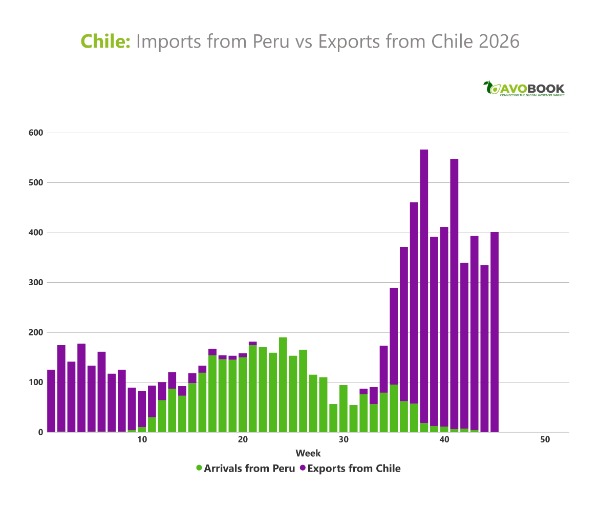
Medina explains that Peru has fruit available approximately between January and September. The season gains volume starting in March, maintains high activity during the following months, and begins to decline in August. This window allows them to supply Chile during part of the year when its exports are lower, as shown by Avobook data.
The trade relationship has also boosted learning about quality and safety for Peru as an exporter.
“Every year we are learning from you how to manage or improve the issues of avocado quality and safety,” Medina says.
How Peru and Chile intersect
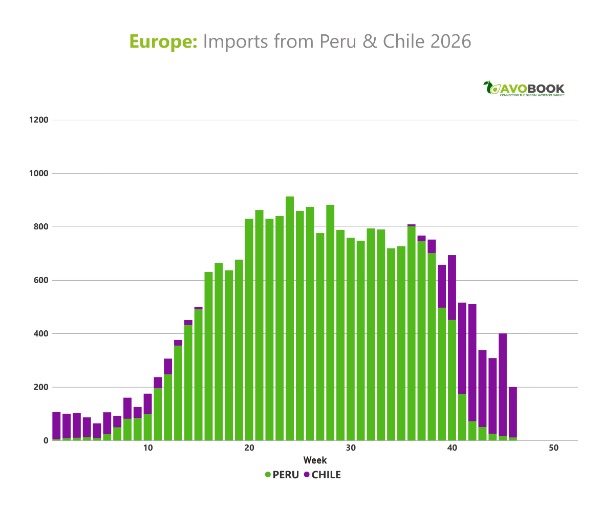
In the European avocado market, Peruvian exports outpaced Chilean exports for much of 2016. This shift became noticeable between weeks 38 and 42, when the volume from Peru decreased and Chile gained ground. In week 41, Chilean arrivals surpassed Peruvian ones. By week 46, arrivals from Peru were only occasional.
In the case of Chile as a destination, imports from Peru increased when Chilean shipments were already low and reached their peak during week 24. The opposite occurred during week 34, when Chilean exports rebounded while Peruvian arrivals began to decrease.
Markets awaiting opening
Peru's trade agenda does not rule out expanding access to new markets. According to Arturo Medina, Peru has the capacity to export avocados to 70 countries and continues working on the phytosanitary requirements for entering Australia, New Zealand, Taiwan, Vietnam, and Mexico.
“These are all phytosanitary issues,” explains the general manager of ProHass, who points out that these efforts are being carried out in conjunction with the National Agrarian Health Service (Senasa).
According to José Antonio Castro's outlook, Europe, the United States, and Chile will continue to be the leading destinations for Peruvian avocados through 2027. The volume estimate that ProHass expects to publish between March and April will allow for an assessment of the available volume following a flowering and fruit set that the industry describes as atypical.
Did you find this news helpful?
Follow us on Instagram → @avobook.avocado
There we publish the most important information about the global avocado market: news, figures and industry trends.
You can also follow us on LinkedIn or join our WhatsApp channel to receive key news as soon as it's published.