Relationship between Peru and Chile
Season, sizes and prices of Peruvian avocados in Chile
Concentrated between March and September, the Peruvian supply feeds the Chilean market in winter, with high demand for medium sizes.
November 20, 2026
Peruvian avocados are becoming increasingly established in the Chilean market. Their arrival during the months of lower local supply has helped maintain a consistent year-round supply in a market that already boasts the highest avocado consumption worldwide.
According to Arturo Medina, general manager of ProHass, Chile is one of the main destinations for Peruvian fruit. The proximity between the two countries and the high volume purchased by Chileans explain part of this importance.
From the wholesale trade, the representative of La Vega Central, Arturo Guerrero, highlights the advances in quality and the acceptance of buyers.
Chile, a nearby market for Peru
Medina points out that Chile currently ranks second or third as a single destination for Peruvian exports. Beyond its commercial importance, he emphasizes the valuable lessons learned from this relationship.
“For us, it is one of our main markets, and every year we are learning from you how to manage or improve the issues of avocado quality and safety,” he explains.
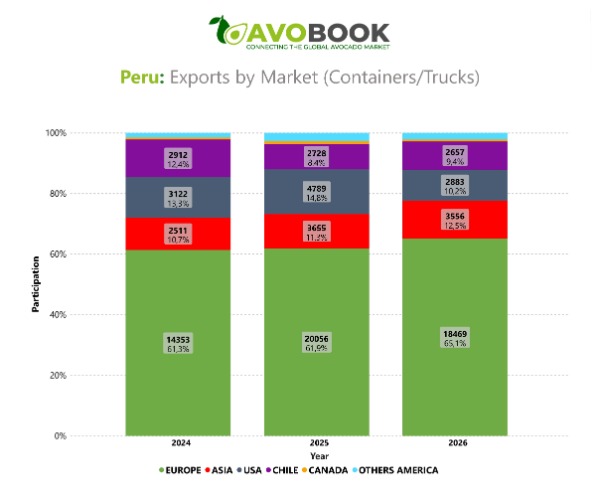
According to Avobook data, Peru shipped 2,912 cargo units to Chile in 2024, representing 12.4% of its total exports. In 2025, shipments decreased to 2,728 units, and their share fell to 8.4%. By 2026, the figure was 2,657 units, corresponding to 9.4% of the total for the period analyzed.
Although the volume shipped to Chile continued to decrease, its share increased by one percentage point compared to 2025. However, it remained below the 12.4% recorded in 2024.
A concentrated arrival between March and September
The General Manager of ProHass explains that the Peruvian trading window extends roughly from January to September. Volume increases in March, remains high during the following months, and begins to decline in August.
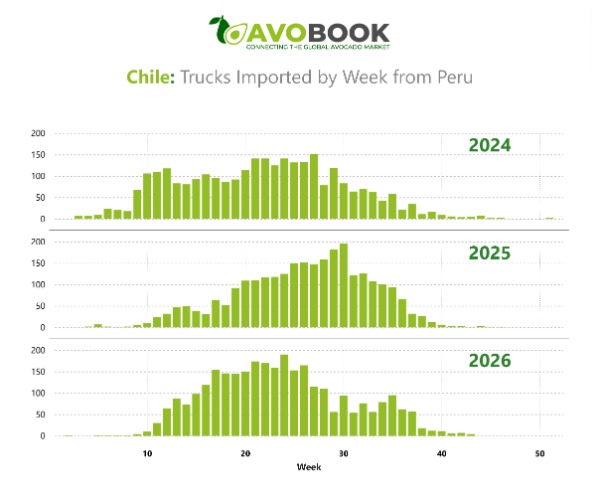
In the case of arrivals to Chile, Avobook records show a concentration between weeks 10 and 37. However, the period of greatest activity changes between seasons.
In 2024, the peak was reached in week 27, with 152 trucks. In 2025, it reached week 30, with 196. During 2026, the highest number was 190 trucks in week 24, six weeks earlier than the previous year's peak.
This supply plays a fundamental role in ensuring continued consumption. During his participation in the Global Avocado Summit 2026 , Matías Reeves, from the exporting company Subsole, highlighted the contribution of Peruvian avocados to supplying the Chilean market during winter and to ensuring year-round availability.
Medium sizes are finding demand
Among wholesale buyers, Arturo Guerrero notes a preference for medium and medium-to-small sizes. He explains that these sizes are in high demand at restaurants and businesses that prepare sushi and hot dogs.
“Mostly, they prefer medium-sized avocados,” he summarizes when describing what these customers are looking for.
According to the representative of La Vega Central market, fruit from Peru has already established a significant presence in the Chilean market. When comparing its presence with other origins, he points out that Brazil, for example, still only makes occasional shipments.
Quality influences price coexistence
Guerrero maintains that the price fluctuation upon the arrival of Peruvian fruit is no longer as pronounced as it once was. According to his analysis, this evolution is linked to improved quality and growing demand from Chilean consumers.
Guerrero argues that the price variation when Peruvian fruit enters the country is no longer as marked as before.
For his part, Arturo Medina believes that the values offered by Chile are attractive for both Peruvian and national avocados.
The spokesperson for La Vega Central also highlights the organization's role in price formation. The presence of different vendors, he explains, allows shoppers to compare offers within the same market.
To better understand demand in order to plan supply
Integrating these two sources also presents several information challenges. Reeves identifies a gap in knowledge about consumption in traditional channels. In this context, he points out that having better data would allow for better management of harvested volumes and a reduction in overstocks.
According to Reeves, this need is compounded by the work on quality, especially in the procedures used to evaluate dry matter and decide on the harvest.
From a Peruvian perspective, Arturo Medina highlights the lessons learned in the Chilean market and notes that this learning continues. The relationship combines a supply window with buyers who demand consistent quality.
For Guerrero, the improvement of Peruvian fruit is already reflected in greater acceptance; Reeves, for his part, maintains that maintaining this progress is part of the work necessary to consolidate its contribution to Chilean consumption.
Did you find this news helpful?
Follow us on Instagram → @avobook.avocado
There we publish the most important information about the global avocado market: news, figures and industry trends.
You can also follow us on LinkedIn or join our WhatsApp channel to receive key news as soon as it's published.