Development of the African avocado industry
Kenya promotes quality and collaboration in avocados
The ASOK awards will focus on innovation, quality and collaboration to strengthen the supply chain and improve producers' results.

Kakuzi Plc won in various categories
November 2, 2026
The Kenyan avocado industry is seeking to ensure that its international development is accompanied by improvements in quality, efficiency, and results for farmers. This is the perspective that the Avocado Society of Kenya (ASOK) is putting forward for the seventh edition of the Kenya Avocado Industry Excellence Awards, whose ceremony and gala dinner will be held on December 9, 2026, at the Argyle Grand Hotel in Nairobi.
Muthomi Ernest, ASOK's chief executive, identifies challenges for the sector that require a joint response in a statement shared with Avobook.
According to the organization, pests and diseases, production inefficiencies, post-harvest losses, logistical costs, and changing demands from international markets are common problems at the source. Furthermore, it proposes using certifications to highlight potential solutions and promote their use throughout the supply chain.
“A stronger avocado industry should be measured not only by its export performance, but also by the value it creates for the people who produce the fruit,” he argues.
Quality as a shared responsibility
The awards recognize contributions in areas such as production, export, processing, research, financing, and services. According to ASOK, this diversity reflects the fact that the competitiveness of a product's origin depends on the work of multiple stakeholders.
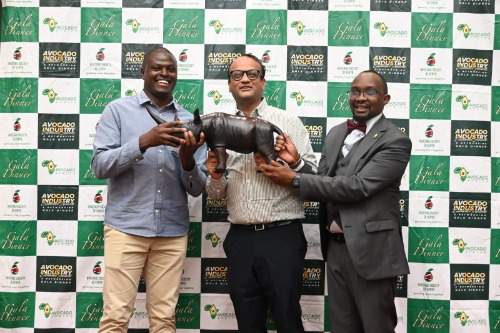
Sunil Savla, CEO of Avoil Industries Limited and winner of the Kenya Avocado Industry Excellence Awards 2025, celebrates with Muthomi Ernest, CEO of ASOK, and Kenyan MP Dindi Njoro, guest of honor.
For farmers, priorities include orchard management, nutrition, pest and disease control, harvest maturity, and post-harvest handling. For packing plants and exporting companies, the organization emphasizes quality assurance, traceability, and compliance with trade and phytosanitary requirements.
The main objective is that recognizing good practices in avocado production will encourage broader improvements.
“A stronger avocado industry should be measured not only by its export performance, but also by the value it creates for the people who produce the fruit.”
Small producers and access to opportunities
Another key aspect is the participation of small producers. Muthomi points out that they need technical information, reliable markets, appropriate financing, and fair trade relations.
This is why it argues that recognition should also include cooperatives, emerging entrepreneurs, and local suppliers. The proposal aims to give visibility to contributions that are not necessarily reflected in large areas or export volumes.
The gala will bring together producers, exporters, processors, researchers, financial institutions, and government representatives. ASOK believes this forum can facilitate exchange between those facing production challenges and those with the technical or financial resources to address them.
Water, innovation and processing

Wangui Dwoya, winner of the 2025 Woman of the Avocado Award.
The organization also proposes broadening the criteria for evaluating excellence. Its priorities include responsible water management, efficient use of inputs, climate-responsive production, waste utilization, and local processing.
In the statement, they indicate that the recognition of companies linked to avocado oil and industrial equipment reflects the growing importance of adding value to production.
ASOK also proposes that the award winners share their experiences at international forums, training sessions, and events such as Avocado Africa. The intention is to extend the exchange of knowledge and learning beyond the annual production period.
ASOK proposes to give greater importance to water management, efficient use of inputs, waste utilization and local processing.
An alliance to give international visibility
The 2026 edition of the awards incorporates an alliance with Avobook, which will publicize the winners and their experiences to an international audience linked to the avocado industry.
According to Muthomi, this collaboration will allow for the documentation and sharing of recognized investments, technologies, and initiatives, connecting local achievements with other players in the global market.
Nominations opened on October 15 and will remain available until November 16, 2026. They can be submitted through the official awards website or by emailing nominations@avocadoawards.co.ke.
For ASOK, the purpose is that the awards help strengthen a better connected industry, capable of sustaining market confidence and generating benefits for the farmers who form its base.