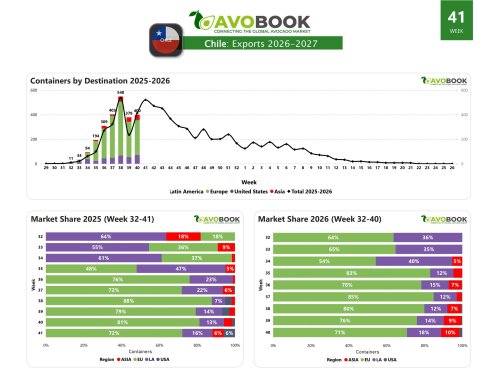
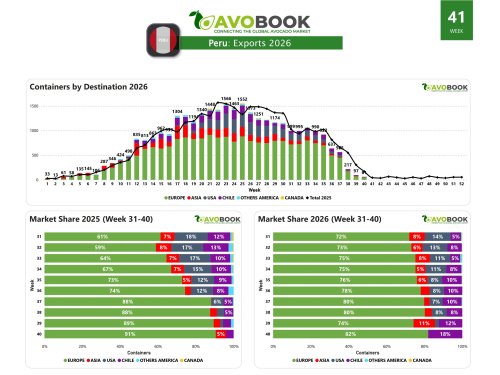
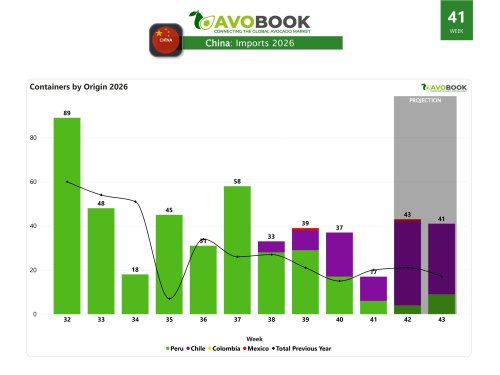
International markets
Medium and small calibers are gaining ground in the US
Medium and small avocado sizes are gaining value in the US and Europe in the face of commercial pressure from large sizes.
The size of the Hass avocado is one of the most decisive factors in its commercial value. However, the relationship between size and price is not always linear. Although larger fruit has traditionally been associated with a higher economic return, recent trends in major global markets demonstrate that valuation depends primarily on the balance between supply and demand.
Currently, both the United States and Europe present unique scenarios, but they share a common trend: medium and small sizes have gained prominence thanks to stable demand and more balanced availability, while large sizes face pressure due to abundance.
United States: preference for medium and processed formats
In the US market, a producer's profitability depends not only on harvest volume but also on the efficient distribution of fruit sizes within their shipments. According to Giovanni Cavaletto , wholesale programs in retail and the continued growth of the processing industry have increased demand for smaller sizes and second-grade fruit, expanding the commercial options for shippers.
Additionally, the United States has a limited capacity to absorb large pieces. When the supply of large gauges exceeds this capacity, the discounts offered by buyers increase substantially. In this scenario, gauges 48 and 60 have established themselves as the most liquid sizes during the season, while sizes like 36 and 40 suffer losses in value due to excessive supply. Meanwhile, smaller gauges such as 70 and 84 have seen increased demand and, during periods of lower overall availability, can even outperform the prices of larger gauges.
Europe: recovery in medium and small sizes
On the other hand, the European market is beginning to show signs of adjustment after weeks characterized by high fruit availability. The gradual reduction in maritime shipments has eased pressure on prices, favoring a progressive recovery, especially for medium and small sizes.
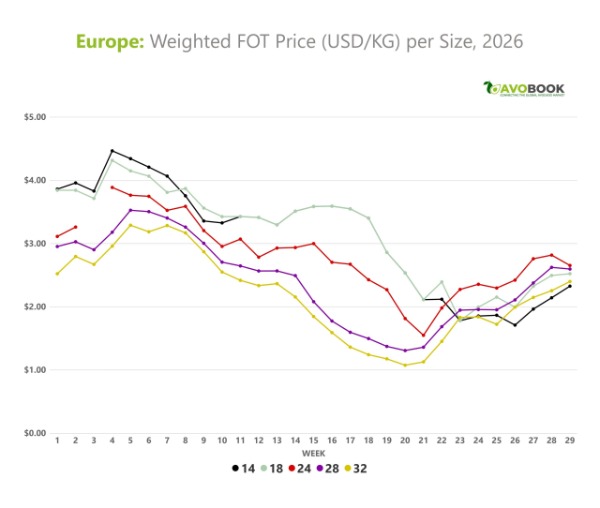
According to Charles Auberge's analysis , although the market remains supplied to meet current demand, price trends in the coming weeks will depend on the ability of other origins to offset the drop in shipments from Peru . Within this context, size 24 stands out as the most consistently appreciating size.
Similarly, sizes 28 and 32 show a strong recovery from the lows of the first half of the year; Gabriel Katkovcin points out that this rebound is due to the reduced availability of small fruit at destination ports. In contrast, larger sizes 14 and 18 continue to be pressured by ample supply, which limits the pace of price adjustments.
Commercial projection for the second half of the season
Although the United States and Europe operate with different trade structures, both markets confirm that avocado prices are driven more by market forces than by the fruit's physical size. While in the United States, wholesale trading and industrial processing support prices for medium-sized avocados, in Europe, reduced South American shipments are contributing to the recovery of sizes 24, 28, and 32. If the decline in Peruvian volume continues without immediate replacement from other supplying countries, the European market will solidify the upward trend for medium and small avocados by the end of the year.