Click here to go directly to the content

Readjustment of origins

US transition: Mexico advances despite decreased volume from Peru and California

Mexico is making its way forward due to the lower participation of Peru and California, which are adjusting the end of their seasons under different strategies.
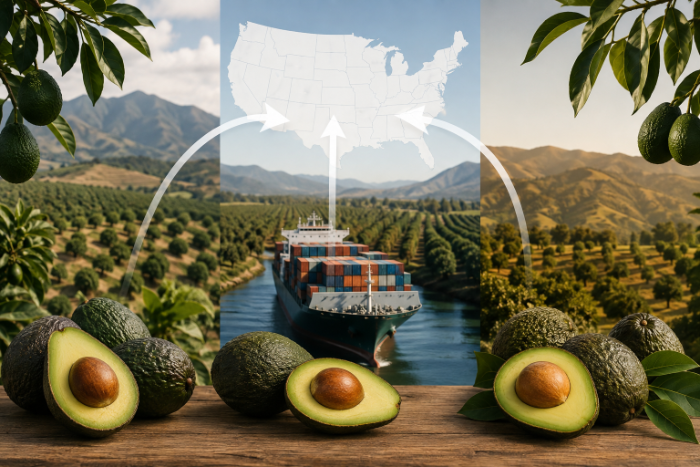
Each August, the U.S. avocado market goes through one of the most relevant moments in its supply calendar. Peru begins approaching the end of its season, California progressively reduces its harvest, and Mexico regains ground until once again consolidating its position as the main supplier to the United States.

In 2026, however, this transition presents some particularities.

During the weeks when Mexico has historically reduced its supply and allowed Peru and California to gain a greater share, Mexican volumes have remained firmer than in previous seasons. This has limited the relative space occupied by both competitors and anticipates a reshuffling of supply during August and September.

Avocado supply transition in the United States with participation from Mexico, Peru and California

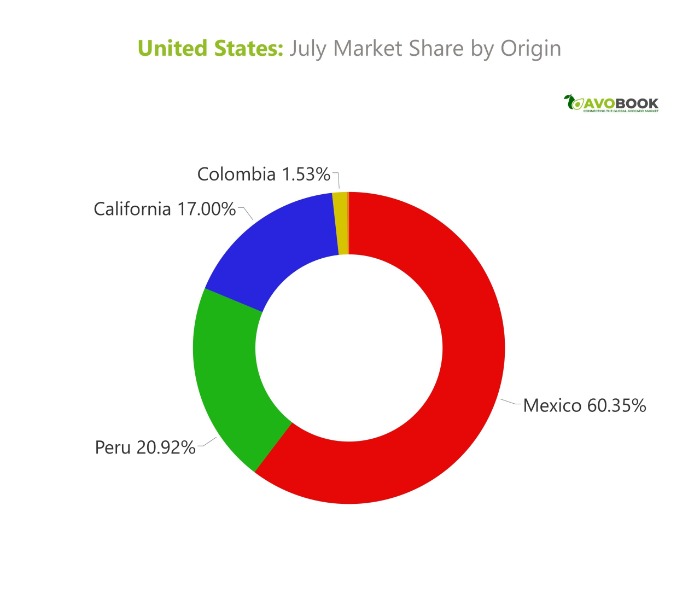
The July data already reflect this structure: Mexico accounted for 60.35% of arrivals into the United States, Peru reached 20.92%, and California represented 17%, while Colombia contributed the remaining 1.53%.

Chart of US avocado market share by supply origin during July 2026

The question now is how this transition will progress and, especially, what it means for the expectations of Peru and California during the final stage of their respective campaigns.

Mexico enters the transition with a stronger presence

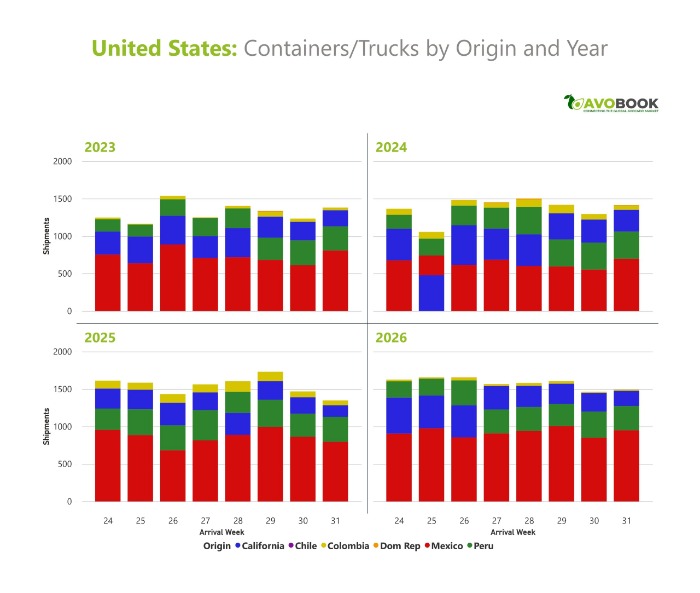
The behavior observed between weeks 24 and 31 illustrates one of the main differences between 2026 and previous campaigns.

This window traditionally coincides with the period when Mexico temporarily reduces its supply. In seasons such as 2023 and 2024, this decline allowed California and Peru to gain greater prominence within U.S. supply.

This year, however, Mexico has maintained high volumes for much of the period, without experiencing as pronounced a contraction. As a result, Peru and California have accounted for a smaller proportion of weekly volume compared with the peaks reached during the same window in previous seasons.

Chart of US avocado market share by supply origin during July 2026

For Gary Clevenger, from Freska Produce, the scenario is part of a seasonal process well known to the industry: as Peru reduces its exports and California slows its harvest, Mexico gradually regains its dominant position. From his perspective, the market remains fundamentally balanced, with stable retail demand and manageable inventories. The key will be to observe how quickly those inventories are absorbed before assessing the true impact of changes in supply.

Peru expects to remain through September

From Peru, the reading of this transition introduces an important nuance: the increase in Mexico does not necessarily alter the schedule anticipated by the Peruvian origin.

José Antonio Castro, president of ProHass, explains that Peru's export window responds mainly to the agroclimatic conditions that determine its Hass production and extends approximately from May through September. According to his projections, the final shipments of Peruvian avocados to the United States should take place during the second week of September.

Its share will gradually decline. During August and part of September, Peru will continue to be present in the U.S. market, moving from levels close to 20% to approximately 7% toward the end of its campaign.

Rather than attempting to artificially extend this window, Castro argues that the challenge is to maintain quality throughout the export period, respecting minimum dry matter levels and optimizing this parameter according to the different producing areas.

Mexico, for its part, supplies the United States during all 52 weeks of the year and has its own production curves according to regions and flowering cycles. For the Peruvian industry, this dynamic does not represent an unexpected scenario.

"The size of the Mexican supply during the different times of the year is not a surprise," explains José Antonio Castro.

The coexistence of different suppliers is also not necessarily viewed as a threat to the origin:

"From our perspective, every market should have supplies of the same product from different origins. This competition is the healthiest thing for the market," says the president of ProHass.

For Peru, therefore, the seasonal strengthening of Mexico is part of a known dynamic incorporated into campaign planning. The challenge is to maintain quality and fulfill commercial commitments throughout its participation window.

California will remain as long as the market allows

California faces the transition from a different position.

Gary Clevenger projects that the origin will remain a relevant supplier during August and that some fruit could remain available even during September. However, the duration of its presence will depend more on market economics than on the physical availability of fruit.

"California's exit will be determined more by market economics than by fruit availability," he notes.

As Mexico increases its share and prices begin to adjust, California growers may become more selective about when they harvest. This partially differentiates the strategies of both origins: while Peru operates within a defined export window and established commercial programs, California retains greater capacity to adjust its harvest pace depending on fruit maturity and available returns.

Clevenger therefore anticipates a gradual reduction in the California harvest during August, although some growers could continue operating in September if commercial conditions prove favorable.

Peru prioritizes its programs

Another relevant question is whether the strengthening of Mexico could lead Peru to redirect part of its fruit toward other destinations.

Clevenger considers that this is possible, but only to a limited extent. Peru has established programs in Europe, the United Kingdom, Asia, and other markets, although many of these commitments are defined in advance.

Castro reinforces precisely this point from the Peruvian perspective: the objective will not be to withdraw fruit from the United States in response to short-term market movements, but rather to respect the programs previously established with the main supermarket chains.

For the president of ProHass, this predictability is part of the commercial positioning of the origin:

"Programs are respected, and based on fulfilling them, trust is built in an origin that delivers and does not speculate," says José Antonio Castro.

This strategy reduces the importance of the spot market as the main indicator for deciding the destination of the fruit and helps explain why the increase in Mexico will not necessarily trigger an early exit from Peru. The United States remains one of its strategic markets, and Peruvian presence will decline mainly in line with the natural progression of its season.

A year of particularly volatile prices

The transition is also taking place after commercial behavior very different from that observed in other seasons.

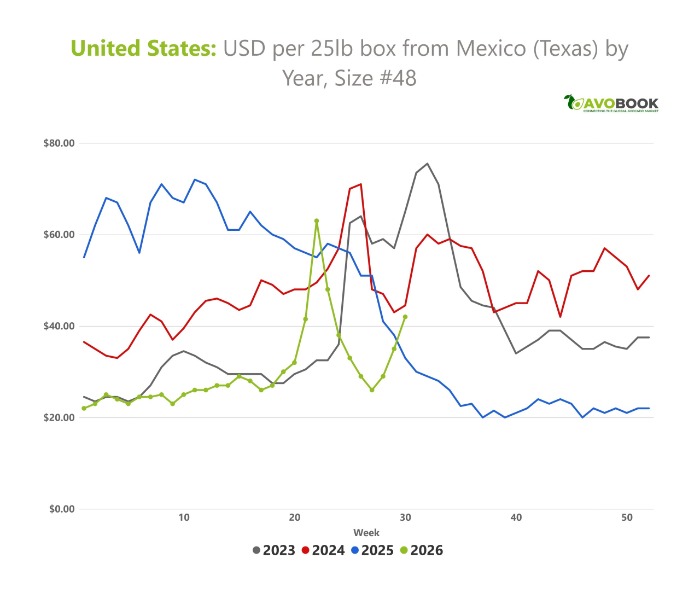
Prices for Mexican 48-count fruit in Texas began 2026 at levels close to USD 22 per 25-pound box. They subsequently rose progressively to reach a peak above USD 60 around week 22. The trend changed rapidly afterward: between weeks 26 and 28, quotations fell to levels near USD 25, before experiencing a partial recovery to approximately USD 42 during week 30.

Historical chart of FOB Texas prices for Mexican avocados size 48 per 25 lb box (2023-2026)

For much of the first part of the year, 2026 values remained below those observed in 2024 and 2025.

For Clevenger, returns during the seasonal window of lower Mexican supply have generally met expectations, although without significantly exceeding them. The combination of sufficient inventories and steady retail demand prevented lower Mexican availability from translating into exceptionally high prices on a sustained basis.

From Peru, Jose Antonio Castro prefers to wait before assessing the final results of the campaign. He considers that making return estimates before the season ends could lead to premature conclusions, especially because each campaign faces different conditions and difficult-to-anticipate factors. His proposal is to wait until November to compare the results of 2026 with previous seasons.

Inventories will set the pace of the transition

What will happen, then, as Peru and California reduce their presence and Mexico regains a greater share?

For Clevenger, inventories should gradually adjust during August, but there are currently sufficient volumes moving through the supply chain to prevent sharp short-term movements.

"The market's focus over the coming weeks should be less on daily headlines and more on the rate at which inventories decline," says Gary Clevenger.

That pace will be decisive for commercial developments. As long as sufficient fruit continues to move through the supply chain, an orderly transition is expected, with adequate availability and relatively stable prices.

A brief interruption in new Mexican supplies would have a limited effect, but if any disruption were to continue for several weeks, inventories would begin to tighten, promotional opportunities would decrease, and prices could strengthen.

Castro, meanwhile, emphasizes another aspect of the transition: changes between origins and hemispheres are a normal part of the planning process for international marketers and supermarkets. The main players know the production windows and plan in advance when to begin replacing one origin with another.

For this reason, the president of ProHass believes that the central objective should not simply be to determine which country gains or loses market share over a few weeks, but to ensure that consumers continue receiving fruit in good condition throughout the process. Product quality and condition are a cross-cutting objective for the different origins and one of the main tools for continuing to increase avocado consumption.

Mexico regains ground, but the transition will be gradual

The data and perspectives from both origins point toward a more progressive than abrupt transition.

Mexico already dominates supply by a wide margin, and its share should continue increasing toward the U.S. fall. California will reduce its harvest as market economic conditions change, although some of its fruit could extend into September.

Peru will also reduce its share, but it will do so while respecting an export window that includes a presence in the United States until approximately the second week of September and maintaining the programs agreed upon with its customers.

The transition, therefore, does not simply mean that Mexico will immediately replace Peru and California. For several weeks, the three origins will continue sharing the market while their respective shares progressively change. During this period, more than daily movements, it will be the rate at which inventories decline that provides a clearer signal regarding prices and availability.

For an industry accustomed to coordinating seasons, hemispheres, and multiple origins, the challenge remains the same: ensuring that the change between suppliers maintains the continuity of supply, quality, and condition that consumers expect.

Tags

Related articles

Small sizes plentiful and large fruit scarce. What's happening with prices in the US?

The Mexican harvest began with a high presence of small fruit, while the lower supply of large sizes widened the price gap.

View more
Avobook and Associação Abacates do Brasil seal a strategic alliance to strengthen the global projection of Brazilian origin

Avobook and Associação Abacates do Brasil join forces to promote Brazilian origin through key market information and greater global visibility.

View more
Chile begins exports focused on Europe and Latin America

Chile begins its exports with 10 initial shipments, prioritizing Europe as the main destination and Latin America in second place.

Premium View more