Market analysis
Small sizes plentiful and large fruit scarce. What's happening with prices in the US?
The Mexican harvest began with a high presence of small fruit, while the lower supply of large sizes widened the price gap.
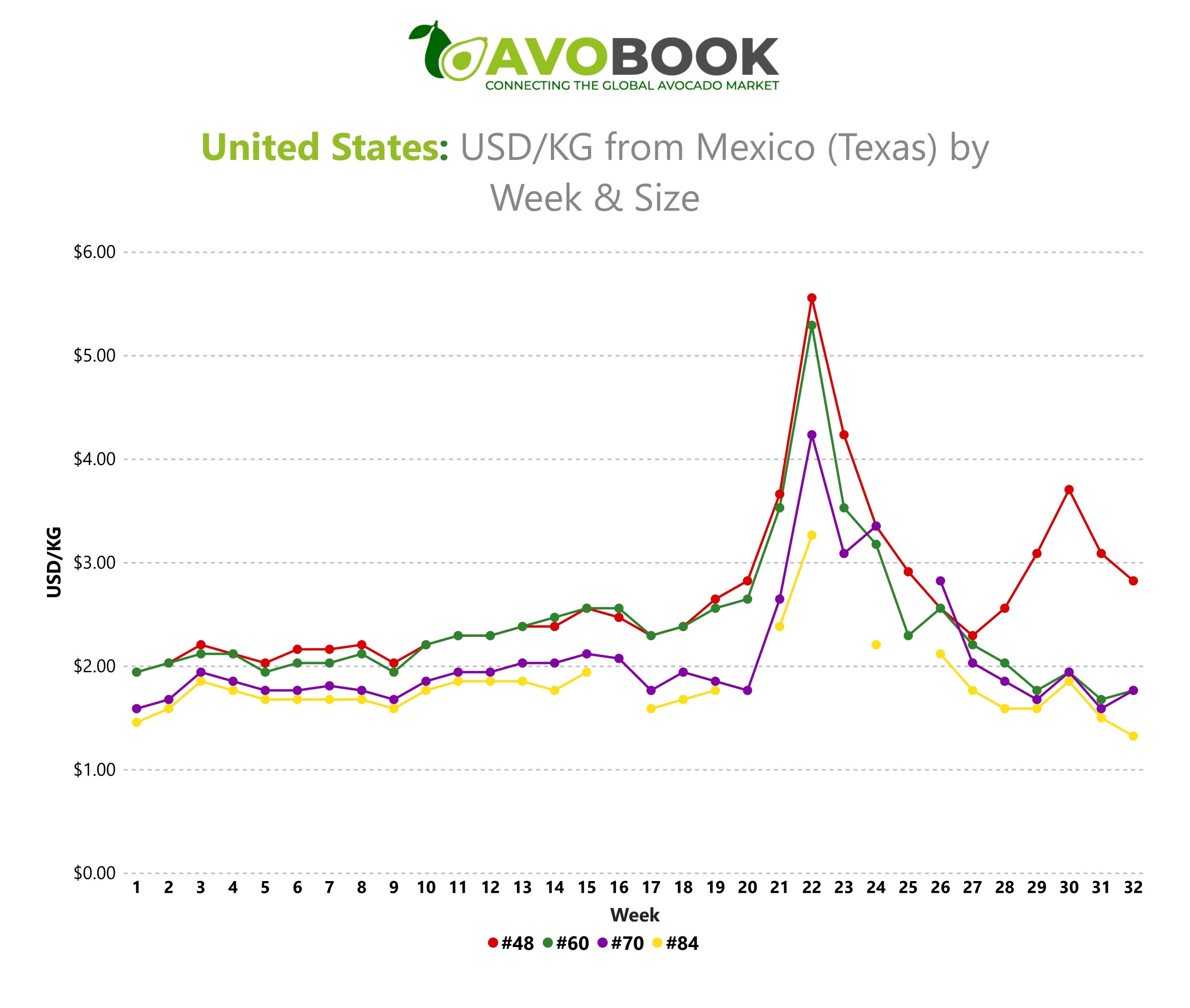
Over the past few weeks, Avobook’s continuous monitoring of the U.S. avocado market has shown an unusual price difference between large and small sizes. While size 48 reached considerably higher values, the greater availability of sizes 60, 70, and 84 kept their prices under pressure.
Avobook’s analytical records show that this gap reached one of its highest points during week 30: the gap reached one of its highest points during week 30. Size 48 was close to US$3.70/kg, while sizes 60 and 70 were around US$1.94/kg and size 84 reached approximately US$1.85/kg. This means a difference of approximately US$1.76/kg between size 48 and sizes 60 and 70, and around US$1.85/kg compared with size 84.
Behind these prices is a combination of production and commercial factors analyzed by Avobook’s data team. The progression of the Mexican harvest across different areas and elevations determines which sizes reach the market, while the gradual reduction in supply from California and Peru modifies the balance available to U.S. buyers.
Elevation helps explain fruit size
The recent behavior begins in the producing areas of Mexico themselves. Sergio Paz, General Manager of Coliman Avocados, explains that harvesting usually begins in areas located around 1,300 meters above sea level, and even at lower elevations in some areas of Jalisco.
In these areas, the so-called “loca” flowering fruit develops a significant part of its growth during the months with the highest temperatures, which initially favors a curve with a greater presence of small sizes.
"In these areas, 'loca' fruit is smaller, since the growth of this fruit occurs during the period of the highest temperatures. As the weeks progress, the harvest moves into higher-elevation areas and the sizes gradually begin to normalize," explains Paz.
This movement is already beginning to be reflected in supply. As harvesting advances into higher-elevation areas, an increasing share of large sizes, particularly size 48, is expected. The next major change should occur during the second half of September, when fruit from the normal flowering begins, presenting a more balanced size curve.
An exceptional gap between sizes 48 and 60
The limited availability of large fruit coincided with a period of strong demand for size 48 in the United States, According to the analysis by Sergio Paz and the historical data compiled by Avobook, while smaller sizes faced a virtually opposite scenario.
The difference reached levels that, according to the General Manager of Coliman Avocados, were exceptional for the market: "The difference between 48 and 60 reached around US$24 per box, which as far as I can remember had never occurred before."
Between 60 and 70, on the other hand, the gap reached between US$1 and US$3 per box, in a scenario where size 60 initially faced particularly weak demand. This phenomenon demonstrates that price does not respond only to the total volume available, but also to the composition of sizes that Avobook monitors week by week.
The gap begins to close
The scenario observed at the end of July is already beginning to change. After several weeks of high prices, size 48 lost strength while interest in size 60 increased. Paz points out that prices for the latter size recorded increases of between US$7 and US$10 per box, accompanied by a substantial improvement in demand.
Size 48 moved in the opposite direction: "In the last days of July, the most demanded size was 48. As of today, demand for this size is practically nonexistent and exporters are pushing this size into the market, which has caused the price to fall," says Sergio Paz.
Part of this rapid correction could be related to the secondary effect of the recently recorded three-day interruption in Mexican operations. However, behind the movement there is also a more structural change: Mexico is beginning to fill the spaces progressively left by Peru and California, but it is doing so with a different size curve.
Three origins, different size curves
During much of the U.S. summer, Mexico, Peru, and California participate simultaneously in supply. But each origin contributes a different combination of sizes. California is approaching the final stage of its harvest and Peru is progressively beginning to reduce its shipments, while Mexico is increasing its prominence.
For Paz, the variation in demand responds precisely to the interaction between these three curves. The transition shows that total availability does not necessarily explain price formation on its own; it is necessary to observe which sizes each origin contributes and which ones are required by the different commercial programs.
Europe tells a different story
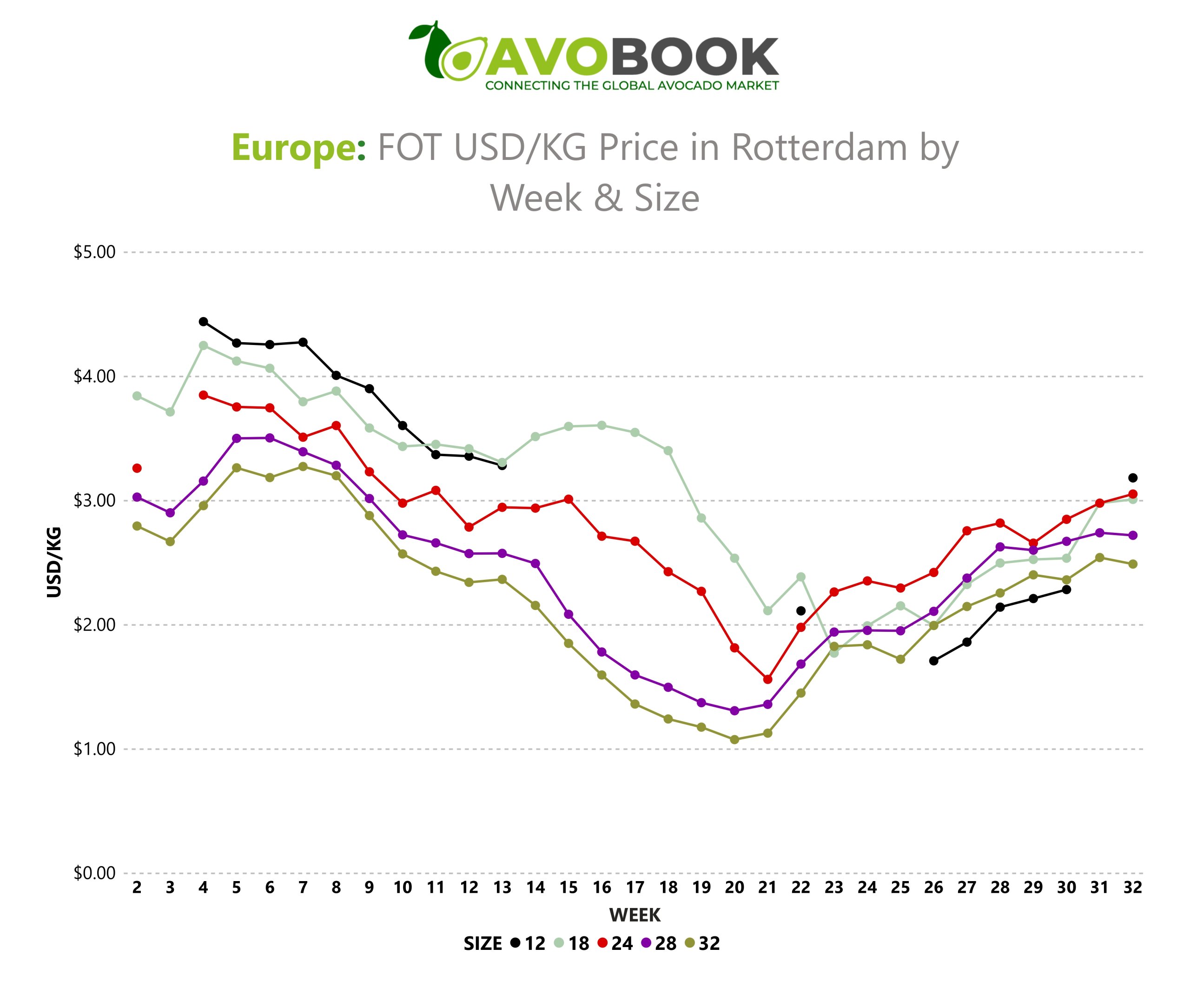
When comparing the U.S. data with the European price panel, the data analyzed by Avobook demonstrate that the contrast is evident. While the United States recorded an exceptional gap between sizes, the Rotterdam market has shown considerably smaller differences. During week 32, size 12 was close to US$3.20/kg compared with approximately US$2.50 for size 32, a difference of approximately US$0.70/kg.
Peru maintains a dominant position in European supply and has allocated significant volumes of large fruit to that market. "Peru has sent too much large fruit to Europe and is by far the dominant origin. That caused medium and small sizes to be better priced than the large ones in Europe," explains Sergio Paz.
Size as a market signal
Avobook’s analysis over the past few weeks in the United States shows why looking only at the average avocado price can conceal an important part of what is happening in the market. The initial abundance of small Mexican sizes, the limited presence of large fruit, and the production curves of Peru and California created an exceptional combination that widened the gap between size 48 and the smaller sizes.
The comparison with Europe reinforces the same conclusion: a size does not have a value determined by its size in isolation. Its price reflects how much is available, which origins are supplying it, and, above all, what fruit each market is looking for at that particular time.