Mexico Season 2026
Michoacán and Jalisco accelerate imports at the start of 2026
Both states begin 2026 with higher shipments than in previous years, maintaining the U.S. as their main destination.
The new Mexican avocado season is getting underway with higher export volumes from the country’s main producing regions. During the first weeks of the campaign, both Michoacán and Jalisco recorded shipment levels above those seen in 2024 and 2025, although with differences in scale, growth rates, and market distribution.
Data for weeks 27 through 31 show that Michoacán continues to hold a commanding lead in volume and is steadily accelerating its exports. Jalisco, meanwhile, is starting from a considerably smaller base but is also posting significant growth compared with previous seasons.
At the same time, the United States continues to account for the majority of shipments, followed by Canada, while other destinations such as Asia, Europe, and Central America maintain smaller shares.
Michoacán Starts with Higher Volumes
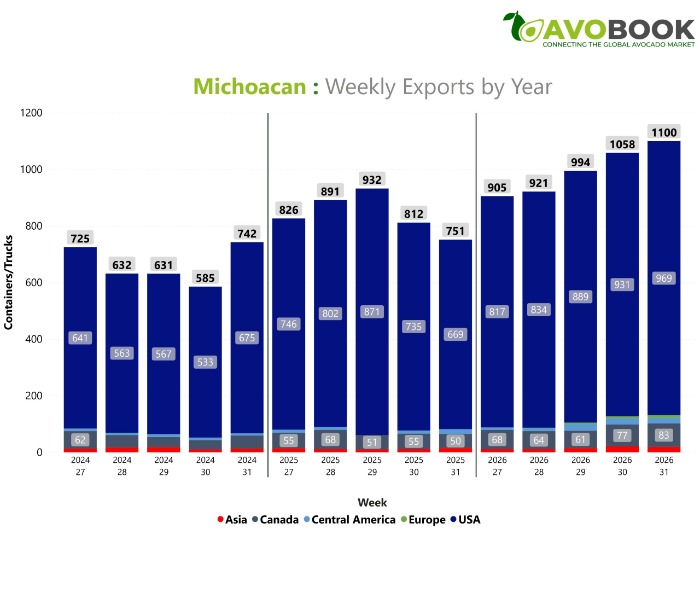
Michoacán began week 27 of 2026 with 905 shipments, compared with 826 during the same period in 2025 and 725 in 2024. The gap widened over the following weeks, with shipments increasing to 921 in week 28, 994 in week 29, 1,058 in week 30, and finally 1,100 shipments in week 31.
This latest figure is 46% higher than at the same point in 2025 and nearly 48% above 2024, highlighting a significantly stronger start to the season than in the previous two years.
The trend also reflects a sustained growth rate. Between weeks 27 and 31, Michoacán increased from 905 to 1,100 shipments, with consecutive gains throughout the period analyzed.
This trajectory contrasts with 2025, when shipments reached 932 in week 29 before declining in the following weeks, and with 2024, when volumes initially decreased before recovering in week 31.
Jalisco Also Accelerates Shipments
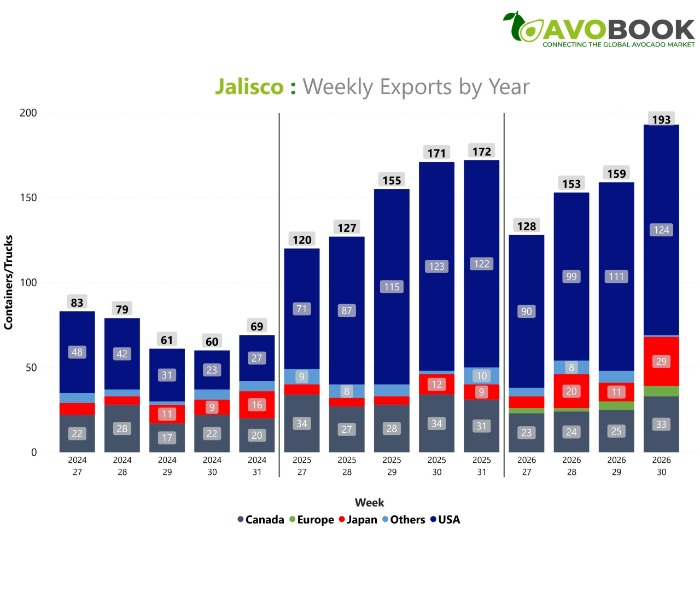
Jalisco is starting the season from a smaller scale, but it is also recording higher volumes than in previous campaigns. In week 27, the state reached 128 shipments, compared with 120 in 2025 and 83 in 2024. It subsequently increased to 153 shipments in week 28 and 159 in week 29. By week 30, shipments had reached 193, surpassing the 171 recorded during the same period in 2025 and significantly exceeding the 60 shipments recorded in 2024.
Although its trajectory shows greater variation than Michoacán’s, the figures point to a significant acceleration during the first weeks of the new campaign. Overall, both states are starting the season above the levels recorded during the previous two years, with Michoacán showing the largest increase in absolute terms and Jalisco posting significant expansion from a smaller base.
Agronomic and Fruit Size Differences: The Role of Irrigation and the Méndez Variety
Beyond shipment volumes, the differences between the two origins are linked to technical, varietal, and field-management factors. According to Saúl Medina, president of APEAJAL and partner at GLC Cerritos, the organoleptic quality of fruit from Jalisco and Michoacán is very similar, but infrastructure creates an important distinction during the first weeks of the season.
"There is a significant amount of Méndez production in Jalisco under technologically advanced irrigation systems and, because the fruit tends to come out about two weeks earlier than in Michoacán, there are weeks like the current one when Jalisco accounts for more than 25% of the crop exported to the U.S., despite having only between 10% and 12% of the total hectares authorized for that market," Medina explains.
This level of technological development also affects fruit size at the beginning of the season: "Because we have orchards with more advanced irrigation technology, Jalisco can sometimes have better fruit sizes at the beginning of the season, at least until mid-September, when Michoacán begins to enter with greater volumes of the early fruit and the market tends to adjust."
The United States Maintains Its Dominant Position
The increase in volumes continues to be accompanied by a strong concentration of shipments toward the United States. In Michoacán’s case, this market absorbs approximately 90% of shipments during the first weeks analyzed. In week 31, for example, 969 of the 1,100 recorded shipments were destined for the United States.
Canada remains the second-largest market, while Asia, Central America, and Europe receive smaller volumes. This distribution confirms that, despite the increase in supply at the beginning of the season, Michoacán’s commercial structure remains heavily oriented toward the U.S. market.
Jalisco Expands Volumes Across Multiple Markets
The United States is also the main destination for shipments from Jalisco, although the distribution shows differences compared with Michoacán. During the first weeks of 2026, the United States increased its share compared with the beginning of 2025, while Canada’s relative share declined. At the same time, shipments to other markets, primarily Japan, as well as Europe and other smaller destinations, have emerged.
In week 30, of the 193 shipments recorded by Jalisco, 124 were destined for the United States, 33 for Canada, and 29 for Japan, while the remaining volume was distributed among Europe and other markets. Thus, both states maintain a clear orientation toward the United States, although Jalisco has a more visible presence in other destinations.
Strategic Market Windows and Complementarity
In terms of market windows, the relationship between the two states is not one of direct competition, but rather one of complementarity, helping to consolidate the dominance of Mexican avocados in North America.
"Jalisco greatly helps Mexico become a more dominant and powerful country in the United States because it creates a very natural transition when the 'black fruit' season in Michoacán comes to an end and the Méndez variety begins here," highlights the APEAJAL president.
However, production windows differ toward the end of the season. While Michoacán maintains solid volumes during the 'black fruit' period from March through June, Jalisco virtually disappears from the market during those months due to a lack of local production.
Opportunities in Asia: Phytosanitary Barriers and the Peru Factor
Regarding whether Peru’s gradual withdrawal from Asian markets could create additional space for Mexican avocados, Medina confirms that the opportunity exists but points to two key constraints: phytosanitary protocol restrictions and price dynamics.
Currently, Michoacán is authorized to export to South Korea, while Jalisco is not. "As APEAJAL, we are actively working to open up all possible options, particularly South Korea. We have been negotiating to open that protocol and allow Jalisco to send volumes there," Medina says.
At the same time, the impact of Peruvian fruit on Asian and European markets is not related to quality, but rather to volume and commercial terms:
"Peru has an impact because it handles a very large critical mass of volume, and the main issue is the consignment schemes they offer in destinations such as Japan and Europe. That is what sometimes prevents Mexico from competing more strongly: it is not a matter of fruit quality, but rather competing against a very low price," the industry leader concludes.
A Season Beginning with Higher Volumes and Major Challenges
In summary, the first figures from the new campaign confirm a considerably more dynamic start for both origins analyzed. Michoacán reached 1,100 shipments in week 31, significantly exceeding the figures recorded in 2024 and 2025, while Jalisco reached 193 shipments in week 30, also positioning itself above previous seasons.
For now, the United States remains the main driver and destination for this greater availability, complemented by Canada and targeted shipments to Asia and Europe.
The coming weeks will be critical in determining whether this growth rate can be sustained, how progress in phytosanitary negotiations for Jalisco will affect its access to Asian markets, and how the Mexican industry will respond to changing international market dynamics as the 2026 season progresses.