Production and competitiveness
The challenge of producing profitable avocados in California
Gary Clevenger, co-founder of Freska Produce International, analyzes how costs, weather, and imported competition affect production.
October 28, 2026
One of the strengths of California 's avocado industry remains the quality of its produce. For Gary Clevenger, co-founder of Freska Produce International, the challenge is ensuring prices cover the costs of maintaining the orchards. Water, labor, and regulatory compliance put pressure on the profitability of a region that also shares its market with imported fruit year-round.
“California’s biggest challenge is not producing quality avocados, but doing so profitably while competing with imported fruit produced at significantly lower costs,” Clevenger told Avobook in an interview.
Their diagnosis sets a condition for the sector. Quality, freshness, and local identity must translate into a sufficient return for producers. While proximity to the consumer offers commercial advantages, it does not guarantee a profitable operation.
Water and labor put pressure on orchard costs
According to the co-founder of Freska Produce International, rising water and labor costs, along with stricter regulations, are among the current challenges. He explains that Californian avocado producers operate with a significantly higher cost structure than many of their foreign competitors.
Water presents two challenges. In addition to costs, there's the issue of its availability for orchards. Clevenger points out that the rising cost has led producers to invest in more efficient irrigation systems, soil moisture monitoring, and better resource management to reduce consumption.
It's also important to consider labor costs. In his analysis, Gary Clevenger explains that labor costs continue to rise due to factors such as the minimum wage increase, regulations, and worker availability.
The weather adds uncertainty to production
In addition to costs, Californian avocado production is constantly exposed to weather events that can have negative effects on orchards, such as extreme heat and strong winds, particularly damaging conditions.
“The heat can cause fruit drop and sunburn, while the winds damage the trees and reduce yields,” Clevenger explains.
From their perspective, this affects the predictability of both production and the profitability of the business.
A local window into a market supplied by imports
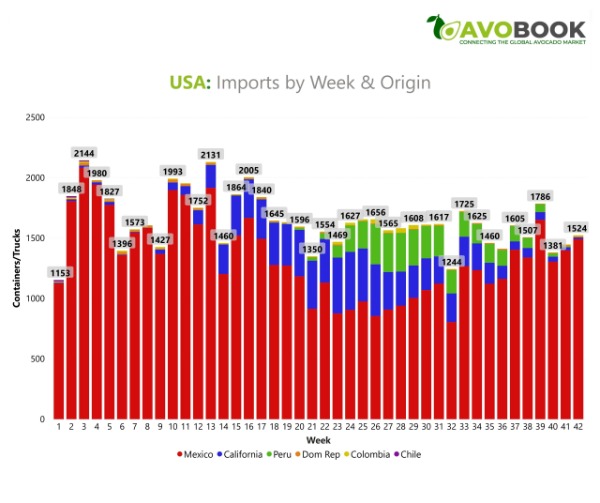
Analysis of Avobook's data shows that California concentrates its share of the US market primarily between April and August, with a significant presence during May and June. Mexico , on the other hand , maintains the highest volume throughout the entire period studied.
The increase in Californian supply in April and May coincides with a relative reduction in Mexican shipments compared to levels at the beginning of the year. However, Mexico maintains its position as the main supplier.
During June and July, another player enters the competition. During these months, Peru gains market share while California remains present. Afterward, California's supply decreases, and Mexico once again controls a larger share of the market.
According to Clevenger, this relationship is part of how the U.S. avocado market works. Imports, especially from Mexico, ensure a year-round supply of the fruit, while California provides local produce during its season.
“Both origins are necessary to meet consumer demand,” he notes.
Proximity has value, but the price premium isn't guaranteed.
The co-founder of Freska Produce International told Avobook that buyers value the freshness, consistent quality, shorter transport distances, and distinctive identity of California-grown avocados. Furthermore, for some retailers, origin is also a quality they can communicate to the consumer.
This differentiation allows for higher prices, especially in markets in the western United States, where local products are highly valued. However, Clevenger cautions that the outcome depends on trading conditions.
“Price increases are not guaranteed. They depend on supply, size, quality, and market conditions,” he explains.
It also points out that Californian fruit is not necessarily cheaper because it is produced close to its buyers.
What conditions can sustain production?
Gary Clevenger identifies opportunities in premium-quality avocados, organic production, improved varieties, and stronger promotion of California as a place of origin. At the same time, he insists that controlling costs and improving yields are essential for business continuity.
“We can’t compete with imports on cost alone. Our future depends on quality, freshness, productivity, and maintaining a strong identity as a California-grown product,” he says.
Clevenger's perspective is that California will remain a major producing region. However, its long-term viability will depend on farmers receiving prices that justify their higher production costs.