International Market Outlook
Avocado to 2036: supply, demand and risk of oversupply
According to Avobook, global avocado production will grow by 89% by 2036, outpacing demand if consumption is not boosted.
November 23, 2026
The supply of avocados destined for international trade could grow faster than demand in the next decade. According to projections presented by Avobook CEO Sebastián de la Cuadra, the volumes considered in the analysis would increase by 89%, rising from approximately 2.9 million tons in 2026 to nearly 5.6 million tons in 2036.
Under the baseline scenario, demand could reach 4.7 million tons by the end of the period. This figure would leave a shortfall of 861,000 tons, equivalent to 15% of the projected supply.
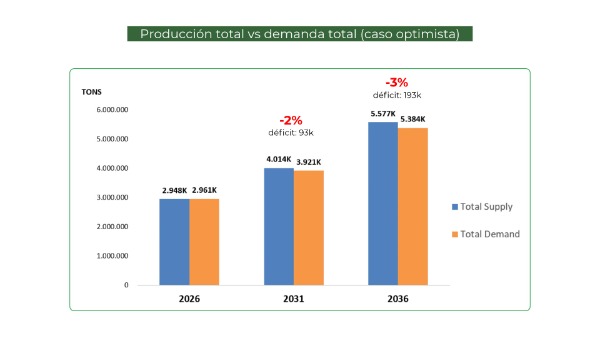
The magnitude of this gap will depend on consumption growth. A second possible scenario, which includes faster demand expansion in the United States and Europe, would reduce the surplus to 193,000 tons in 2036.
In both cases, the supply is the same; the difference lies in the markets' capacity to absorb it.
Mexico and Peru would boost the increase in supply
According to Avobook's data analysis, the growth in supply would be driven primarily by Mexico and Peru.
In the case of Mexico, it would maintain its position as the largest supplier among the countries analyzed. Peru, meanwhile, would increase from 740,000 tons in 2026 to 1.2 million tons in 2036.
Brazil, the Kenya/Tanzania bloc, and Morocco would also be included in this projection, as these countries are expected to show significant increases, although smaller compared to the first exporters mentioned. In contrast, the projection anticipates a more stable trend for Chile and California.
Brazil, the Kenya/Tanzania bloc, and Morocco would be added to this projection, with significant increases.
This leads to an expansion of available volumes, led by Mexico and Peru and accompanied by the growth of other supplier countries.
The United States and Europe face the greatest absorption challenge.
From the demand perspective, the United States and Europe would take on the task of absorbing the largest available volume.
Based on this scenario, annual growth of approximately 4.5% is projected for the United States and 8% for Europe, starting in 2028. Under this scenario, total demand for the model would increase from 2.961 billion in 2026 to 4.716 billion ten years later.
Another scenario raises the rates to 6% for the US market and 10% for Europe. At that rate, demand would reach 5.384 billion tons in 2036, an increase of 668,000 tons compared to the first scenario.
From a balanced market to a growing surplus
The model developed by Avobook starts from a virtually balanced base in 2026, with a supply of 2.948 billion tons and a demand of 2.961 billion.
By 2031, the scenario projects a supply of 4.014 billion tons versus a demand of 3.680 billion. In this case, the difference would reach 334,000 tons, before widening to 861,000 tons in 2036.
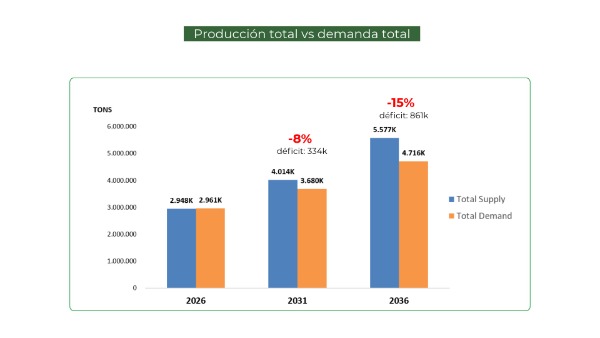
If consumption grows more, this gap would narrow considerably. Reaching 93,000 tons in 2031 and 193,000 tons in 2036, these figures represent approximately 2% and 3% of the annual supply, respectively.
The potential pressure on prices and margins
A scenario in which supply far outpaces demand poses a commercial risk to the global avocado industry. Increased competition to place the fruit on the market could put downward pressure on prices and, depending on the costs of each operation, reduce profit margins.
Avobook's analysis highlights the challenge of market absorption. In the first scenario, avocado consumption would not keep pace with the projected supply expansion. However, in the scenario with higher demand, the market is closer to equilibrium.
Promotion and quality to support growth
The conclusion of Avobook's data analysis and the presentation by its CEO, Sebastián de la Cuadra, brings together three elements as a response: unity in the guilds, promotion and quality.
The contrast between these two scenarios places the development of consumption at the heart of the proposal. With the same level of supply projected for 2036, a faster expansion of demand in the United States and Europe would mean a reduction of the surplus by approximately 600,000 tons.
Thus, strong promotion and consistent quality emerge as priorities to accompany the increase in available volumes.
Thus, strong promotion and consistent quality emerge as priorities to support the increase in available volumes. Avobook's projection presents a challenge for the global avocado industry over the next decade: developing demand alongside supply through collaborative efforts among industry associations for enhanced promotion and improved quality of the fruit that reaches consumers.
Did you find this news helpful?
Follow us on Instagram → @avobook.avocado
There we publish the most important information about the global avocado market: news, figures and industry trends.
You can also follow us on LinkedIn or join our WhatsApp channel to receive key news as soon as it's published.