Evolution of the global avocado landscape
Morocco seeks to consolidate its position in Europe
After a season hampered by the weather, Morocco expects a harvest of 100,000 tons of avocados, which is complemented by new orchards and proximity to Europe.
October 26, 2026
Morocco Seeks to Regain Ground in Europe
In recent years, Morocco has established itself as a significant avocado supplier to the European market. However, this growth has not shielded the country from challenges. After reaching a record level of exports in the 2024–2025 season, the effects of adverse weather conditions reduced its supply in the following season. With the start of the 2026–2027 season, the Moroccan industry expects to recover some of those volumes.
Geographical proximity to the Old Continent, investments in new orchards, and a marketing window that overlaps with other suppliers during the European winter are among the key factors shaping the development of this origin. Attention is now focused on the volumes Morocco will manage to ship during 2026–2027 and the conditions in a market that will also include exporters such as Chile, Colombia, Israel, and Spain.
Victor Ruete, manager of Baika España, projects a recovery in Moroccan exports, estimating production at approximately 100 million kilos. Meanwhile, Yassin Chaib, manager of exporter Mavoca, indicates that the harvest could reach 100,000 tonnes of fruit. He also expects improvements in avocado quality and sizing.
Growth Driven by Proximity and Investment
According to Ruete's analysis, Morocco's progress has taken place in a context where Spanish avocado production has faced difficulties and grown more slowly than demand. Investments in new orchards, lower production costs, and regulations that, according to him, have historically been less restrictive have also contributed to this growth.
The African country's location has also helped strengthen its position. Transit times from Morocco to European markets can range from 48 to 72 hours, Ruete notes. The proximity between origin and destination provides commercial flexibility and reduces the time between dispatch and the arrival of the avocados.
Although Chaib agrees that proximity is an important advantage for Morocco, he considers the country to still be a relatively young supplier. The businessman also highlights the technical expertise the avocado sector has acquired in recent years.
The destinations of Moroccan avocados reflect the country's close ties with Europe. According to trade data compiled by WITS based on UN Comtrade, Spain received 29,246 tonnes of Moroccan avocados in 2025, followed by France with 26,436 tonnes and the Netherlands with 22,856 tonnes.
Weather Hampered the 2025/26 Season
The industry's growth in Morocco did not prevent a contraction during the previous season. In its report Global Avocado Update 2026, Rabobank notes that exports from this origin declined compared with the record level reached in 2024–2025.
Among the factors behind the decline, the report cites the impact of hot, dry weather on orchards during the summer. It also points to logistical difficulties associated with weather conditions in winter.
Victor Ruete indicates that the decline was approximately 46%, from 114 million kilos in 2024–2025 to around 62 million kilos in 2025–2026. According to his explanation, production losses resulted from high temperatures during critical stages of fruit development.
Chaib attributes the smaller harvest to intense heat waves. The Mavoca manager notes that the weather not only reduced production but also damaged some of the fruit that remained on the trees.
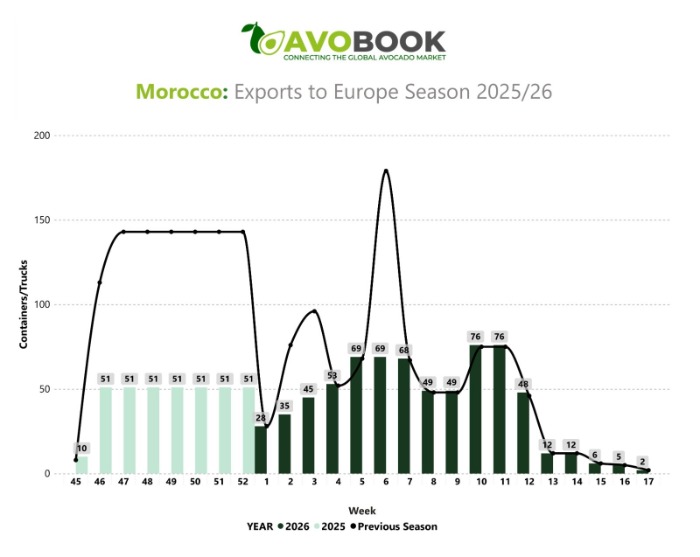
An analysis of Avobook data shows differences between the two seasons in shipments to the European market. One of the most significant gaps occurred in week 6, when 179 shipments were recorded in 2025 compared with 69 in 2026. Toward the end of the period studied, volumes declined in both seasons.
Expectations for the New Season
With the 2026–2027 season in its early stages, Ruete reports that the first green-skinned varieties have already begun to be marketed. For Hass avocados, he expects shipments to begin between weeks 44 and 45, followed by a gradual increase in November.
His preliminary estimate points to exports of around 100 million kilos. However, he notes that high temperatures in May caused fruit drop, potentially resulting in losses of approximately 30%. For this reason, the final volume is still being assessed.
From Morocco, Yassin Chaib expects the harvest to reach around 100,000 tonnes, with significant improvements in quality and sizing compared with the previous season.
Although both assessments point to a recovery in Moroccan volumes, Ruete focuses on exports, while Chaib refers to the harvest for the 2026–2027 season.
Another relevant factor is the commercial environment. Victor Ruete anticipates a period of intense competition. He expects Chilean supply, an increase in Colombian shipments, higher production in Israel, and the gradual entry of Spain's crop into the market.
According to Ruete's assessment, a substantial share of the winter supply will consist of medium and small sizes, particularly sizes #18 and #24. In this scenario, he believes larger fruit could find better commercial opportunities.
Water Remains a Challenge for Growth
Rainfall in Morocco in 2026 offered a more favorable outlook for producers. Chaib maintains that precipitation improved water availability and made it possible to lift restrictions that had affected the sector.
Ruete, meanwhile, identifies water resources as a major long-term challenge. According to his analysis, the expansion of avocado plantations has increased irrigation requirements, and it will be difficult to sustain indefinitely the pace of orchard expansion observed in recent years.
The FAO notes that increased rainfall in 2026 helped replenish reservoirs and water reserves in Morocco after a prolonged period of drought. However, it warns that this recovery does not eliminate structural pressures on water resources, including groundwater.
For Victor Ruete, future growth will increasingly depend on the productivity of existing plantations and the efficient use of water. The new season will make it possible to assess not only how much volume Morocco recovers, but also how it competes during the European winter and its ability to sustain development in the coming seasons.