Industrialization and technology
Food safety and HPP in guacamole: shelf life extension
HPP technology allows guacamole to have a shelf life of up to 60 days without heat treatment, opening up new export routes.
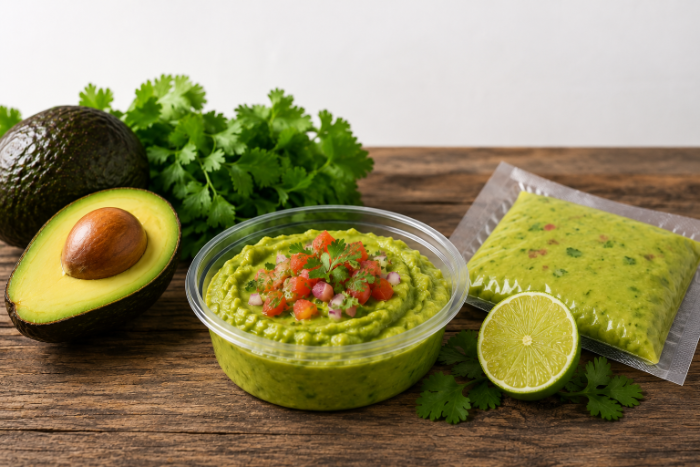
The growth of processed avocado products is opening up new opportunities for an industry that has traditionally focused on the marketing of fresh fruit. Guacamole, pulp, and other formats make it possible to add value and expand commercial options, but they also pose a fundamental challenge: ensuring that a ready-to-eat product maintains its safety and quality throughout its shelf life.
In this context, High Pressure Processing (HPP) has become one of the technologies used by the industry to control microorganisms and extend shelf life without relying on conventional heat treatment.
However, its adoption does not replace the food safety systems required to produce and export food products. HPP functions as an additional barrier within a chain that begins with raw material controls and continues through hygiene, processing, packaging, cold chain management, microbiological testing, and compliance with the requirements of the destination market.
From Fresh Avocado to a Ready-to-Eat Food
Processing changes the risks that must be managed. Unlike whole fruit, guacamole is a handled product and is generally ready to eat, making microbiological control particularly important.
Microorganisms of concern include Salmonella spp. and Listeria monocytogenes. Between 2017 and 2019, the U.S. Food and Drug Administration (FDA) analyzed a total of 887 domestic and imported samples of processed avocado and guacamole specifically to detect both pathogens. The agency found Salmonella in two samples and Listeria monocytogenes in 15.
As part of that program, the FDA sought to exclude from sampling products that had undergone HPP or were intended to undergo the process, describing the technology as a validated kill step for eliminating pathogenic microorganisms and noting that it is commonly used in the production of processed avocado and guacamole. The agency itself cautioned, however, that the study was not designed to directly compare HPP-treated and untreated products.
In addition to these food safety risks, spoilage microorganisms such as molds and yeasts must also be considered, along with avocado-specific phenomena such as browning, all of which influence how long the product can remain commercially viable.
How Does HPP Work on Guacamole?
Unlike conventional thermal pasteurization, HPP uses pressure. The product, typically already packaged, is placed inside a system where water transmits pressures that can reach 600 MPa, or 6,000 bar.
Pressure makes it possible to inactivate microorganisms without exposing the food to the high temperatures associated with other preservation methods. In the case of avocado, Hiperbaric also points to partial inactivation of the enzyme polyphenol oxidase (PPO), which is involved in browning, helping to maintain the green color for a longer period.
This is particularly relevant for a product in which color, texture, and flavor are part of its commercial value. As a non-thermal process, HPP aims to preserve these attributes and reduce the need for preservatives while simultaneously improving microbiological safety.
The technology should not be viewed as a stand-alone solution either. The outcome depends on variables such as formulation, pH, initial microbial load, pressure and processing time, packaging, and the maintenance of refrigeration.
From Days to Several Weeks of Shelf Life
One of the main impacts of HPP is precisely its effect on shelf life.
Hiperbaric states that guacamole processed using high pressure can achieve a shelf life of six to eight weeks. For HPP-treated avocado products with a pH below 5.0, the company indicates shelf lives of up to 60 days.
These figures do not represent a universal shelf life for every guacamole product. Shelf life must be validated for each specific formulation and process, while also taking storage and distribution conditions into account.
Extending this window has implications that go beyond keeping the product on the retail shelf for a longer period. A longer commercial shelf life can facilitate longer logistics routes and expand the marketing possibilities for processed products in markets located far from the place of production.
Exporting Requires More Than HPP
The use of high pressure does not, by itself, constitute a certification or a universal requirement for exporting guacamole. Companies must comply with the applicable food safety regulations in each market and demonstrate that the hazards associated with their products are adequately controlled.
In the United States, the preventive controls requirements for human food under the Food Safety Modernization Act (FSMA) require facilities subject to the regulation to have a written food safety plan that includes a hazard analysis and risk-based preventive controls. These requirements address reasonably foreseeable biological, chemical, and physical hazards.
For imported foods, there is also the Foreign Supplier Verification Program (FSVP). Under this system, the U.S. importer is responsible for verifying that its foreign suppliers produce food in accordance with the applicable U.S. food safety standards, subject to the exceptions established by the regulation.
In the European Union, Regulation (EC) No 852/2004 establishes general hygiene requirements and requires food business operators beyond primary production to implement and maintain procedures based on HACCP principles. It also addresses aspects such as microbiological criteria, temperature control, and the maintenance of the cold chain where applicable.
For ready-to-eat foods, the control of Listeria monocytogenes is particularly important. As of July 1, 2026, an amendment to the European criteria for this microorganism applies, strengthening the requirements for certain foods capable of supporting its growth throughout their shelf life.
Alongside regulatory requirements, private standards may also be requested by buyers, distributors, or retail chains, such as BRCGS Food Safety or FSSC 22000. Their relevance will depend on the customer and market, and therefore they should not be confused with universal regulatory export requirements.
Investment Depends on Scale
Adopting HPP also represents an economic decision. The required capacity depends on processing volumes, frequency of use, and the markets targeted by each company.
Hiperbaric currently offers industrial systems with approximate capacities ranging from 270 to 3,200 kilograms per hour, a range that allows operations ranging from smaller-scale facilities to high-volume industrial plants.
There is, however, no single implementation cost applicable to every company. Investment varies according to capacity, line configuration, automation, and supporting infrastructure. Additional costs include refrigeration, compatible packaging, operation, and maintenance.
For this reason, the decision is not simply about purchasing equipment, but about determining whether the volume processed is sufficient to justify and efficiently utilize that capacity. For companies that have not yet reached such a scale, access to third-party processing services can provide an alternative before bringing the technology in-house.
The economic equation should also take potential benefits into account: a longer commercial shelf life can reduce losses, expand the distribution radius, and facilitate access to markets that require longer logistics times.
Hiperbaric: High Pressure from Spain to the World
Hiperbaric is a Spanish company specializing in industrial high-pressure technologies. Its history began in 1999 in Burgos, with a research and development project aimed at designing an industrial system for food processing using high pressure. Two years later, the company developed its first HPP prototype and began its international expansion.
Today, the company states that it has industrial systems installed in more than 50 countries, with commercial offices in the United States, Mexico, and China. In addition to HPP for food and beverages, it has expanded its activities into other high-pressure applications.
In the avocado sector, Hiperbaric has developed solutions for guacamole, pulp, halves, and other ready-to-eat products, within a category that was among the first to adopt high-pressure processing on an industrial scale.
For an industry seeking to move beyond the marketing of fresh fruit toward higher-value-added products, the challenge therefore does not end with processing more avocado. Extending shelf life only creates a genuine commercial opportunity when it is accompanied by microbiological safety, quality preservation, regulatory compliance, and a scale capable of making the process economically sustainable.