European supply of Hass avocados
Europe changes Hass avocado suppliers
The trade shift in Europe came early in 2026: Chile took the lead in week 41 and Israel will lead the market towards the end of the year.
November 9, 2026
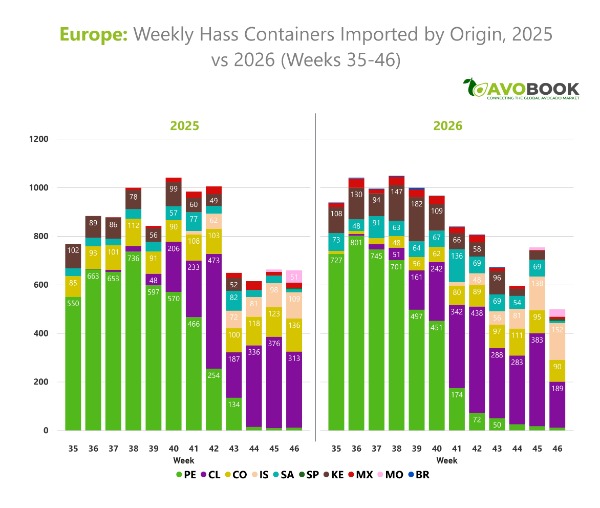
Chile overtook Peru as the main supplier of Hass avocados to the European market in week 41 of 2026, one week earlier than in 2025, according to data from Avobook. Between weeks 40 and 41, Peruvian shipments fell from 451 to 174 containers, while Chilean shipments rose from 242 to 342.
In week 46 of 2026, Peruvian arrivals were minimal, South Africa was nearing the end of its season, and Kenya and Tanzania were no longer registering arrivals. Meanwhile, Israel and Morocco were increasing their volumes, and Spain was registering its first arrivals of the period analyzed.
The analysis shows not only this earlier transition, but also breaks down the volumes and behaviors by exporting origin.
Peru lost volume earlier and Chile took over
Peru began the study period with more avocado shipments than in 2025. During weeks 35 and 36, it contributed 727 and 801 containers, respectively, compared to 550 and 663 the previous year. However, this difference reversed in October. Between weeks 41 and 43, its shipments fell from 174 to 50 containers, whereas in the same period of 2025, Peru's shipments had dropped from 466 to 134. However, by week 46, both years converged at around 11 containers.
During the period of declining Peruvian export volume, Chile increased its exports to Europe. In week 41, it supplied 342 containers of avocados, a significant increase compared to the 233 containers shipped in 2015, and became the leading supplier that week.
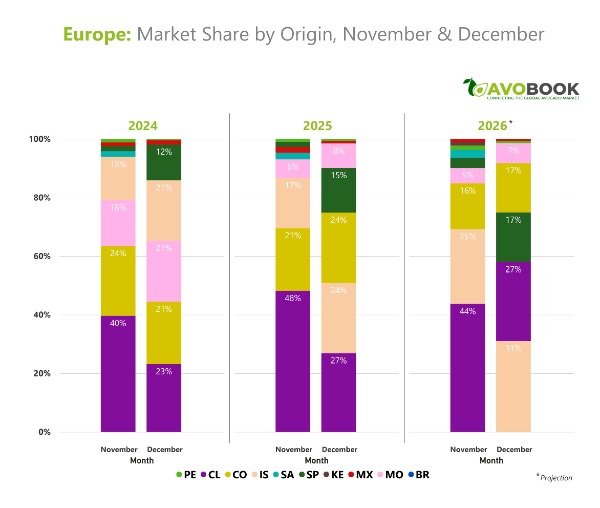
However, by week 46, Chilean shipments had fallen to 189 containers, compared to 313 shipped during the same period the previous year. Even with this decline, data projects that Chile will lead November exports with 44% of the supply, a figure slightly lower than the 48% recorded in 2025.
South Africa and Kenya-Tanzania reach the final
South Africa, meanwhile, saw its shipments drop from 69 containers in week 45 to 9 in the following period. At the same time, the Kenyan and Tanzanian bloc went from 38 shipments to 0. The data shows that the African bloc extended its presence compared to 2025, a year in which no arrivals were recorded in week 44.
Another variation in African exports is observed in that, according to Avobook's monthly records, Kenya and Tanzania did not contribute any avocado volume in November or December of 2024 and 2025. However, at the beginning of November 2026, the arrival of 38 containers to Europe was recorded.
Although African origins extended their participation by two weeks, a similar outcome is reached as in previous seasons; there are no longer significant volumes towards the closing two months.
Israel would reach 31% of European supply in December 2026, compared to 24% in December 2025.
Israel gains ground and Morocco and Spain begin to enter the market.
As in 2025, Israel began registering arrivals during week 41, although its volume increased more rapidly. In weeks 45 and 46, the origin reached 138 and 152 containers, respectively, while in 2025 it accounted for 98 and 109 during the same weeks.
By December, Israel is projected to lead the European market with a 31% share, surpassing Chile's 27%. In the same period of 2025, these two countries held 24% and 27% of the market, respectively.
The first arrivals from Morocco were recorded in week 45 in both 2025 and 2026. In the cut-off of week 46 of 2026, the country contributed 30 containers, down from 51 arrivals in the same week of the previous year.
Colombia is also showing a change in pace. In week 35 of 2026, Europe received 12 containers of Colombian avocados, compared to 85 in the same week of 2025. Between weeks 43 and 46 of 2026, Colombian arrivals ranged from 90 to 111 containers per week. By December 2026, Avobook projects that Colombia will account for 17% of European supply, down from 24% in December 2025.
Prices are separated by size
Between weeks 40 and 45 of 2026, weighted FOT avocado prices in Europe fell most sharply for smaller sizes. Size 32 dropped from US$2.12 to US$0.88 per kilo, and size 28 fell from US$2.51 to US$1.28 per kilo. For larger fruit, size 18 saw a more moderate decline, from US$3.24 to US$2.73 per kilo.
The difference between sizes 18 and 32 went from US$1.12 per kilo in week 40 to US$1.85 in week 45. In that last cut, size 18 was quoted at just over three times the price of size 32.
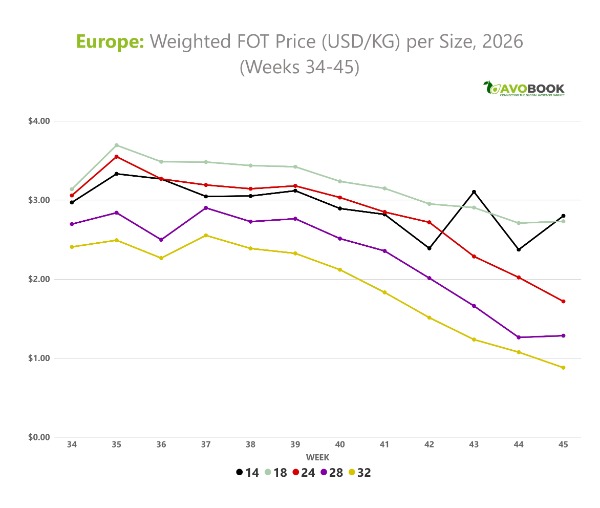
In week 45 of 2026, the 18 caliber was trading at just over three times the price of the 32 caliber.
Thus, the European Hass avocado market faces the end of the year marked by a clear recomposition of its suppliers and a marked price gap according to the size of the fruit.
With the definitive withdrawal of Peru and the African bloc, Chile will maintain its leadership during November with 44% of the supply, before giving up first place in December to Israel (projected with 31%), in a scenario where the stable volume of Colombia and the entry of Morocco will finish defining the commercial transition towards the last two months.
Did you find this news helpful?
Follow us on Instagram → @avobook.avocado
There we publish the most important information about the global avocado market: news, figures and industry trends.
You can also follow us on LinkedIn or join our WhatsApp channel to receive key news as soon as it's published.