Argentine market
Argentina: Chile remains the main supplier of avocados
Chile is consolidating its position as the main supplier of avocados to Argentina, although the contraction in consumption is putting a ceiling on prices.
October 26, 2026
Currently, Chile is practically the sole supplier of avocados to Argentina. Miguel Bauzá, manager of the import and export company Don Jaime, points out that this is mainly due to the end of imports from Brazil and Peru, as well as the closure of domestic production. For Chilean exporting companies, while this scenario opens a window of opportunity, demand imposes price limits.
“Avocados from other origins (Brazil, Peru) are no longer being imported, and domestic production has already ended,” he explains.
Data from Avobook shows that Chile has regained its leading role in Argentine Hass avocado imports. In September, the last month with consolidated data, it accounted for 211 of the imported containers, representing 77% of the total volume. Previously, its share had reached 90% in January and 92% in February, figures that declined during the months of increased Peruvian and Brazilian presence.
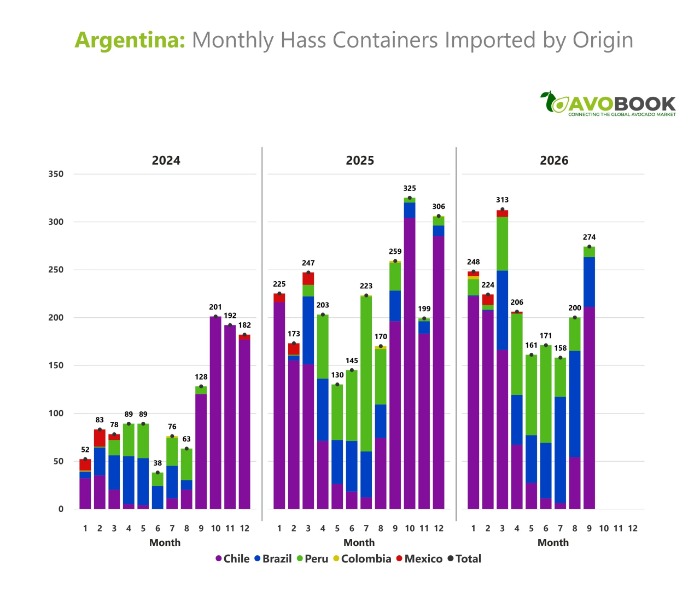
The behavior of previous years observed by Avobook also shows a high concentration of Chilean participation towards the end of the calendar, leading the market in the October-February window.
Less competition, but limits on price increases
Given the current situation, Bauzá expects prices to rise slightly compared to last month. However, this expectation comes with a warning to exporters : "The Argentine economy will not withstand excessive prices," he notes.
According to Don Jaime's manager's analysis, sales are 30% lower than the previous year, in a context where the consumer has low purchasing power and there is no clarity on when the situation might change.
“It’s still unclear when things might change. These are completely different years,” Bauzá points out.
Avobook's data analysis shows that Chilean dominance in the Argentine market does not necessarily correspond to higher import prices. In February 2026, when Chile accounted for 92% of the volume, the average CIF value was US$1.74 per kilo. Another example is November 2025, another month with a strong Chilean presence, where the average was US$1.86.
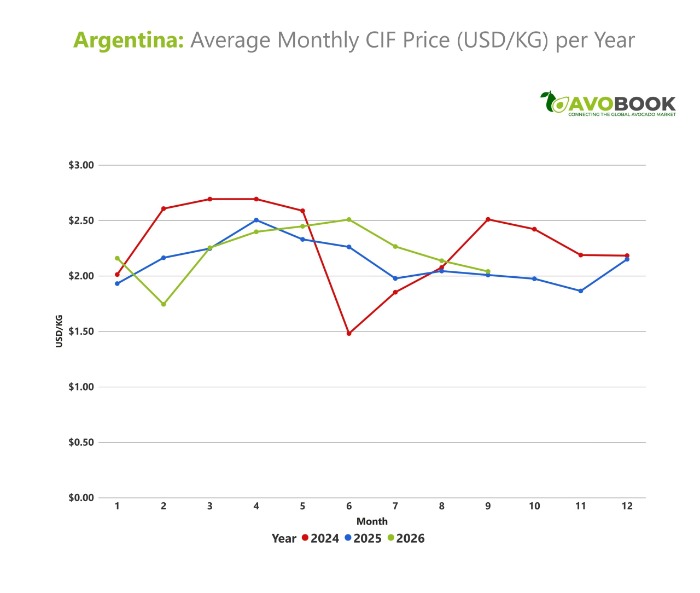
These figures show that a strong leadership in Argentine imports can coexist with moderate prices.
The calibers sought by the Argentine buyer
As advice for those considering shipping fruit from Chile, Bauzá notes that demand is focused on sizes 96 to 70, although there are smaller purchases of size 60. The preference for these sizes, he explains, is due to Argentina's domestic purchasing power.
“Obviously, 96 and 84 is due to a matter of internal purchasing power,” he explains.
Chilean exporters, therefore, must evaluate this opportunity in conjunction with the capacity of the Argentine market and the sizes requested. Less competition may favor their position as the main supplier, but it does not guarantee that Argentina can absorb any volume or at prices beyond its capacity.