Avocado oil industry
AOMA seeks common criteria for avocado oil
AOMA will bring together producers, researchers, and processors in Seville to discuss quality, authenticity, and efficiency. The meeting aims to establish a basis for technical dialogue to support the sector's development.
October 23, 2026
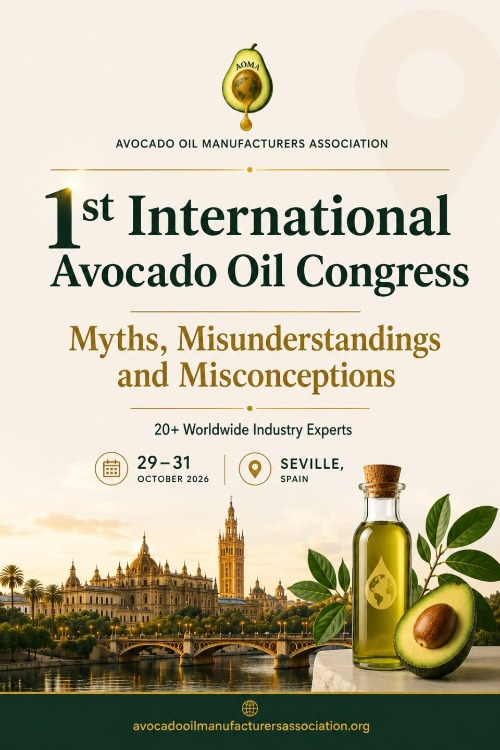
From October 29 to 31, 2026, the Avocado Oil Manufacturers Association (AOMA) will hold the First International Avocado Oil Congress . This event is the first international forum dedicated to discussing how avocado oil is produced, evaluated, and what information should support its marketing. The congress will feature the participation of scientific, production, technological, and institutional stakeholders.
The meeting aims to bring together the perspectives of professionals around a need that AOMA considers central: to have clear quality parameters and production and marketing criteria that can support the growth of the avocado oil industry.
The aim is also to open conversations between countries and links in the production chain. Its objective is to generate the necessary technical exchange to move towards shared quality standards.
“For the avocado oil sector to evolve, growth from the field is necessary, not just commercial growth,” says Enrique García Gavira, president of AOMA.
A conversation about the rules of business
The congress will be held at the Institute of Fat and the Higher School of Hospitality in Seville. According to the press release, experts from 15 countries will participate, along with producers, researchers, institutions, and professionals linked to the sector.
The proposed discussion connects decisions that are typically addressed at different stages of oil production: fruit selection, extraction yield, oil evaluation, and the information the buyer receives.
“We need criteria, knowledge, dialogue, debate and to have clear 'rules' in all producing countries,” says García Gavira.
From that perspective, the meeting seeks to provide a basis for discussing what attributes should be measured, how to interpret the results, and what practices can strengthen confidence in the product.
Authenticity: distinguishing the origin from a possible adulteration
One of the topics to be addressed at the congress will be the characterization of the "chemical fingerprint" of avocado oil. The program includes an international study aimed at identifying the characteristics of oil from different origins and distinguishing natural variations from possible adulteration.
This approach prioritizes product authenticity alongside traceability and the information provided to the consumer. The congress poses the challenge of building knowledge that allows for interpreting the differences between oils and supporting their identification.
Quality will be addressed from three perspectives: chemical analysis, sensory evaluation, and gastronomy. The communication aims to connect technical measurements with the characteristics that can be recognized during the use and consumption of the product.
Quality begins before extraction
AOMA also seeks to bring the discussion back to the field. The maturity axis aims to examine how the selection and handling of avocados influence the outcome of processing. In this context, the organization plans to present a prototype for avocado selection based on artificial intelligence.
The program also incorporates extraction efficiency and lessons learned from the olive oil industry, focusing on improving process performance and understanding the technical decisions involved in oil production.
In this way, the congress proposes to relate the condition of the raw material to the performance of the plant and the final quality of the product, instead of evaluating the stages in isolation.
By-products and value beyond oil
Another area of discussion will be the utilization of leftover materials. The avocado peel, seed, and pulp, along with the processing water, will be analyzed as potential sources of bioactive compounds, biochar, biogas, or energy.
These alternatives are part of the conversation about responsible industry development. The program presents them as areas for development that should be studied, but it does not stipulate that all of them are implemented or applicable in the same way to every facility.
Its inclusion broadens the perspective on the processing. In addition to the oil obtained, it is interesting to observe what other uses can be given to the materials generated by the operation.
Experiences to compare different stages of development
The Extra Virgin Avocado Oil Forum will take place on the afternoon of Friday, the 30th, featuring researchers, chefs, and international participants. The event will include testimonials from five producers from New Zealand, California, Kenya, South Africa, and Spain.
The diversity of experiences will allow the discussion to include both recent projects and longer-standing operations. On Saturday the 31st, the activities will continue with technical visits to the Molino del Genil mill and the IFAPA center in Mengíbar, Jaén, which is already a pomace processing plant.
With this first call for proposals, AOMA seeks to establish a collaborative space connecting research, production, and marketing. The precedent it aims to build is a technical community capable of sharing verifiable knowledge and advancing criteria that add value to the entire supply chain.