Evolution of imports
Avocado in Europe: Chile takes over from Peru
Chile accounted for nearly 50% of arrivals in week 42, while Peru's share fell to 8%. This transition is occurring with weekly volumes lower than those projected for 2025.
October 19, 2026
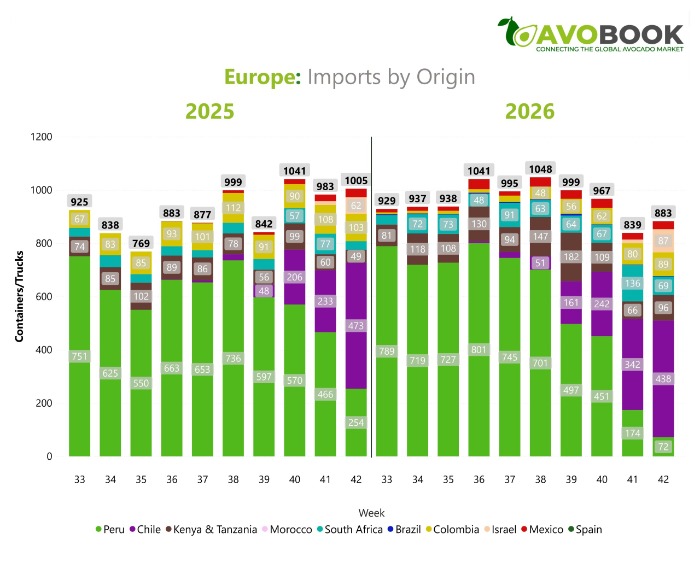
The European avocado market has undergone changes in its composition. Between weeks 33 and 42 of 2026, Peru, which had maintained a consistent lead in the first few weeks, reduced its shipments to Europe, while Chile increased its presence to become the main weekly supplier. Israel also entered the market in week 41.
According to data analysis by Avobook, 9,576 shipments arrived at European ports during the period studied, 4.5% more than the number received during the same weeks in 2015. However, this cumulative growth was not sustained until the end of the period. During week 42, for example, arrivals reached 883 shipments, a 12.1% decrease compared to the 1,005 shipments received the previous year.
The data shows that the European market is experiencing two simultaneous trends: a higher cumulative volume and lower avocado arrivals in recent weeks, which coincides with the fluctuating weight of the main exporting countries.
Chile takes over from Peru in the European market
Peru was the largest supplier during the period, exporting a total of 5,676 shipments. Shipments from Peru consistently exceeded 700 units between weeks 33 and 38, peaking at 801 units during week 36.
Peruvian participation began to decline more sharply from week 39, with volumes falling to 497 units, then to 451, reaching 174 shipments in week 41, and closing week 42 with 72. This trajectory indicates Peru's progressive exit during the studied time frame, although the origin still maintains a presence in the European market.
Chile followed the opposite path, its first shipments to Europe were observed in week 36 with seven shipments, increasing steadily until reaching 438 arrivals in week 42, accumulating a total volume of 1,236 shipments.
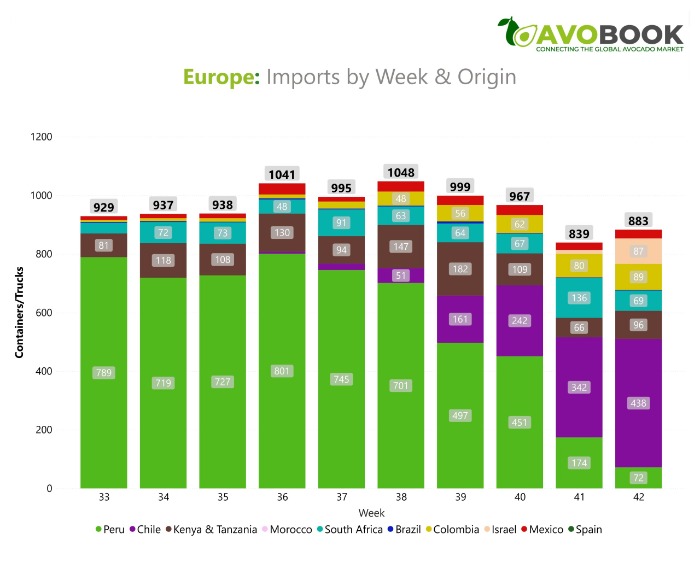
The crossover between the two origins was recorded in week 41, when Chile contributed 342 shipments and Peru 174. In the following week, Chilean participation accounted for about half of the European arrivals, while Peru represented around 8% of the total participation.
A change of leadership one week earlier than in 2025
Year-over-year data comparisons allow us to accurately describe this transition. In 2025, Chile surpassed Peru during week 42, with 473 Chilean shipments compared to 254 Peruvian ones. In 2026, this advantage emerged a week earlier.
Chile also brought forward the crossing of the 100 weekly unit threshold, reaching 161 in week 39 of 2026. The previous year this had occurred in week 40 with 206 shipments.
It is important to note that the earlier changeover is primarily due to a faster decline in Peruvian shipments. Between weeks 33 and 38 of 2026, Peru registered an increase of 504 shipments compared to the same period in 2025. However, in the following four weeks, a decrease of 693 arrivals was observed compared to the previous year.
The difference between the two periods becomes especially visible at the end of the weeks analyzed. In week 42, Peru registered 254 shipments in 2025, which decreased to 72 in 2026.
For its part, Chile's volume was relatively similar to that of 2025, although slightly lower. Shipments decreased from 473 to 438.
Israel joins the offering, and other origins complement the selection.
Avocado shipments from Israel to Europe began in week 41, entering the market during the same period as in 2025. During the last two weeks studied, a total of 101 shipments were recorded, 87 of which occurred in week 42. The arrival of this source added a new component to the European supply during the transition from Peruvian and Chilean avocados.
The Kenyan-Tanzanian bloc also maintained a significant presence in the market. Together, they contributed 1,131 avocado shipments during the period, increasing their volume by 45% compared to 2015 and reaching a peak of 182 shipments during week 39.
South Africa recorded 719 shipments during the period studied, representing a 72% increase compared to the previous year. Within that period, week 41 stood out, with arrivals rising to 136 shipments.
In the case of Mexico, an increase from 99 to 254 shipments is observed between 2025 and 2026, with weekly arrivals during this year ranging from 13 to 38 units.
Colombia, on the other hand, shows a different trend depending on the comparison used. Within the period studied, in 2026 its shipments increased from seven to 89 weekly shipments. However, its cumulative volume of 401 arrivals was 57% lower than that of the same weeks in 2025.
Changing suppliers does not prevent weekly losses
The European market received between 929 and 1048 weekly shipments of avocados until week 40. After this period, the volume dropped to 839 in week 41 and partially rebounded to 883 during the following week.
The growth of Chilean shipments and the addition of Israel as a source coincided with a period of lower supply compared to the first eight weeks of the period analyzed by Avobook, so in this transition, the increase from some suppliers did not fully compensate for the reduction from others.
Towards the end of week 42, the avocado supply in Europe shows a different composition than at the beginning of the period studied. Chile leads the exporting origins, Peru maintains a small presence, and Israel is beginning to gain ground.