Global avocado market
Avocados from Jalisco are eyeing Japan, while Michoacán dominates in Canada.
Jalisco maintains a greater presence in Japan, competing with Peru, while Michoacán retains almost absolute dominance in the Canadian market.
September 15, 2026
Michoacán and Jalisco: two markets, two export patterns
Outside the United States , Mexico's two main avocado-producing regions show a different distribution across some of their international markets. Avobook data from 2023 to 2026 reveals a consistent pattern: Jalisco has a greater presence in Mexican shipments to Japan, while Michoacán largely dominates the supply to Canada.
In Japan, Jalisco has surpassed Michoacán in all four years analyzed. In 2023, it accounted for 51% of Mexican fruit exports to this market, a share that increased to 57% in 2024 and reached 68% in 2025. For the available data for 2026, it remains at 66% of Mexican shipments, compared to 34% for Michoacán.
Looking at the entire Japanese market, in 2026 Jalisco accounted for 38.8% of shipments, Michoacán 20.3%, and Peru 40.8%. Thus, Mexico as a whole maintained a 59.2% share, although Peru was the leading individual source.
Canada shows the opposite pattern.
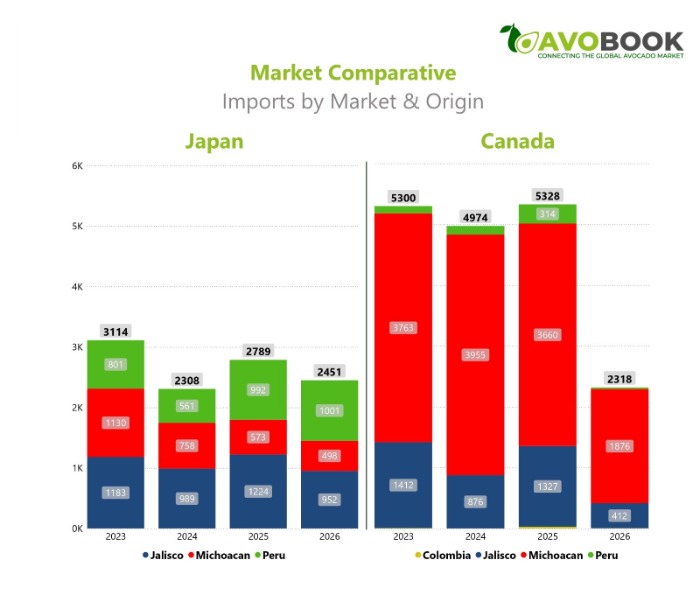
The distribution changes significantly when looking at Canada. There, Michoacán has accounted for the majority of Mexican shipments throughout the period analyzed.
Its share of Mexican fruit reached 73% in 2023, increased to 82% in 2024, returned to 73% in 2025, and is again at 82% during 2026.
So far this year, Michoacán accounts for 81.2% of the Canadian market, while Jalisco represents 17.8%. Peru contributes 0.9% and Colombia 0.1%, meaning that these two Mexican origins together account for approximately 99% of registered shipments.
The comparison reveals that the difference between the two destinations is not solely due to seasonal fluctuations. Since 2023, Jalisco has maintained a larger market share than Michoacán in Japan, while Michoacán retains a dominant position in Canada.
Japan: a shared market with Peru
Unlike Canada, where the recorded supply is almost entirely concentrated in Mexico, Japan has a structure more evenly distributed between Mexican and Peruvian origins.
Antonio Villaseñor, director of Aztecavo, explains that the client in Japan mainly corresponds to the importer-distributor profile and points out that, at the moment, no particular growth is observed in this segment.
The data also shows changes in the total volume received by Japan. Shipments decreased from 3,114 in 2023 to 2,308 in 2024 and subsequently increased to 2,789 in 2025. The available data for 2026 shows 2,451 shipments.
Canada and Asia mark diversification outside the U.S.
According to Villaseñor, tracking Mexican exports to destinations other than the United States still presents challenges because some information is not managed through APEAM. This limitation makes it impossible to determine, solely from the available records, which commercial or logistical factors explain the greater relative presence of Jalisco and Michoacán in each market.
Beyond this distribution, the director of Aztecavo identifies Canada as the main alternative market for Mexican avocados, followed by Asia and, subsequently, Europe.
The data reveals that this diversification does not follow the same pattern across all destinations. While Jalisco maintains a greater presence in Mexican exports to Japan, where it also competes with a significant share from Peru, Michoacán retains a clear dominance in Canada. This distribution has remained consistent since 2023 and demonstrates how the two main Mexican export regions have consolidated different positions outside the United States.
The evolution of the last four years thus reveals two distinct paths for major Mexican exporters outside the United States. While Jalisco maintains a stronger position in Japan and competes in a market where Peru retains a significant share, Michoacán finds in Canada a destination where its dominance remains consistent.