global market
Europe after the Peruvian peak: space opens up for new origins
The contraction of shipments from Peru opens up opportunities for South Africa, Kenya and Colombia in a European market in transition.
The European avocado market is entering a new phase of the season. After reaching its peak in shipments to Europe, Peru has gradually reduced its volumes, while other origins are beginning to gain ground in the supply.
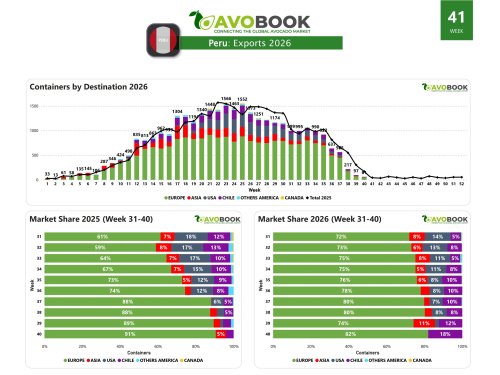
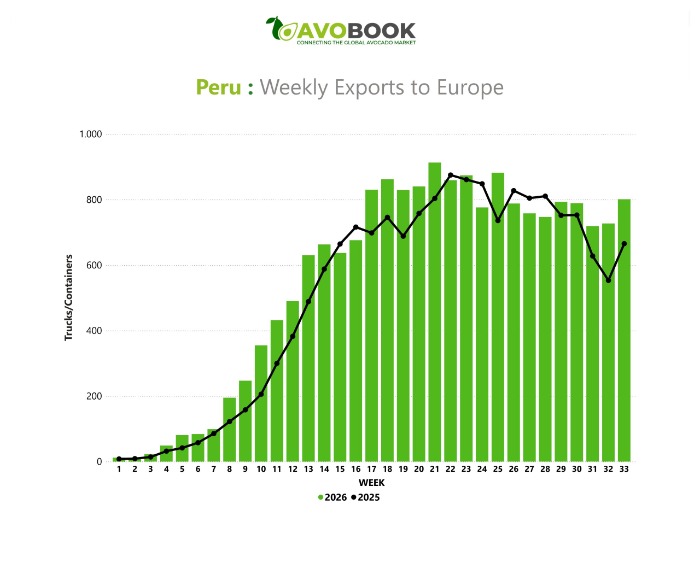
Data from Avobook shows that Peru reached a peak of 913 containers in week 24. Ten weeks later, in week 34, shipments stood at 719 containers, a decrease of 194 units, equivalent to approximately 21% from the peak.
However, Peruvian exports are still far from complete. After reaching their peak, shipments remained close to 850 containers between weeks 25 and 28, before subsequently dropping to levels between 700 and 800. Thus, Peru continues to be by far the main source of European supply.
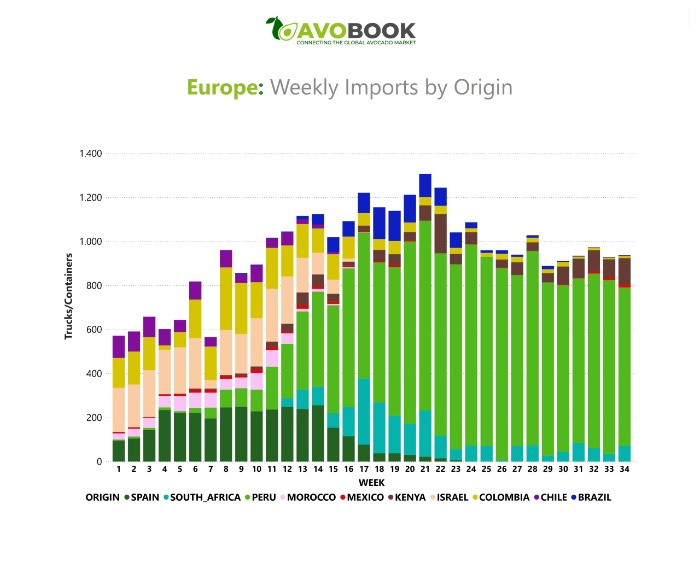
South Africa and Kenya gain ground
The reduction in Peruvian production is beginning to affect the market share of other suppliers. During week 34, Kenya registered 118 containers and South Africa 72, representing approximately 12.6% and 7.7%, respectively, of the total volume registered that week.
According to Gabriel Katkovcin, Sourcing Manager at TITBIT, both origins are gaining importance as Peruvian production declines. In the case of Kenya, he notes that there is commercial acceptance, although the condition of the fruit remains a determining factor.
"Kenya is present and accepted, but quality continues to be a key factor in how quickly the fruit is sold," Katkovcin points out.
Víctor Ruete, advisor at Tropical Millenium, agrees on the acceptance of Kenyan fruit, particularly due to the availability of smaller sizes, although he warns of significant heterogeneity between batches. He explains that dry matter content exceeding 28% is being observed in numerous cases, along with transit times of more than 30 days, factors that can lead to shelf-life issues. Exporters who are able to fill containers with fruit from one or two farms, he adds, are getting better results.
Colombia awaits September; Brazil maintains low presence
For now, Colombia and Brazil have considerably smaller market shares. In week 34, they registered 10 and 3 containers, respectively.
Between weeks 27 and 34, Colombia accumulated 120 containers, equivalent to an average of 15 per week, while Brazil totaled 54, less than seven per week. The data confirms this lower presence, but on its own, it doesn't allow us to determine its causes.
Ruete provides context for the Colombian case: "Colombia is right in the middle of the transition period between the end of the off-season and the beginning of the main season."
According to the specialist, the off-season also saw a drop of more than 50% compared to previous seasons. He expects Colombian shipments to increase gradually toward the end of August and more significantly during September, as the main season begins.
According to Ruete, Brazil maintains a practically negligible presence in Europe during this window, without sufficient volumes at the moment to significantly alter the market balance.
Medium calibers take center stage
Price trends also show significant differences by size and market.
In Rotterdam, data available for week 34 places size 18 at around USD 3.15/kg, as the highest valued among the sizes analyzed. Sizes 24 and 12 are close to USD 3.05/kg, while 28 and 32 remain at lower levels, around USD 2.70/kg and USD 2.40/kg, respectively.
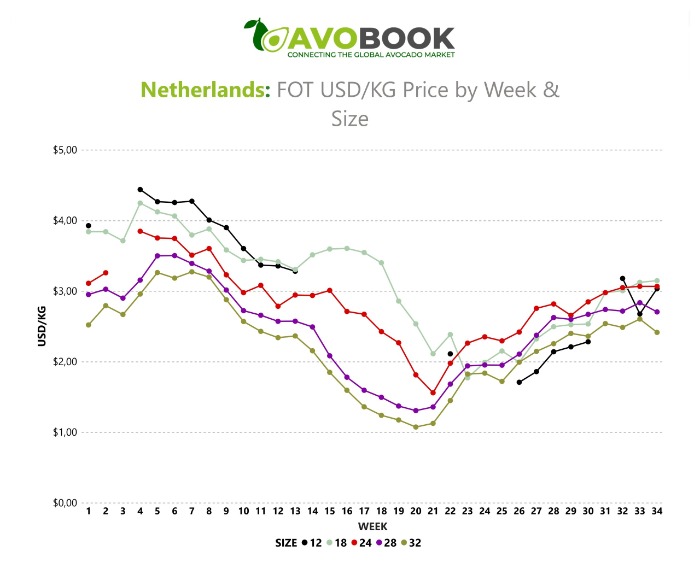
This higher valuation of medium sizes coincides with Katkovcin's observation. "In Rotterdam and Algeciras, the most valued sizes tend to be medium sizes, especially those from 16 to 18, and often from 18 to 24, depending on the market and packaging format," he explains. Ruete also notes relative interest in sizes 20, 22, and 24, which he attributes to a combination of strong demand and lower availability, while larger sizes still maintain a sufficient supply, primarily from Peru.
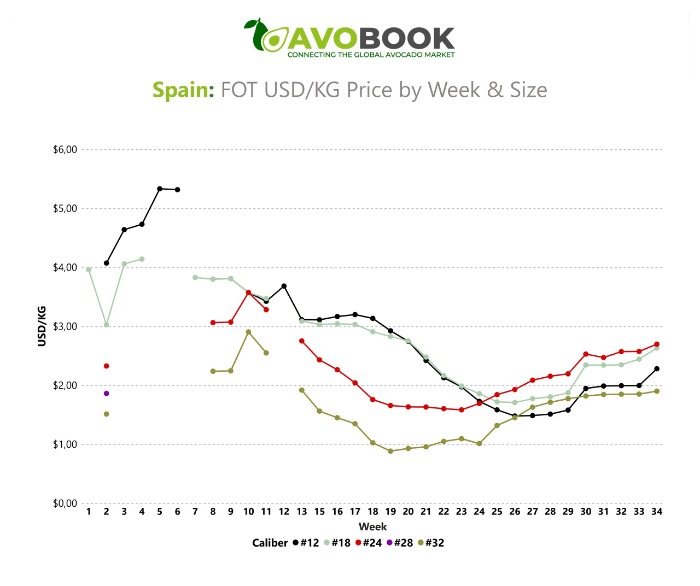
In the case of Algeciras, as a benchmark for the Spanish market, in week 34, size 24 was priced at around USD 2.70/kg, slightly above size 18, which was around USD 2.65/kg.
Does less supply mean higher prices?
The decrease in Peruvian shipments opens the possibility of a tighter market, although the sources consulted avoid projecting a linear price increase.
Katkovcin anticipates a mixed scenario, in which lower supply could favor prices, although without eliminating week-to-week variations.
"I foresee a mixed scenario: some upward pressure, but with weekly fluctuations that will depend on the pace of arrivals from South Africa, Kenya, and the remaining volume from Peru," he notes.
Ruete places even more emphasis on volatility. According to his analysis, Peru is ending its season four or five weeks earlier than initially expected, while the other sources have not yet reached sufficient volumes to quickly replace that supply. For the specialist, relatively low European inventories favor prices, although the capacity of demand to absorb further increases also sets a limit.
"The critical point in the coming weeks is not only how much volume is leaving Peru, but the speed of that decline versus the speed with which Colombia, Chile, South Africa, Kenya, and eventually Mexico are able to fill the gap," Ruete maintains. Rather than a Europe suddenly lacking fruit, the data shows a market that continues to receive significant volumes from Peru, but is beginning to redistribute its supply. The space left by Peru exists; the question is which origins will be able to fill it, how quickly, and with what quality.