In-depth analysis of Chilean avocados: record exports raise questions for the 2026-2027 season
Chile recorded its highest avocado export volume in the last seven seasons. But behind this record lies a perhaps more relevant signal for the coming season: the Chilean avocado industry is shifting its destination map and will increasingly depend on its ability to choose markets and trade windows.
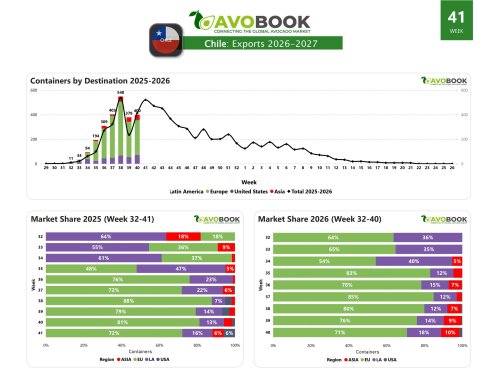
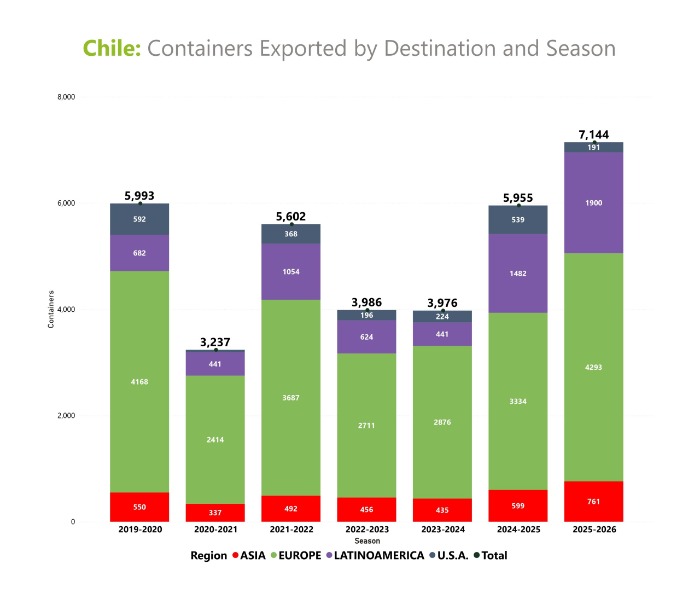
The 2025-2026 season marked a milestone for Chilean avocado exports. Avobook records showed 7,144 containers shipped abroad, representing Chile's highest volume in the last seven seasons analyzed by our market analysts and surpassing the previous season's result by almost 20%.
However, the most interesting data point for 2026-2027 may not be solely the quantity of Chile's exports, but rather how that increased volume was distributed.
The last season revealed a market quite different from that of a few years ago: Europe reinforced its position as the primary destination, Argentina gained unprecedented importance, Asia continued to grow, and the United States lost ground. If these trends continue, the next season could find the Chilean industry facing a scenario where increased production will remain important, but determining where and when to place that production will be equally crucial.
According to data recorded by Avobook, the 7,144 containers shipped in 2025-2026 exceeded the 5,955 of the previous season by 1,189 units and were almost 80% higher than the 3,976 containers shipped in 2023-2024.
For Tomás de la Cuadra, market analyst at Avobook, the figures show both a recovery in export capacity and a transformation of the Chilean avocado trade landscape. And that second variable could be crucial for understanding what lies ahead.
Shipments of Chilean avocados to Europe will continue to be key
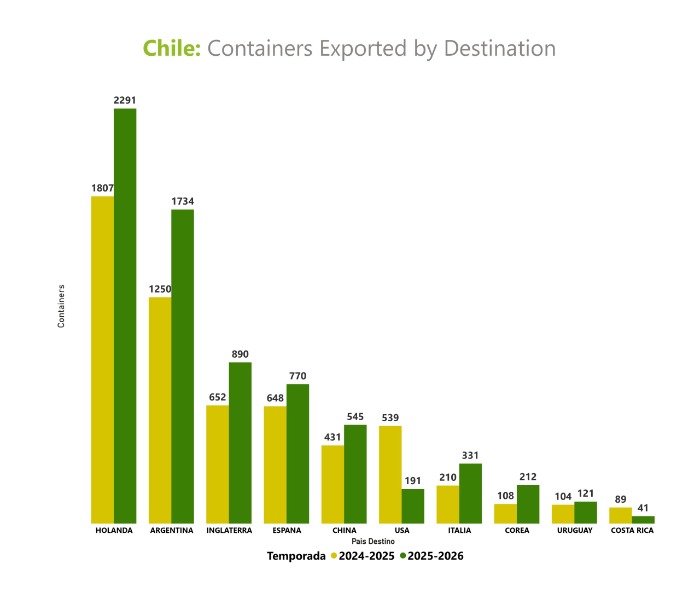
Europe received 4,293 Chilean containers in 2025-2026, just over 60% of total exports. The Netherlands was once again the leading destination, receiving 2,291 containers, compared to 1,807 in the previous season, a 26.8% increase.
But the expansion wasn't limited to the Netherlands. The United Kingdom saw its imports rise from 652 to 890 containers; Spain, from 648 to 770; and Italy, from 210 to 331. This distribution provides an initial indication for the next season. If Chile maintains or increases its exportable production, Europe will likely have to continue absorbing a significant portion of the additional volume.
This makes the European market both an opportunity and a point of concern. Greater Chilean availability will have to coexist with supply from other origins, so more fruit won't necessarily translate into better returns.
In that scenario, factors such as arrival times, available sizes, fruit condition, and competing supply from other countries could be as important as the total harvest volume.
The question for 2026-2027, therefore, will not only be how much Europe can grow, but also how much market space Chile will find within the windows where its fruit is competitive.
Mercado de Argentina podría ser el gran regulador del aguacate chileno
The most significant transformation of the last season occurred much closer to home: Argentina received 1,734 containers, a 38.7% increase compared to 2014-2025, making it the second largest single destination for Chilean avocados, second only to the Netherlands.
The change takes on greater significance when viewed in perspective. Latin America accounted for approximately 26.6% of Chilean exports last season, compared to 11.4% in 2019-2020.
This raises one of the main questions for the upcoming season: Will Argentina maintain sufficient demand to absorb nearly a quarter of the containers that Chile ships abroad?
If the answer is yes, the neighboring country could become a structural component of Chile's export business, not just a good short-term alternative.
Its proximity offers significant advantages: shorter transit times, the ability to react quickly to business opportunities, and a different logistical approach than that required for shipping fruit to Europe or Asia. During peak production, this flexibility can help alleviate congestion in other destinations and provide alternatives in the face of rapid price changes.
But precisely because of Argentina's growing importance, its performance will need to be monitored closely. The upcoming Chilean season will be more sensitive than before to any significant fluctuations in demand from that market. Argentine sources warn that the farmgate price will be key to determining whether it is possible to increase consumption in a country experiencing economic instability.
Chilean avocados in Asia: growth, but not enough volume for a change
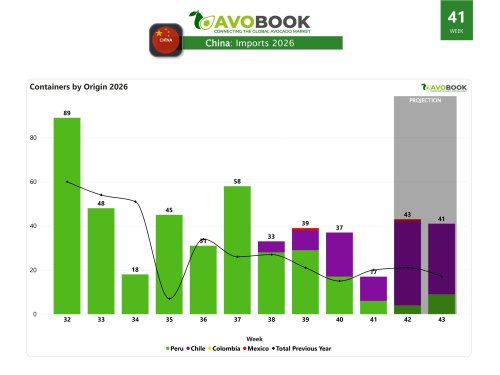
Asia received 761 containers during 2025-2026, equivalent to 10.7% of Chilean exports. China increased its imports from 431 to 545 containers, and South Korea practically doubled its purchases, from 108 to 212. In absolute terms, there is still a considerable gap compared to Europe and Argentina. However, this growth offers something strategic for Chile: a third market in which to distribute its exports.
If China and South Korea continue to increase their purchases during 2026-2027, Asia could become more important as a diversification tool, especially during periods when other markets face high fruit availability.
For now, rather than replacing major destinations, Asia seems poised to expand the trade options available to exporters.
Chilean avocados in the United States: not irrelevant, but no longer indispensable
The United States moved in the opposite direction. Shipments decreased from 539 to just 191 containers, a drop of 64.6%. This figure allows for an interesting interpretation: Chile managed to achieve its highest export volume in the last seven seasons despite significantly reducing its shipments to the United States.
This indicates that the industry is now less dependent on that market to sell its production.
But it would be premature to interpret this decline as a definitive end. The United States remains one of the largest international markets for avocados, and competitive conditions can change from one season to the next.
For Chile, its role could increasingly be that of a market of opportunity: attractive when there are favorable price and supply windows, but less necessary as a structural destination for large volumes.
The evolution of the Mexican supply and that of other providers will, in this sense, be a particularly relevant variable in determining whether the United States regains ground in 2026-2027.
Not just container numbers
The true indicator for the upcoming season will not be solely whether Chile surpasses 7,000 containers again. At least three other factors will need to be observed: whether Argentina consolidates the surge recorded during the last season; whether Europe maintains the capacity to absorb a high Chilean supply without negatively impacting returns; and whether China and Korea continue to gain market share as alternative destinations.
A fourth variable will also be considered: the potential reopening of trade opportunities in the United States.