end of campaign
Peru begins its descent: the keys to the end of the season
Peru begins its downward trend: how the avocado market is reorganizing as the season ends.
The Peruvian avocado season is entering its final stretch. After experiencing growth ahead of the previous two seasons and reaching a peak close to the 2025 highs, shipments have begun a downward trend already visible in the records of recent weeks.
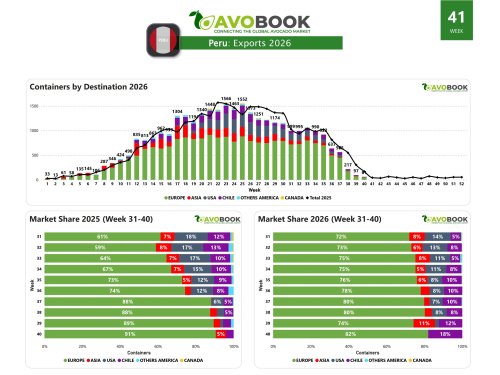
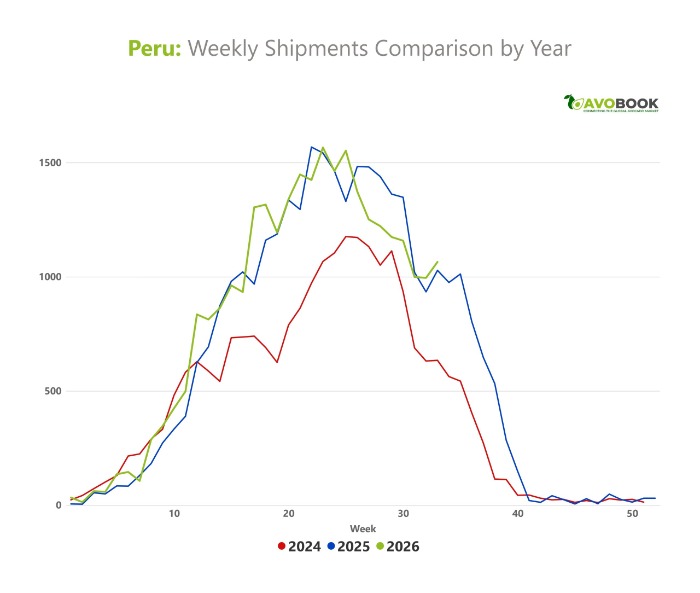
Avobook's data shows a similar seasonal pattern in the 2024, 2025, and 2026 campaigns: shipments start at low levels during the first weeks of the year, gradually increase during the following months, and then begin to decline towards the end of the season.
The differences appear in the magnitude and the moment in which each curve develops.
Earlier growth in 2026
The 2024 campaign remained below the two subsequent seasons and reached a peak of around 1,180 shipments in week 25. In 2025, on the other hand, the highest weekly peak of the three campaigns analyzed was observed, with around 1,570 shipments in week 22 and a curve that maintained relevant volumes for more weeks.
In 2026, growth began earlier. Between weeks 12 and 18, shipments exceeded the records for 2024 and 2025. Subsequently, the campaign reached approximately 1,566 shipments in week 23, a level similar to the peak recorded last year.
After that point, the trend began to change. The reduction became visible from week 25: shipments dropped from 1,552 that week to 1,251 in week 27, a decrease of nearly 300 shipments in two weeks.
Alfredo Lira, CEO and founder of Agroleal, also places the first clear signs of the campaign's change of stage during July.
“I think it was noticeable from the first to the second half of July that we reached the peak of the season. Now the condition of the fruit is no longer good, and few will be able to harvest acceptable avocados until mid-September,” he says.
The condition of the fruit marks the final stage
In addition to the reduction shown in shipments, Lira warns that the condition of the fruit is becoming more important as the campaign draws to a close.
According to the executive, the available volume ended up being less than initially estimated due to both fruit drop and faster ripening, which left some of it unsuitable for export.
“There was less volume than initially estimated because some fruit fell and also because the fruit ripened more quickly and was not in a condition to be exported,” he explains.
His sights are also set on the next season. “Now we have to work very hard on the 2027 campaign because the trees aren’t rested,” Lira adds.
When will the Peruvian season end?
While it is not yet possible to speak with certainty about a definitive date for the end of the campaign, the trends of the previous two years allow us to establish a reference point for how its final stretch might evolve.
In 2024 and 2025, shipments declined to below 100 shipments around week 40. If the current campaign follows a similar trajectory, by that time volumes could already be at marginal levels, with residual shipments thereafter.
This estimate does not imply that 2026 will necessarily repeat the behavior of previous seasons. The rate of decline over the next few weeks will determine how closely the current season approximates those trends.
Lira's perspective offers another point of reference. Rather than focusing on the statistical data for shipments in a specific week, the executive points to the availability of fruit in suitable condition for export and estimates that few players will be able to maintain it until mid-September.
Thus, the closure can be observed from two different dimensions: on the one hand, the progressive reduction of shipments recorded in the data and, on the other hand, the commercial availability of fruit with exportable condition.
Europe and Chile face reduced availability
The gradual decline in Peruvian shipments is also beginning to shift attention to the markets that receive the fruit during this part of the season.
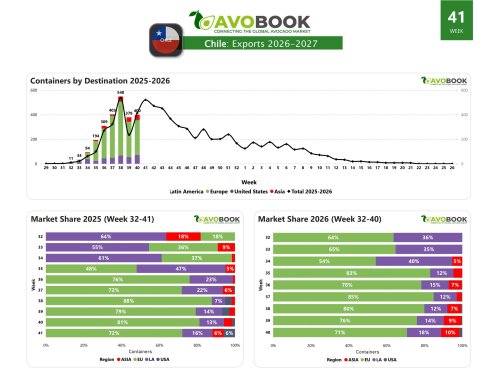
Lira identifies Europe and Chile as the main markets at the moment and believes that both will perceive the lower availability as the season closes.
“Europe and Chile are the main markets now and will feel the absence of fruit, although in a regular or normal year, nothing is normal anymore, we are at the end of the season,” he says.
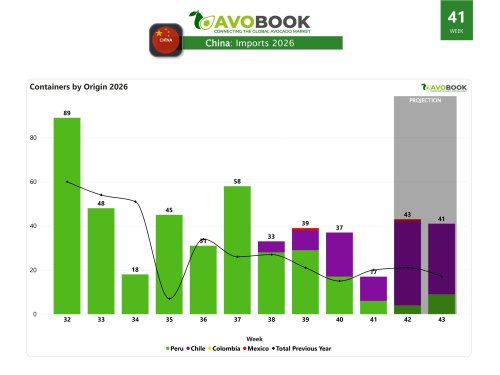
With the information currently available, it is not yet possible to determine how this reduced supply will be redistributed or which markets or origins will absorb the space left by Peru. What the data does show is that the Peruvian campaign has already begun its downward phase after reaching levels close to the 2025 peak.
The coming weeks will reveal the speed of this reduction. If the trend is similar to that of the previous two seasons, shipments could approach marginal levels by week 40. Before then, the condition of the fruit and the capacity to maintain exportable volumes will determine how quickly Peru closes its 2026 season.