International analysis
A snapshot of the Asian avocado market
China, Japan, South Korea, and India show different stages of consumption, while Singapore and Taiwan are expanding the options in the Asian region.
September 15, 2026
Asia has now established itself as an increasingly important market in the global avocado industry. However, it is important to distinguish the unique characteristics of each country within this region.
In China, the high volumes entering its ports are combined with marked seasonality. Japan has a more continuous and diversified supply chain, South Korea is growing as a destination, and India is going through a period of expansion in which logistical and commercial challenges are shaping consumption. Added to this picture are countries like Singapore and Taiwan, which broaden the map of opportunities in the region.
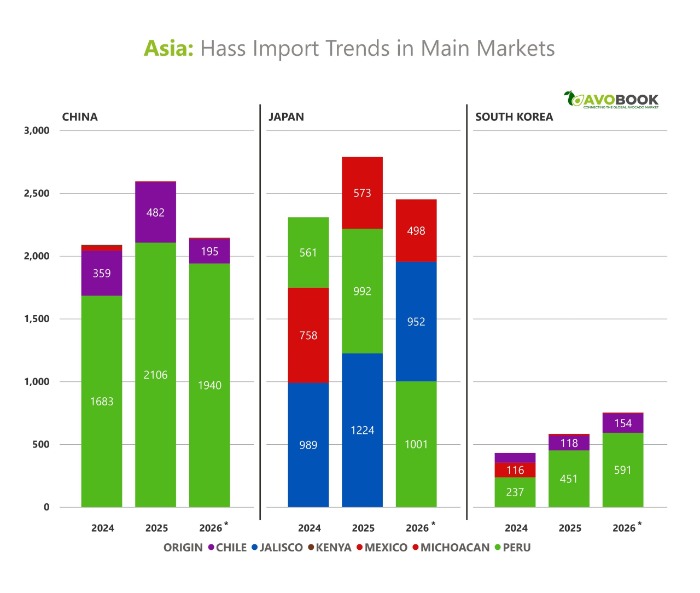
Avobook's data shows that between 2024 and 2025, shipments to China grew by 24%, Japan saw a 21% increase, and South Korea a 30% increase, making it the fastest-growing market in terms of percentage growth among the three. However, it currently still has the lowest volume of incoming shipments.
China: concentrated volume and marked seasonality
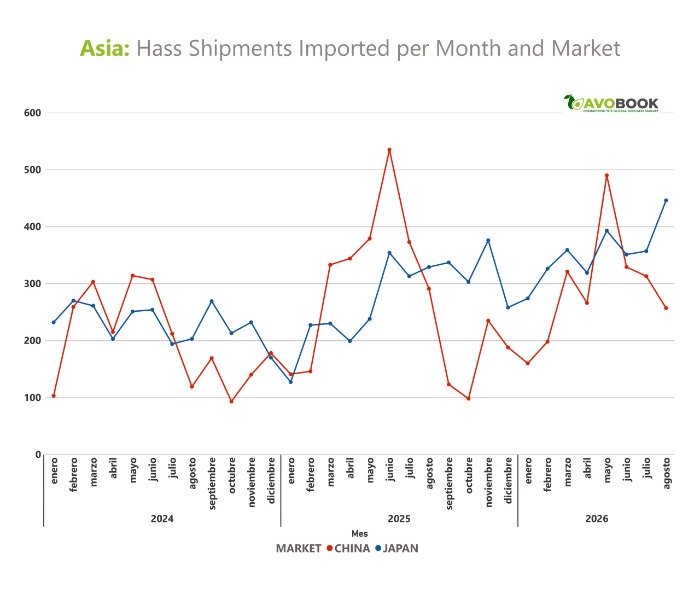
Of the markets analyzed by Avobook, China is the largest and exhibits a strongly seasonal dynamic. The highest volume is concentrated between March and June, before beginning to decline during the last months of the year.
In 2025, the monthly peak was recorded in June, with 535 shipments. In 2026, however, the highest point occurred earlier, in May.
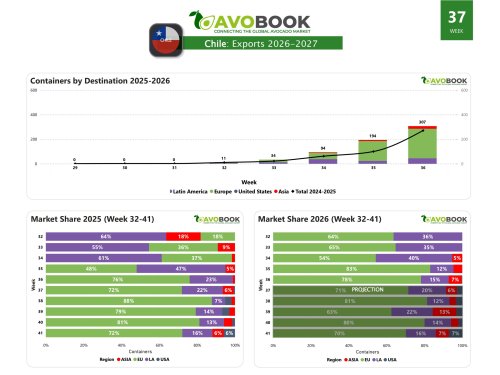
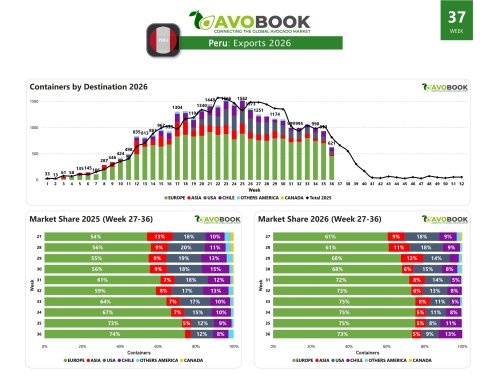
Peru is by far the leading exporting country. In 2024, it registered 1,683 shipments, and in 2025 it reached 2,106, while the cumulative total for 2026 is 1,940. Chile participates as a complementary source and with a later export window, so the data accumulated up to week 37 does not yet reflect the peak of its season.
The structure of the Chinese trade window is a fundamental variable for understanding this origin. It's not just the market demand that matters; it's also essential to understand when it's concentrated during the year and which exporting countries are available to supply it.
Japan: stability and greater diversity of suppliers
In the case of Japan, a different structure is observed. Its monthly imports fluctuate less than those of China and have maintained high levels so far in 2016. In August, they reached 445 shipments, the highest monthly figure in the analyzed series.
It is also the market with the greatest diversity among those analyzed by Avobook's data. Currently, Mexico leads the supply, complementing the fruit from Jalisco and Michoacán, while Peru has gradually increased its share.
In 2026, Peru accounted for 1,001 shipments, making it the largest single origin, surpassing Jalisco's 952. However, when all Mexican origins are combined, Mexico still represents approximately 59% of the supply.
This diversity of suppliers and the stability of import volumes distinguish the Japanese market from the concentration seen in China. Furthermore, the country continues to rely heavily on agricultural imports due to its limited acreage available for production, according to the USDA.
South Korea: smaller scale, but greater growth
South Korea remains a considerably smaller market than China and Japan, but between 2024 and 2025 it showed the highest percentage growth of the three, with an increase of 30%.
The supply to this country is mainly led by Peru. Shipments from this origin went from 237 in 2024 to 451 in 2025 and reached 591 in the cumulative total up to week 37 of 2026.
Chile occupies a secondary position, with 118 shipments in 2025 and 154 in the analyzed period of 2026. As with China, its later supply window requires caution in interpreting the partial year cutoff.
The overall context also favors a growing presence of imported products: South Korea has progressively turned to food imports to meet a demand geared towards greater variety, convenience and competitive prices, according to the USDA.
Three markets, three supply structures
| Market | 2024-2025 Evolution | Supply Structure | Main Characteristic |
|---|---|---|---|
| China | +24% | High concentration in Peru; Chile provides support | Greater seasonality |
| Japan | +21% | Mexico and Peru; greater diversification | More stable volumes |
| South Korea | +30% | Peru predominates; Chile plays a secondary role | Smaller scale and higher percentage growth |
Source: Avobook. 2026 data are accumulated through week 37 and are not compared as a full year.
India: a category seeking to expand its consumer base
India is at a different stage. Industry sources describe a country whose market is expanding, as avocado consumption begins to extend beyond a relatively small group of high-income consumers.
In India, avocado has gained a presence in modern retail, restaurants, and the hospitality sector and has begun reaching new cities. Tanzania currently holds a dominant position among suppliers, due in part to its tariff structure, while Kenya also contributes to the supply.
Growth, however, brings new challenges. As volumes increase, inventory management, the cold chain, ripening, and distribution become increasingly important. For importers in this market, the challenge is progressively shifting from introducing the product to ensuring that the increase in supply develops in line with consumption.
Purchasing characteristics are also becoming increasingly relevant to avocado consumption in India. According to representatives of Abacate International cited by FreshPlaza, consumers do not necessarily select avocados based on their country of origin; factors such as size, appearance, ripening behavior, flavor, and consistency influence purchasing decisions.
The development of this market is also beginning to extend into processed products. IMARC estimates that India's avocado oil market reached US$56.9 million in 2025, with applications spanning food and beverages, cosmetics, and pharmaceutical products.
Singapore and Taiwan expand the regional map
Beyond the main Asian destinations, Singapore and Taiwan present smaller-scale opportunities with their own market dynamics. In 2024, Singapore imported 6,008 tonnes of avocados worth US$22.2 million, with Australia as its main supplier, accounting for 4,509 tonnes, or approximately 75% of total import volume.
Taiwan, meanwhile, combines imports with local production, creating a different dynamic from markets that are highly dependent on imports. Although it occupies a secondary position within regional avocado trade, industry sources reported import growth of more than 15% in 2024, indicating an expansion in international purchases.
Both markets broaden Asia's commercial map without replicating the conditions of the main destinations: Singapore stands out for the concentration of its supply in Australia, while Taiwan adds growing import demand alongside domestic supply.
Asia is not a single market
| Market | Distinctive Feature(s) | Commercial Key |
|---|---|---|
| China | Large volume and marked seasonality. | Identify supply windows. |
| Japan | Stable and diversified supply. | Compete among multiple origins. |
| South Korea | Smaller scale and recent growth. | Support market expansion. |
| India | Developing market and new channels. | Ripening, cold chain, and distribution. |
| Singapore | Smaller scale and strong Australian presence. | Market concentrated around a dominant supplier. |
Source: prepared by Avobook based on proprietary data and industry sources: FreshPlaza, Bonafide Research, WITS/UN Comtrade, and Avocados Australia.
The differences between these countries show that avocado growth in Asia does not follow a uniform trajectory. Even among the three markets that recorded increases between 2024 and 2025, commercial conditions differ.
China offers scale but has greater concentration and seasonality. Japan combines significant volumes with a more diversified supplier structure. South Korea is growing rapidly from a smaller base. India represents an opportunity associated with the development of new consumers and channels, but it requires parallel progress in distribution, ripening, and logistics.
Singapore and Taiwan, meanwhile, broaden the map beyond the major destinations and show that regional opportunities can also be found in smaller markets with their own structures.
For exporters and traders, understanding Asia therefore depends less on identifying a single high-growth market and more on understanding the supply windows, suppliers, consumers, and channels that determine the opportunities in each destination.