Origin analysis
Which exporting origins compete with Peru during its production window?
California, Brazil, and Africa overlap with Peru on a smaller scale, while Mexico and the Mediterranean play key roles in the global calendar.
The presence of Peruvian avocados in the international avocado market is not an isolated phenomenon. Throughout its export season, different countries coincide with its production window, although with varying volumes and peak availability times.
The analysis of production curves carried out by Sebastián De la Cuadra, CEO of Avobook, allows us to distinguish three scenarios: origins that compete directly during the Peruvian season, countries whose production partially overlaps with it, and markets that, due to the distribution of their harvests, function mainly as a complement.
The main difference lies in the scale. While the Peruvian curve reaches its highest volumes during the middle of the year, the other origins that coincide directly with that window currently show lower levels.
California, Brazil, and Africa are in agreement with Peru.
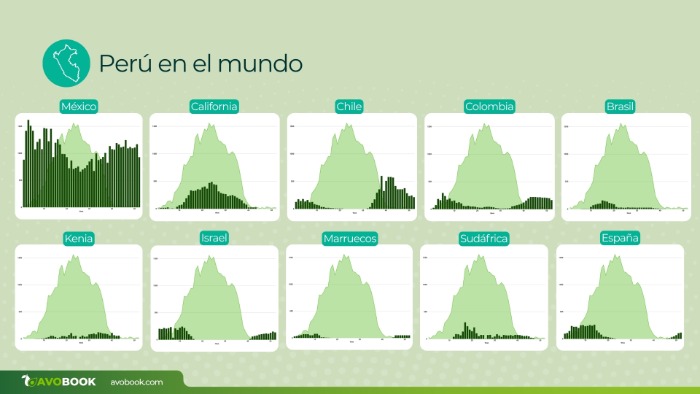
Among the most direct competitors is California, whose season runs almost simultaneously with the Peruvian season. However, its presence is concentrated in the United States , and its volumes are generally lower.
Brazil exhibits a similar pattern , although with a significant time difference. Its greatest activity is concentrated towards the beginning of the Peruvian season, allowing it to take advantage of a period when Peru has not yet reached its peak volume.
Brazil currently operates on a smaller scale, but its evolution appears to be one of the factors to watch. According to Sebastián de la Cuadra's analysis, its growth could increase its relevance during a window that directly coincides with Peru's supply in the coming years.
In Africa, Kenya and South Africa also have seasons that overlap with Peru's. Their curves again show a difference in scale favoring the Peruvian origin, although Kenya, along with Brazil, appears as one of the countries whose growth could acquire greater competitive importance in the future.
The overlap in harvest windows, therefore, does not necessarily imply equivalent competition in volume. While several producers participate in the market during the same months, Peru maintains a considerably larger presence during its peak season.
Mexico: a competition with different peaks
The case of Mexico is different. Michoacán and Jalisco allow for availability throughout practically the entire year, so Mexican origin is also present when Peru reaches its highest volumes.
However, the peaks of both seasons do not coincide. Mexico reaches its highest levels when the Peruvian season begins to decline or before it starts a new cycle. During the period of maximum Peruvian availability, the US market continues to receive Mexican fruit, but in a smaller proportion compared to the peaks of its own season.
This distribution creates a particular relationship between the two main suppliers: when Mexico reduces its volume, Peru is precisely going through its period of greatest presence.
In this way, both origins coincide and compete within the US market, but they do so from different points in their respective production curves.
The Mediterranean complements the Peruvian season
A third dynamic emerges when observing Mediterranean countries. Spain , Israel, and Morocco concentrate much of their availability outside of Peru's peak production period.
Their seasons tend to end when the Peruvian campaign begins to gain momentum and increase again as Peru approaches the close of its main window. For this reason, rather than directly competing during the Peruvian peak, these origins help to supplement the supply at other times of the year.
A competition defined by the window and the volume
The global comparison shows that Peru's position depends not only on the number of countries producing avocados during the same months. The intensity of the competition is also determined by the magnitude of the available volumes and the degree of overlap between the harvest windows of each origin.
California, Brazil, Kenya, and South Africa overlap directly with the Peruvian season, although currently on a smaller scale. Mexico maintains a consistent presence but concentrates its largest volumes outside of Peru's peak season. Mediterranean producers, on the other hand, primarily occupy the beginning and end of the growing season and complement international availability.
In this scenario, Brazil and Kenya emerge as two sources to watch. Their growth could progressively increase the available supply during the same window as Peru.