Prices by size
Caliber .48 loses price advantage due to increased supply in the US
In five weeks, size 48 went from leading prices in the US to trading below smaller sizes, amid greater availability of large fruit.
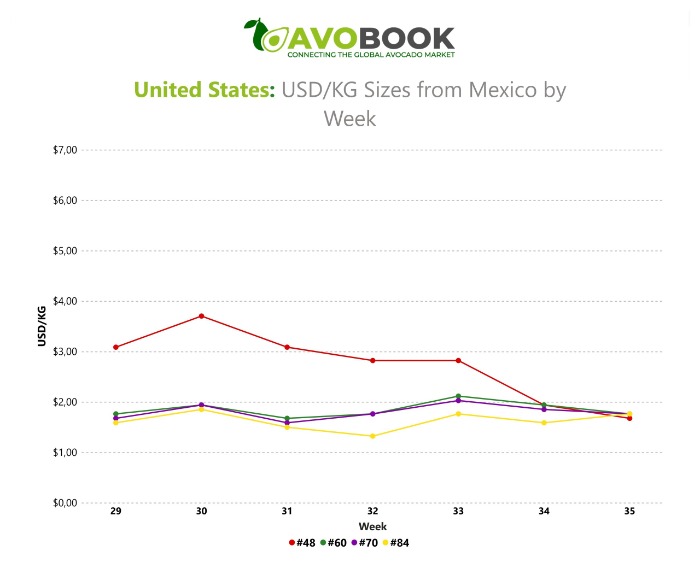
The U.S. avocado market is undergoing a shift in the price relationship between sizes. Avobook data showed that during Week 30, Size 48 reached approximately USD 3.70 per kilogram, nearly twice the roughly USD 1.85/kg recorded for Size 84. Five weeks later, that difference had disappeared.
By Week 35, Size 48 had fallen to approximately USD 1.70/kg, placing it slightly below Sizes 60, 70, and 84. This reversal occurred at the same time as the availability of large fruit increased, particularly Sizes 48 and 60, which only a few weeks earlier had recorded some of the highest prices.
From a Premium for Large Fruit to Greater Supply
The picture was very different at the beginning of the period. In Week 30, Sergio Paz, general manager of Coliman Avocados, described demand for Mexican fruit as concentrated on Size 48 and larger sizes, while demand for smaller fruit remained weak. The price difference between Sizes 48 and 60 had reached as much as USD 22 per box at the time, a situation he described as unusual.
Paz also explained that the beginning of the Mexican season was characterized by an abundance of Size 60 and smaller fruit, average availability of Size 48, and very limited availability of Size 40 and larger. He also anticipated that Mexico would continue gaining market share as California reduced its volume and, subsequently, Peru did the same.
Five weeks later, the composition of supply shows a different scenario. Between Weeks 30 and 35, Mexican Size 48 volume increased from approximately 8,700 to 12,500 metric tons, while Size 60 rose from around 8,700 to 11,300 metric tons. Sizes 70 and 84 also recorded increases, although to a lesser extent.
The trend is consistent with data analyzed by Gary Clevenger of Freska Produce. For the week ending August 23, Mexico recorded 49.4 million pounds of arrivals and an inventory of 28.1 million pounds, 20% higher than the previous week. Within Mexico's conventional No. 1 inventory, there were approximately 355,000 25-pound boxes of Size 48 and 249,000 boxes of Size 60.
Why Can a Large Size End Up Being Worth Less?
This behavior reflects a relationship that Giovanni Cavaletto, CEO of GLC Cerritos, has addressed when analyzing profitability by size in the United States: larger fruit does not necessarily guarantee a higher value.
Cavaletto explains that prices respond, among other factors, to the balance between supply and demand. When certain sizes are overrepresented in the available supply, they may receive greater discounts, while sizes whose availability is more closely aligned with market requirements tend to maintain their prices more effectively.
At the same time, U.S. demand for smaller fruit has developed new channels of absorption. According to Cavaletto, over the past five years, bagged avocado programs for North American customers have increased demand for smaller sizes and second-grade fruit.
This factor is compounded by the way avocados are marketed in the United States. Unlike markets where produce is sold by weight, avocados in U.S. supermarkets are primarily sold by the piece.
This allows smaller sizes to represent a lower cost per piece for consumers while also creating better return opportunities for sizes that have historically received lower valuations.
This scenario helps put the situation observed in Week 35 into context: the relative decline in the price of Size 48 occurred during a period of greater availability of this size, with supply coming from both Mexico and Peru, while smaller sizes benefit from demand that has strengthened in recent years.
Mexico Gains Ground as Peru Reduces Its Presence
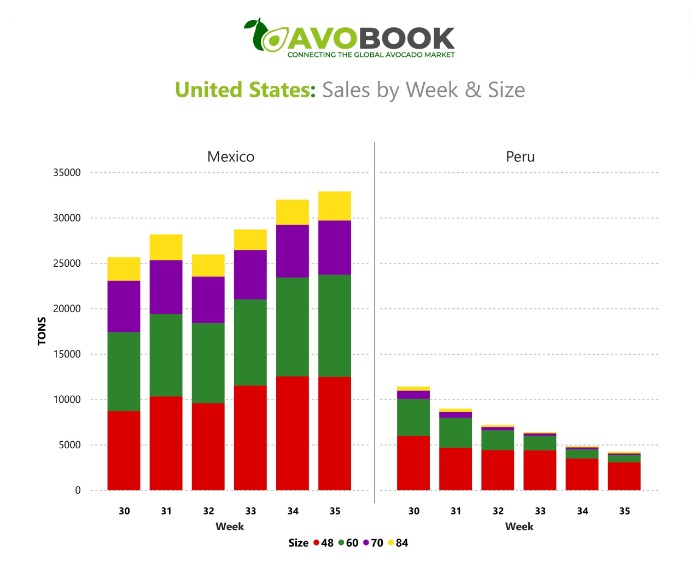
The change in size distribution is also occurring amid a transition between origins. While Peru is progressively reducing its volumes, Mexico is increasing its presence and consolidating its position as the main supplier to the U.S. market.
Clevenger's data showed that Peruvian inventory had declined by 18.6% as of August 21, while Mexican arrivals were increasing. Subsequently, Antonio Villaseñor, director of Aztecavo, estimated Mexico's share of the market at 70%, compared with 15% for Peru, 14% for California, and 1% for other origins.
This transition coincides with the increase observed in the availability of Mexican Sizes 48 and 60 in recent weeks, modifying the size balance supplying the market.
Origin Prices Remain Below Last Year's Levels
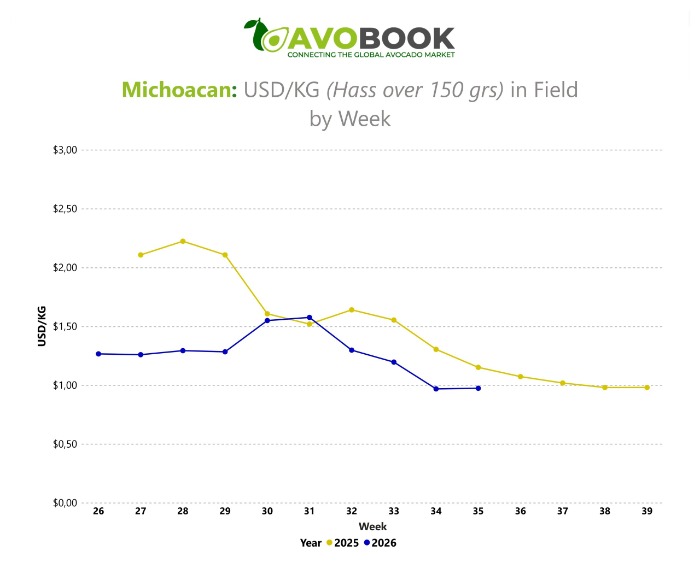
Price pressure is also evident at origin. In Week 34, the farmgate price in Michoacán stood at approximately USD 0.97/kg, compared with USD 1.30/kg during the same week in 2025, a difference of nearly 25%.
In Week 35, the value remained around USD 0.97/kg, while in 2025 it was approximately USD 1.15/kg, narrowing the year-over-year gap to around 16%.
Villaseñor has also observed this difference, recently noting that the farmgate price was 25% below the previous season and describing market conditions as challenging due to the prevailing price levels.
A Balance That Could Begin to Stabilize in October
The current price relationship between sizes could begin to normalize in the coming weeks as the composition of supply changes once again.
Peru's exit from the market, which during this period supplied mainly large sizes—including Size 48—and the start of harvests in new producing areas of Mexico should favor a size distribution closer to the seasonal norm.
Under this scenario, stabilization in the relationship between sizes could begin to emerge from October onward.
However, price inversions are not unprecedented. Cavaletto notes that smaller sizes, such as Size 70, can occasionally trade above larger sizes when the availability balance changes, although these periods tend to be short-lived.
For now, the evolution between Weeks 30 and 35 shows how quickly this relationship can change: in just five weeks, Size 48 went from recording one of the highest prices among the sizes analyzed to trading slightly below Sizes 60, 70, and 84.