Origin analysis
Jalisco doubles its avocado exports to the US in three seasons
With 45,000 hectares and a presence in 30 destinations, Jalisco consolidates its place as the second origin of Mexican avocados.
September 22, 2026
Jalisco has established itself as the second largest producer of Mexican avocados. Although its volume remains far from that of Michoacán, the state has built a productive and export platform with a presence in North America, Asia, and Europe .
Hectares, producers and municipalities: the size of the origin
Figures published by the Jalisco Avocado Producers and Exporters Association (APEAJAL) illustrate the scale of this development: 45,000 hectares under cultivation, 3,200 producers, and 80 municipalities involved in production. The industry also generates 38,000 direct jobs and another 45,000 indirect jobs.
At the commercial level, the organization reports that 15 municipalities are certified for export and that Jalisco's avocados reach 30 international destinations. Collectively, this region accounts for 12% of Mexico's avocado exports.
Jalisco vs Michoacán: a necessary comparison
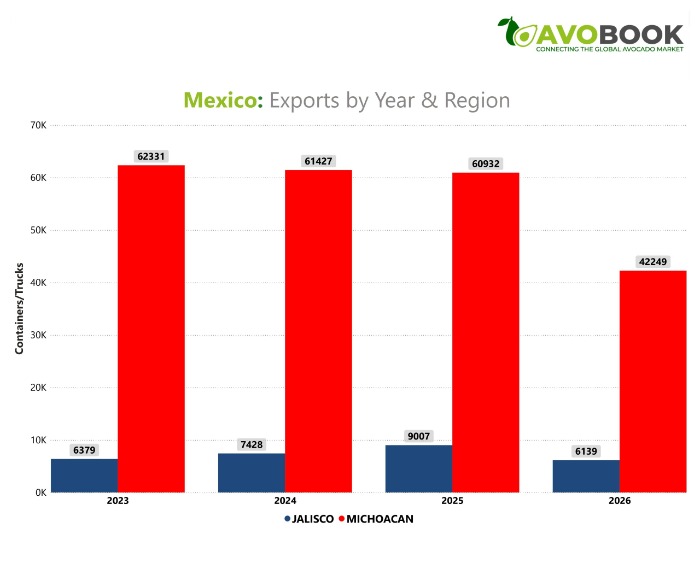
Comparing Jalisco to Michoacán helps to understand its place within the Mexican industry. According to data from Avobook, Michoacán exported 60,932 containers and trucks in 2025, while Jalisco exported 9,007 units.
The difference is significant: for every unit exported from Jalisco that year, Michoacán shipped approximately seven. However, the smaller scale does not prevent Jalisco from playing a relevant role in Mexican exports, especially given the expansion of its export activity.
Growth and scale
Between 2023 and 2025, its shipments increased from 6,378 to 9,007 containers and trucks, representing an approximate growth of 41%. During this period, the country registered 7,428 units in 2024.
The 2026 data does not yet allow for a year-over-year comparison. Through week 37, Jalisco had accumulated 6,139 containers and trucks, while Michoacán registered 42,249. Since this is a partial period, these figures should be understood as a reference for the progress of the season and not as a year-over-year finale.
United States Gains Ground
The opening of the United States market meant a change in the distribution of exports for Jalisco. In July 2022, the state made its first shipment of avocados to the U.S. market, becoming the second Mexican state authorized to supply it.
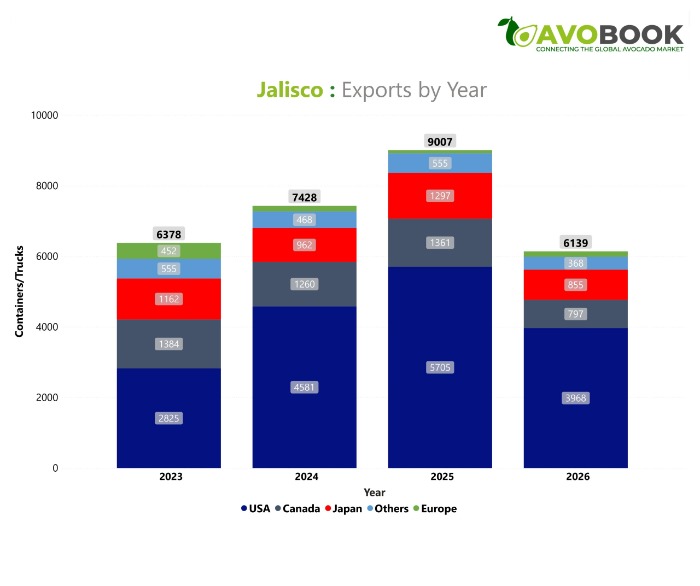
Avobook's records show how this destination gained market share in subsequent years. In 2023, the United States received 2,825 containers and trucks from Jalisco, equivalent to about 44% of its exports. In 2024, the volume increased to 4,581 units, and in 2025, it reached 5,705.
In 2025, the United States accounted for approximately 63% of Jalisco's exports. While the growth of this market explains a significant portion of the state's export increase, it has not eliminated the share of other destinations.
Canada and Japan support diversification
Canada and Japan comprise the second tier of Jalisco's trade structure. In 2025, the state shipped 1,361 containers and trucks to Canada and 1,297 to Japan. Other destinations received 555 units, and Europe, 89.
The distribution network reveals an industry heavily oriented towards North America, but with established trade routes to Asia and other markets. This diversification is especially relevant for a country seeking to expand its international reach without relying on a single buyer.
Partial data for 2026 maintains this composition. Through week 37, the United States accounted for 3,968 units; Japan, 855; Canada, 797; other destinations, 368; and Europe, 151. Again, these figures should not be directly compared with the year-end totals, as they only represent the available cumulative data.
An offer distributed throughout the year
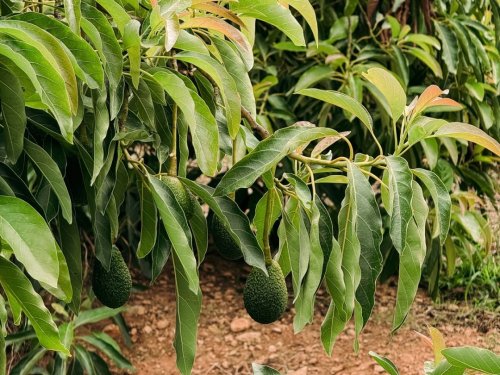
The presence of orchards in various production zones allows Jalisco to have fruit available for a significant portion of the year. According to the agricultural magazine Tierra Fértil, Jalisco's orchards achieve an average yield of approximately 16 tons per hectare. The publication also notes that their geographical distribution contributes to year-round fruit availability.
This characteristic does not mean that the volume is uniform throughout the year. Supply can vary depending on the region, flowering season, altitude, and the conditions of each cycle. However, the geographical breadth provides the origin with a base to participate at different times of the commercial calendar.
The combination of availability, proximity to the United States, and access to markets such as Canada and Japan positions Jalisco as a relevant complement within the Mexican offering.
Production with territorial impact
The industry's importance is not limited to exports. The 3,200 producers and 83,000 direct and indirect jobs reported by APEAJAL demonstrate the extent of the activity within the regional economy.
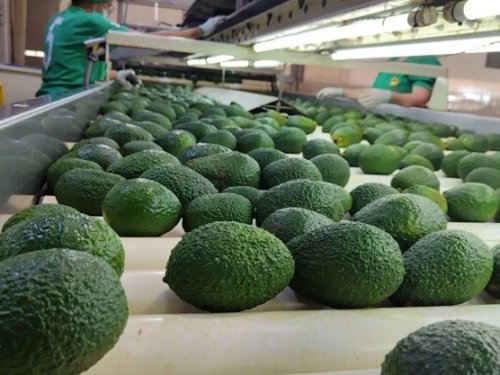
Production is distributed across 80 municipalities, although only a portion possess the necessary conditions and certifications to participate directly in export programs. This disparity reflects the fact that a region's production volume does not automatically equate to its export capacity. Access to certain markets also requires phytosanitary protocols, traceability, infrastructure, and authorized packing facilities.
APEAJAL currently represents more than 3,200 producers and 23 exporting packing plants, while promoting the opening of new markets and the competitiveness of the chain.
Jalisco's place in the global offering
Jalisco has not yet reached the volume of Michoacán, but its relevance does not depend solely on that comparison. Its importance lies in having built a second export platform within Mexico , with a base of 45,000 hectares, access to 30 destinations, and a declared share of 12% of national exports.
Avobook's data also shows that this development has been accompanied by greater penetration in the United States: between 2023 and 2025, shipments to that market practically doubled.
Its production scale, the extent of its cultivation, and the diversification of its destinations make Jalisco a significant origin on the international avocado map. Rather than simply replicating the size of Michoacán, its position is being built by expanding Mexico's export capacity and adding a diverse offering with different regions, distribution channels, and trade routes.