Growth in consumption in Europe
Italy is gaining ground as a destination for imported avocados.
With a 28% growth in retail sales and a consumption of 1.12 kg per capita, Italy is consolidating its position as a key destination for Chile and Peru.
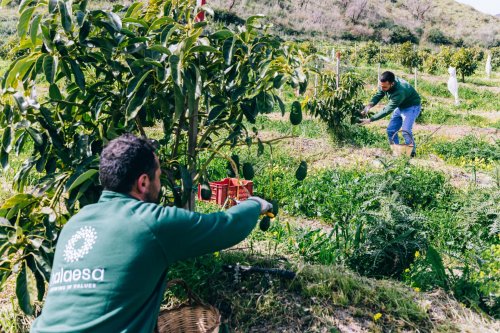
Image credits: Halaesa
November 10, 2026
During 2025, retail avocado sales in Italy grew by 28% in volume. This increase is a positive sign for exporters looking to expand their presence in Europe , specifically in a country where supermarkets account for 87.3% of purchases.
Analyzing 2026, Avobook data shows that between weeks 1 and 44, Chile led at the beginning of the year among the suppliers that supplied Italy, regaining weight in the second half.
Peru, for its part, concentrated its shipments in the shoulder months. This shift opens opportunities to expand supply programs to different times of the year. The data also indicates occasional shipments from Michoacán.
According to the Italian Independent Association Fruitimprese, Italy imported 27,900 tons of fresh or dried avocados in 2020, while in 2025 this figure rose to 67,576 tons. Furthermore, retail sales in the Mediterranean country grew by 28% in volume by 2025, according to data presented by the World Avocado Organization (WAO) at Macfrut 2026.
In 2023, WAO estimated Italian avocado consumption at 0.7 kg per person, a figure projected to reach 1.12 kg by 2025. The organization maintains that the category's reach remains limited, as only 35% of households purchase avocados at least once a year.
Consumption habits and geographical distribution of demand
The north of the country offers a more developed consumption base. In the household panel published by ISMEA and NIQ in 2023, the average annual purchase was 644 grams per household in the northeast and 626 in the northwest, almost double the 334 grams in the south. The panel indicates that the highest proportion of purchasing households is located in central and northeastern Italy.
Francesco Mastrandrea, founder and CEO of Halaesa, a company that grows avocados in Sicily, notes that, based on his experience with other operators, he perceives a greater familiarity with the fruit in urban centers.
“Guacamole and sushi have been the gateway,” Mastrandrea points out.
According to their analysis, the increase in consumption is explained by changing habits. They identify young people as the largest group buying avocados, followed by adults aged 55 to 64. Among the motivations, Mastandrea points out, are health and well-being.
Factors such as in-store promotions and training initiatives, he adds, can help incorporate avocados into new consumption occasions.
To reach the Italian consumer, Halaesa opted for supermarkets. The company marketed its first harvest, in the winter of 2025/26, through distributors that supply these chains.
Domestic production in Sicily: Proximity and value differentiation
Halaesa's CEO estimates that currently, between 2% and 5% of Italian avocado consumption is met by local production. Specifically for the company, the harvest in Sicily runs from December to March, with possible extensions into April. Their expansion project includes approximately 300 hectares of avocado orchards, which the company plans to bring into production starting in 2029.
Mastandrea estimates that Italy currently has about 1,500 hectares planted with avocado and mango, and believes there is potential to advance to 10,000 hectares between the two fruits.
The businessman expects Italian fruit to gain market share as new plantations come into production, although he anticipates that it will continue to cover a minority share of consumption because demand is also growing.
“The first limitation is the land and water supply, ” the executive explains. Expanding cultivation, he adds, requires land with a suitable microclimate and reliable access to water, as well as certified plants and financing to cover the years leading up to the first harvest.
The proximity of the orchards to the market allows for a shorter time between harvest and sale. Coop Italia, the central purchasing arm of Coop supermarkets, reported that its domestically grown avocados were selling for around 20% more than imported ones, and that consumers who try them tend to buy them again.
“We see a complementary relationship. Imports remain strategic, and the Italian supply provides a product harvested close to the market, for a few months of the year,” says Mastandrea.
The executive sees room for Sicilian avocados to gain ground in the premium segment. In his opinion, the supply of avocados in that category still doesn't meet Italian demand. This situation is also observed in France, Germany, the United Kingdom, and other markets in Northern Europe.
Supply opportunities and windows by export origin
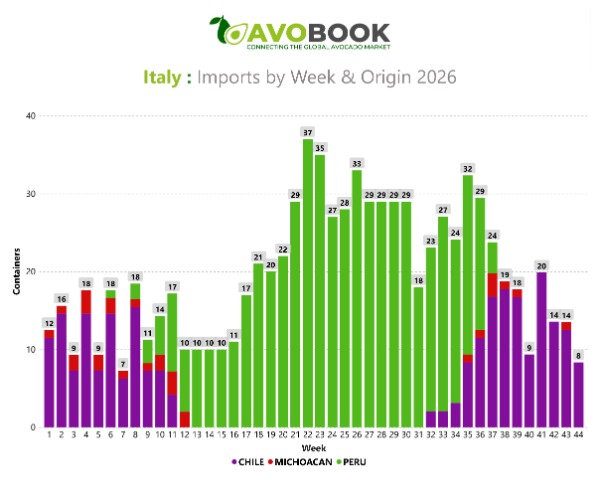
Peru and Chile now have an opportunity to expand their programs. According to data from Avobook, between weeks 1 and 44 of 2026, Italy received 584 containers of Hass avocados from Peru and approximately 250 from Chile.
Peru remained dominant between weeks 13 and 31, reaching 37 units in week 22. Chile had the lead at the beginning of the year and regained it in the second half, reaching a maximum export volume of 20 containers in week 41.
Mexico has a specific entry point. Avobook recorded 29 containers from Michoacán up to week 44, mainly at the beginning of the year. The observed scale allows for testing limited programs with buyers before committing to a regular supply.
Francesco Mastandrea also identifies Spain as one of Italy's main avocado suppliers. According to customs statistics, France and the Netherlands also play a significant role, accounting for approximately 44% of the imported volume in 2025.
Both countries function as distribution centers, so some of the registered fruit may have been grown in other origins.
With a per capita consumption that already reaches 1.12 kg, a penetration rate of 35% in households and an import volume that exceeded 67,500 tons in 2025, the Italian market is consolidating its expansion process.
The union between the local Sicilian supply and its projection of reaching up to 10,000 hectares together with the supply windows led by Peru and Chile defines a scenario of progressive diversification to respond to the retail demand in the country.
Did you find this news helpful?
Follow us on Instagram → @avobook.avocado
There we publish the most important information about the global avocado market: news, figures and industry trends.
You can also follow us on LinkedIn or join our WhatsApp channel to receive key news as soon as it's published.