Managing pollination in the field
BloomX raises US$13 million for robotic pollination
Agtech BloomX raises US$13 million to expand its robotic pollination service for avocados and boost performance in Peru and Mexico.
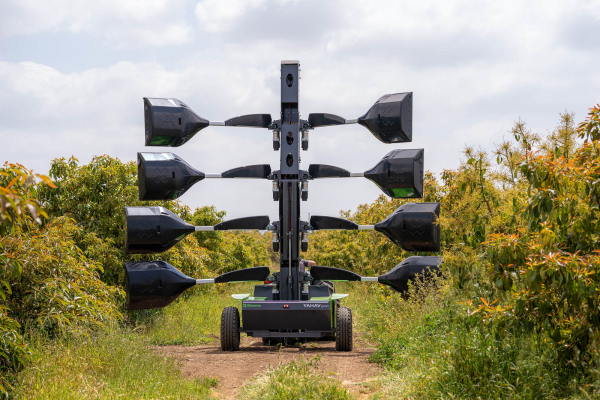
Image credits: BloomX
November 9, 2026
Agricultural technology company BloomX raised US$13 million in an investment round led by Elah Fund. The funds will be used to expand the company's operations in countries such as Peru and Mexico, where it already has a presence.
The robot, developed to support pollination in avocado orchards, entered commercial use in 2026 and is currently offered as a service, meaning the producer can hire BloomX to use their equipment without having to buy it.
How can the robot help?
The robot collects pollen from male flowers and deposits it on female flowers that can receive it. Its contribution would be to reinforce pollen transfer during flowering, a task also performed by bees and other pollinators.
How much can the service contribute to an orchard where pollinating insects are already present? In its commercial cases, BloomX reports an average increase of 16.5% in avocado yield in Allesbeste, South Africa.
In one block of El Rancho Farm in Peru, the company reports a 35% increase, equivalent to between 8 and 9 additional tons per hectare. These results, from specific plots and disclosed by the supplier, provide us with a benchmark for evaluating the service under local conditions.
What else can the producer do?
Preserving natural vegetation around orchards helps maintain a greater diversity of insects and natural pollinators. A study led by Keira Dymond found more wild insects and floral visits alongside their natural habitat in three orchards in central Chile. The research concludes that flower clusters accessible to insects produced more small fruits than those covered with netting to prevent their entry.
In parallel, introducing beehives during flowering allows for an increase in honeybee populations; a trial conducted in Australia observed improvements in fruit set after their introduction. These results contrast with a study carried out in Chile, where a greater abundance of honeybees was not associated with improved fruit set.
A first step before deciding to add beehives or try the robot developed by BloomX is to observe which insects visit the flowers and whether they do so both on the trees at the edge and those inside the orchard.
BloomX proposes evaluating robotic pollination in two blocks of the same variety, one low-yielding and one high-yielding, while keeping all other inputs constant. The company suggests measuring fruit set, marketable yield, and fruit size in both blocks as a method for assessing results in the orchard.
Did you find this news helpful?
Follow us on Instagram → @avobook.avocado
There we publish the most important information about the global avocado market: news, figures and industry trends.
You can also follow us on LinkedIn or join our WhatsApp channel to receive key news as soon as it's published.