Global avocado markets
Dominican and Peruvian avocados complement each other in the market
Oniel Núñez Guzmán's analysis details how seasonality avoids direct competition and connects the campaigns of both avocado origins.
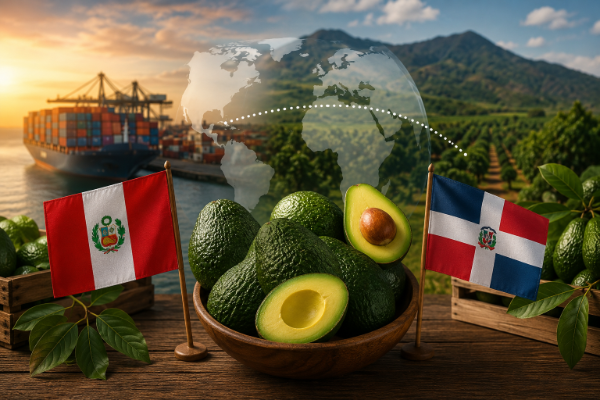
Although both countries play a significant role in the international Hass avocado market, the seasonality of their production means their main export periods occur at different times. However, the evolution of Peru's supply continues to indirectly influence the commercial landscape the Dominican Republic will face at the start of its season.
As global supply continues to grow and new origins consolidate their presence in international markets, it is increasingly common to wonder whether producing countries like Peru and the Dominican Republic are competing directly for the same market share. However, the current market dynamics paint a different picture, where timing continues to play a decisive role.
According to Oniel Núñez Guzmán, the exportable production of both countries responds to commercial windows that, rather than overlapping, follow one another in an orderly fashion throughout the year.
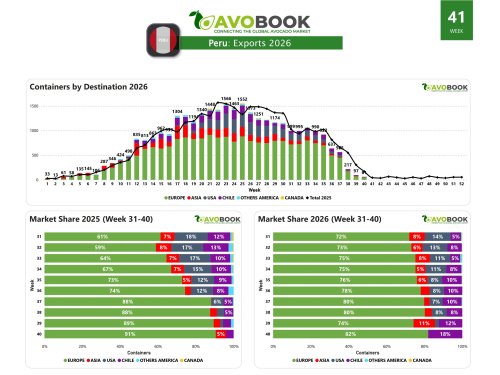
"During this period, the Dominican Republic is unable to complement the Peruvian supply, since Peru concentrates its production mainly between April and September, months in which the Dominican Republic does not have fruit available for export. There is simply no competition between the two origins."
July: a market led by Peruvian supply
During the month of July, Dominican production is mainly concentrated on local varieties destined for the domestic market, while the international supply of Hass avocados falls mainly on Peru, which is going through one of the times of greatest availability of fruit for export.
In this context, the Dominican Republic's absence from global markets is not due to a loss of competitiveness, but rather to the seasonality of its production. Historically, the Caribbean nation has built its commercial presence by taking advantage of a distinct window of opportunity, primarily between September and February.
As Núñez Guzmán explains, that has been one of the main strengths of the Dominican industry: to enter the global market at a different time than other major suppliers and to offer an attractive alternative when international availability begins to decrease.
Two calendars that end up connecting
Although the shipping windows don't directly coincide, both markets maintain a close indirect relationship. The specialist explains that the behavior of Peruvian supply at the end of its season can directly influence the price scenario that the Dominican Republic will encounter when its main export period begins.
"More than logistics or quality, what can affect Dominican marketing is how the Peruvian season ends. If international demand doesn't fully absorb those volumes, prices tend to decrease during October and November, coinciding with the peak of Dominican production and exports."
Thus, the relationship between the two countries is not determined by direct competition on the shelves, but by the way in which the behavior of one origin contributes to defining the price conditions that the next supplier will find within the global calendar.
A Dominican industry that evolves alongside the market
During the last few years, the Dominican Republic has steadily increased the area dedicated to Hass avocados, progressively replacing some of its traditional green skin plantations and strengthening a supply increasingly oriented towards export markets.
At the same time, Europe continues to consolidate its position as one of its main strategic destinations. Key factors in this positioning:
- Logistical proximity: Direct and efficient connections with key ports such as Rotterdam and Algeciras.
- Differentiated production window: Ability to arrive with fresh fruit when the supply from the southern hemisphere declines.
However, Núñez Guzmán acknowledges that the international landscape has become more demanding. The increased production in countries like Peru, Mexico , and Colombia has allowed the market to have a more consistent supply throughout the year, reducing the periods of shortages that previously offered greater commercial opportunities and price peaks.
Key factors to monitor in the coming months
Looking ahead to the next season, Guzmán believes that industry analysis must go beyond gross production volumes. To understand the performance of Dominican avocados, it will be necessary to closely monitor the evolution of available sizes in the producing regions, the behavior of Mexican exports to the United States, and the rate at which Peruvian supply is being withdrawn from the European market .
These factors will help anticipate the pace of consumption and the commercial context that the Dominican Republic will encounter when it resumes its exports. More than a story of competition, the relationship between Peru and the Dominican Republic reflects how different trade opportunities can coexist and complement each other within a dynamic global market.