Evolution analysis 2026
China and South Korea: A Comparison of Curves in Asia
While China shows volatility and slowdown, the South Korean market is consolidating itself as a stable and attractive destination for exporters.
Although China remains the leading Asian destination for Hass avocados by import volume, the trends of the last five years show a shift in regional dynamics. While the Chinese market has lost momentum after reaching its all-time high in 2023, South Korea has maintained more consistent growth and is beginning to establish itself as one of the destinations with the best prospects for exporters.
China: Slowdown and volatility in import volume
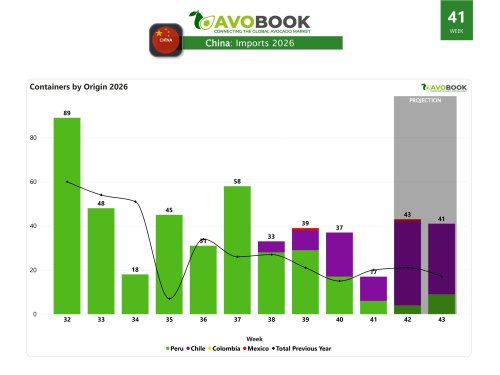
Avobook data shows that China accumulated 1,541 containers during the first half of 2026, a figure that confirms the slowdown observed after the record of 2,819 containers registered in 2023. Although Peru continues to be the leading supplier to the Chinese market, imports have shown greater volatility during the last few seasons.
After strong growth in 2023, China recorded a decline in 2024 (2,088 containers), a partial recovery in 2025 (2,595 containers), and a further setback in the advance in 2026, reflecting a market that has yet to consolidate a sustained growth trajectory.
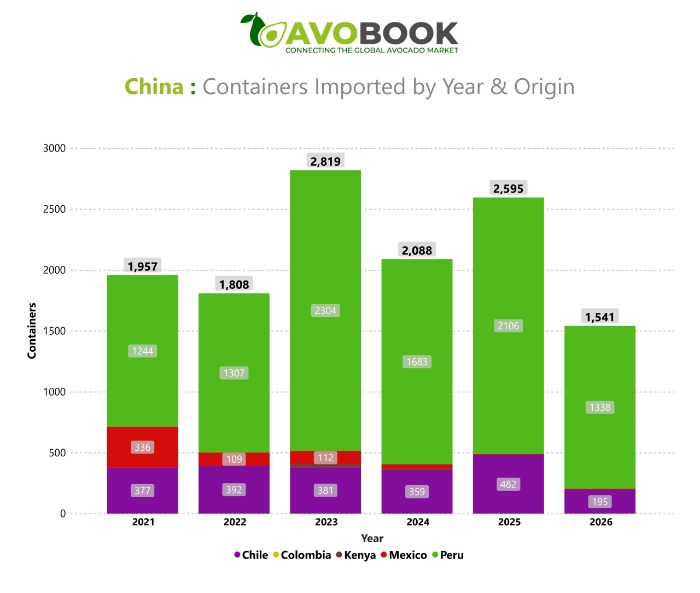
Evolution of Hass avocado imports in China by year and origin (2021-2026).
Supply pressure is also reflected in prices
Price trends confirm this behavior. During the first weeks of 2026, the Chinese market registered relatively high prices for size 18, reaching almost US$6 per kilo in week 18. However, the seasonal increase in shipments, driven mainly by the Peruvian season, began to exert strong pressure on supply.
As arrivals increased from week 20 onward, prices fell significantly below US$2 per kilo, subsequently showing a partial recovery toward the end of week 26, although without regaining the stability of previous years. This behavior again highlights a characteristic of the Chinese market: it remains highly sensitive to rapid increases in available supply.
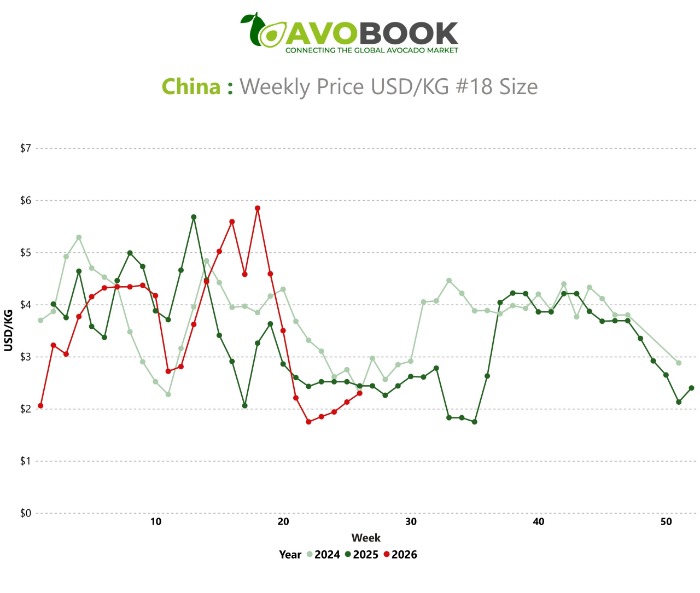
Weekly price behavior of Hass avocado size 18 in the Chinese market (USD/KG).
South Korea grows with greater stability
While China faces a period of increased volatility, South Korea shows a different trajectory. Although it remains a considerably smaller market, the figures reflect a sustained recovery after the decline recorded in 2024 (429 containers). During 2025, it grew again, reaching 583 containers, and in the first half of 2026, it maintains a steady pace with 516 containers accumulated.
More important than market size is the consistency of its growth. South Korea has avoided the sharp expansion and correction cycles seen in China, exhibiting a much more stable growth curve.
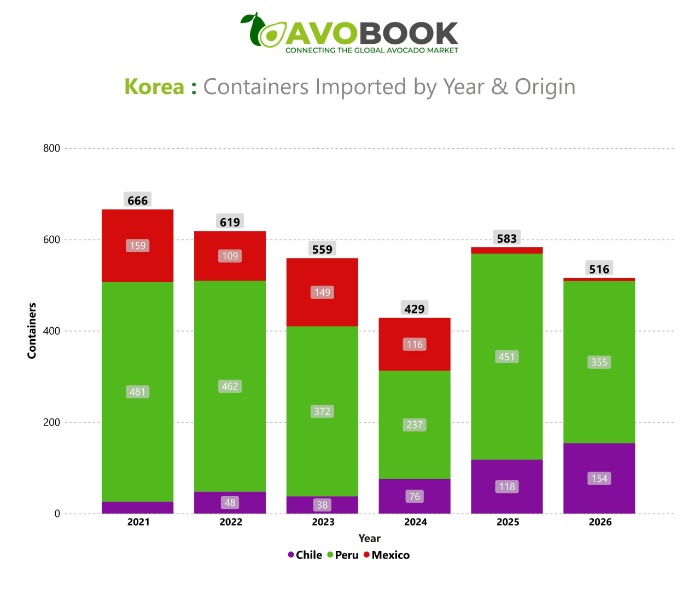
Evolution of avocado containers imported by South Korea according to year and origin (2021-2026).
Peru maintains its leadership and Chile gains prominence
In both markets, Peru remains the main supplier of Hass avocados. However, trends in recent years also show changes in the market share of other origins. In China, Peru accounts for a large share of shipments (registering 1,338 containers out of a total of 1,541 so far in 2016), while Mexico has progressively reduced its presence.
In South Korea, in addition to Peru's leading position, Chile's sustained growth stands out, having increased its share season after season—reaching 154 containers in the first half of 2026—and consolidating itself as an increasingly relevant supplier for that market. Mexico, on the other hand, has lost prominence in both destinations, gradually reducing its share of Asian supply.
The commercial appeal begins to shift
While China will continue to be the largest Asian market by volume for the next few years, the data suggests that the main growth potential is no longer necessarily associated with the largest market.
The stability observed in South Korea, the gradual growth of its imports, and a supply structure that has evolved without major episodes of oversupply are beginning to position it as one of the most attractive destinations for the export industry.
While China is going through a consolidation phase, marked by greater fluctuations in volumes and a high sensitivity of prices to supply, South Korea continues to strengthen a more stable demand, emerging as one of the markets with the best prospects for the development of Hass avocados in Asia.
Join our WhatsApp channel and receive the latest news from the international avocado market every week:https://www.whatsapp.com/channel/0029Vb81Exv1yT2Eff1Hjo2w