South American Market
Argentina completes its shift towards Peru and Brazil
Following Chile's withdrawal, Peru leads imports and Brazil complements the supply of Hass avocados while awaiting the new Chilean cycle.
Chile 's withdrawal from the market led to a new supply structure in the Southern Cone . Currently, Peru leads imports, and Brazil complements the supply while the market awaits the start of the next Chilean avocado season.
With the end of the Chilean season, the Argentine Hass avocado market is beginning to show a new supply configuration. Data for May and June 2026 reflect a marked seasonal shift in the origin of imports, with Peru consolidating its position as the main supplier and Brazil strengthening its commercial presence during the Southern Hemisphere winter.
During the previous Chilean campaign, between September and December 2025, Chile largely dominated the supply to the Argentine market, reaching a peak of 304 containers in October and maintaining its absolute leadership until the end of the year. However, as the first half of 2026 progressed, Chilean volumes began to decline gradually, opening the door for other suppliers in the region to enter the market.
Peru leads in avocado supply while Brazil strengthens its position
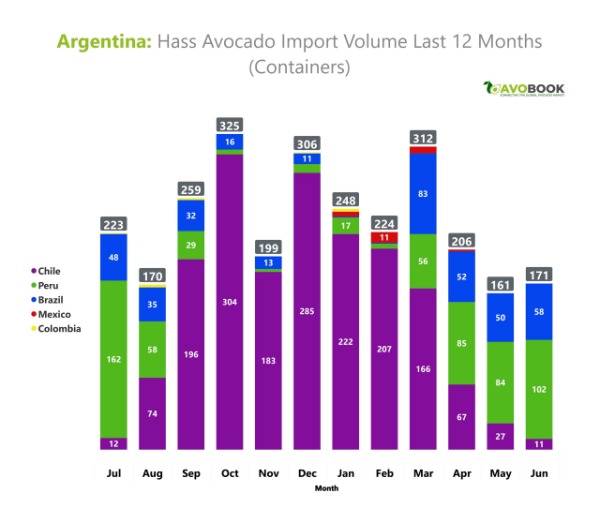
The evolution recorded between May and June confirms this change of scenario on Argentina's borders, as Chile drastically reduced its shipments from 27 containers in May to just 11 in June, reflecting the definitive closure of its export season.
Conversely, Peru increased its shipments from 84 to 102 containers, becoming the main origin and driving force of the Argentine market, and Brazil showed moderate but constant growth, increasing its shipments from 50 to 58 containers during the same period, consolidating a very stable share.
Together, both countries accounted for about 94% of Argentina's Hass avocado imports during June, demonstrating the strong joint prominence they have acquired once Chile's presence ended.
Rather than competing, both origins complement each other in the market
Although the simultaneous increase in shipments from both countries might suggest direct competition for Argentine customers, the actual dynamics of the industry respond to a different commercial logic.
"Peru and Brazil are not competing. They are complementing each other's offerings ," explains Miguel Bauzá, representative of Don Jaime.
This complementarity is clearly reflected in the physical distribution of volumes. While Peru concentrates the largest availability of fruit for major chains and distributors during this time of year, Brazil provides a valuable additional supply that helps maintain a continuous supply of avocados to the Argentine market during the transition between seasons.
"There's a point where they intersect, and obviously, one hurts the other. Brazil hurts Peru, without a doubt," Bauzá adds.
Medium sizes command the highest value at destination
Regarding commercial and price behavior, Bauzá points out that the sizes that currently obtain the best value in Argentina correspond mainly to the range between 60 and 84, while the extreme sizes (very large or excessively small) present a much lower demand at the moment.
The expert also explains that supermarkets still represent a limited proportion of Argentine national consumption. According to his estimates, around 20% of Hass avocado sales in Argentina are conducted through supermarket shelves.
The remaining 80% continues to flow through wholesale markets and traditional greengrocers, making it difficult to establish a uniform preference for sizes within the retail segment.
August will mark a new change in avocado imports
The snapshot provided by the consolidated data for May and June confirms that Argentina has already successfully completed its seasonal supplier turnover.
While Peru leads the supply and Brazil maintains its strategic share, the import sector is already looking ahead to August. It is at this time that the start of the new Chilean season will once again alter the composition of imports, opening a new and important chapter in the dynamic Hass avocado trade calendar in South America.