Analysis of supply and markets for avocados at origin
Colombian avocado: from peak to lowest point
Colombian exports experienced a sharp slowdown in the first half of the year. The sector is analyzing what to expect starting in September.
After registering the highest weekly volume in the last three seasons at the beginning of 2016, Colombian Hass avocado shipments experienced a sharp slowdown during the first half of the year. Now, the market is focusing its attention on the upcoming main season and the possibility of a recovery starting in September.
Shipments from Colombia were one of the most striking trends in the first half of 2026. The year began with strong export activity, reaching a peak of 290 shipments in week 5, the highest figure recorded in the last three seasons.
However, that initial surge gave way to a sustained decline in shipments. From week 14 onward, volumes fell below 60 weekly loads, and between weeks 20 and 26, they stabilized at around 30-45 shipments per week, marking the period of lowest export activity for the year.
A different behavior compared to the 2024 and 2025 seasons
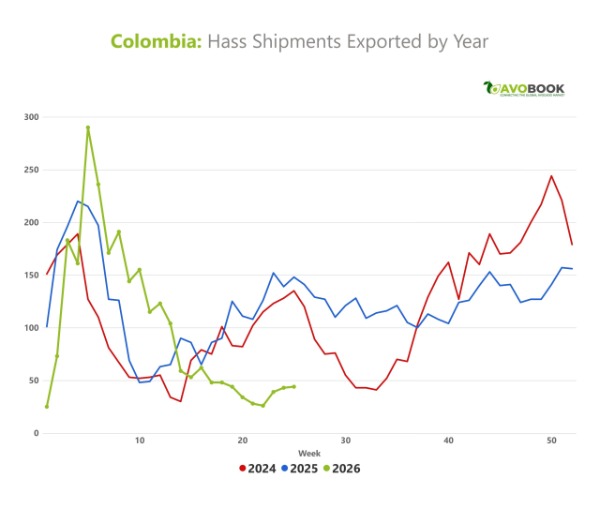
When comparing the evolution of exports with previous seasons, the contrast is evident. While 2024 and 2025 maintained relatively stable activity after their initial peak weeks, 2026 showed a completely different trend.
The year began with the highest export peak of the period analyzed, but also registered the steepest decline in the following months. In other words, the first half of the year was not marked by a steady decrease from the outset, but rather by a sharp acceleration followed by an equally significant slowdown, substantially altering Colombia's presence in international markets.
Europe maintains its leading position among destinations for Colombian avocados
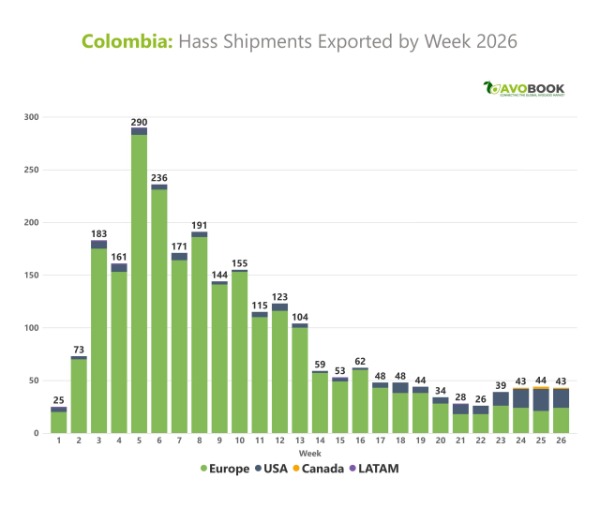
Despite the reduction in shipments, Europe continued to solidify its position as the main destination for Colombian fruit throughout the first half of the year. Data shows that the majority of shipments remained concentrated in the European market , while the United States maintained a considerably smaller share. Toward the end of the period, small shipments to Canada also began to appear, slightly expanding the geographic distribution.
However, the lower availability of fruit gradually reduced Colombia's presence in the supply of the Old Continent.
Other origins are gaining market share in Europe
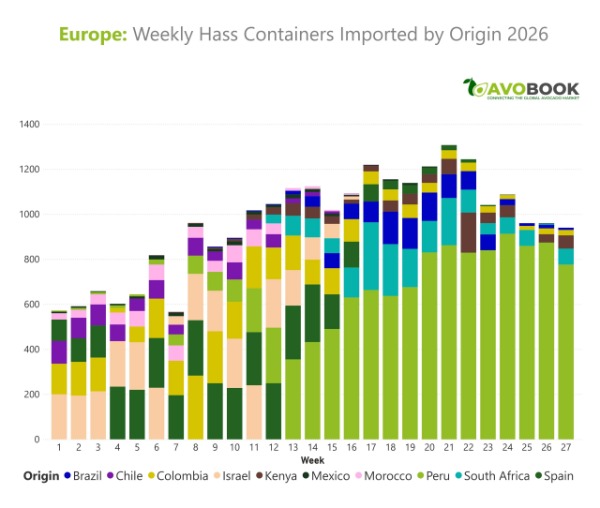
The decrease in Colombian shipments coincided with a seasonal increase from other suppliers, allowing the European Union market to maintain a stable supply:
- Peru as the dominant origin: Its volume began to increase steadily from approximately week 13.
- Entry of competitors: South Africa began its seasonal incorporation, while Brazil , Kenya and Spain also strengthened their participation within the European market.
Rather than a direct replacement, this behavior reflects the ability of international trade to redistribute supply among different countries as the production windows of each region change.
September will be the focus of industry attention
With the next major campaign scheduled to begin around September, the main question is whether Colombia will be able to recover the dynamism that has historically characterized that period or whether the trend observed during the first half of the year anticipates a lower export participation during the rest of the year.
For now, the data clearly show a loss of prominence compared to previous seasons, although it does not yet allow us to determine whether this is a temporary adjustment associated with seasonality or the beginning of a more structural change within the Colombian export supply.
Similarly, the available information does not allow us to draw conclusions about the behavior of the domestic market, the fruit intake by the processing industry, or the impact these factors have had on prices. These elements will require further analysis to fully understand the industry's performance in the coming months.