International analysis
European avocado market during the first half of 2026
Peru led shipments to Europe in the first half of 2026, while Colombia marked the largest expansion.
The European Hass avocado market closed the first half of 2026 with a supply distribution that continues to evolve dynamically. While Peru reaffirmed its position as the continent's main supplier, the period was marked by significant growth from diverse origins, diversifying the supply available to importers and supermarket chains.
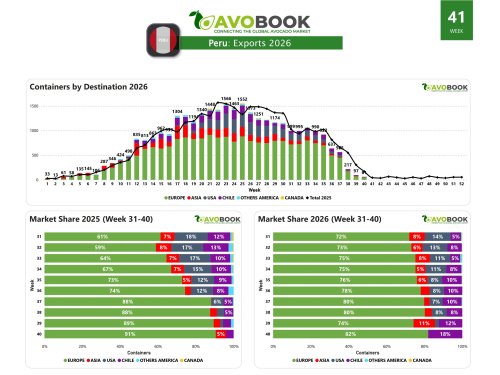
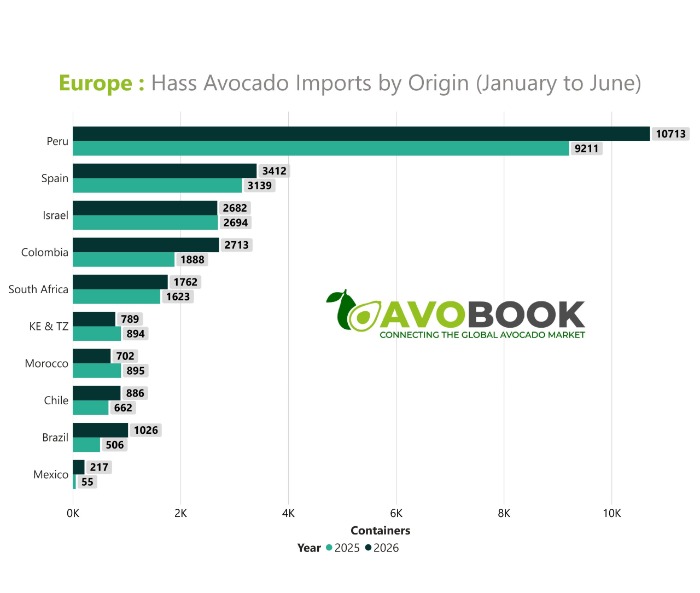
Data from Avobook shows that, between January and June, Peru accounted for 10,713 containers shipped to the European market. This figure represents an increase of nearly 16% compared to the 9,211 containers registered in the same period of 2015.
This performance allowed the Andean origin to extend its absolute leadership and further distance itself from its competitors, ratifying its key role as the backbone of the supply chain in Europe thanks to its production volume and the continuity of its commercial programs.
The behavior of traditional suppliers
Regarding the established players supplying the European market, Spain once again ranked second in exports. The Iberian country shipped 3,412 containers, reflecting growth of nearly 9% compared to the previous year.
For its part, Israel maintained a stable performance in its shipments, recording a volume of 2,682 containers, very similar to that recorded in 2025, which demonstrates a fully consolidated participation without major fluctuations within the international bloc.
New origins accelerate their pace of expansion
One of the most significant changes in the first half of the year was in Colombia , which increased its shipments from 1,888 to 2,713 containers. With this impressive 44% jump, the South American nation positioned itself as the fastest-growing supplier to Europe.
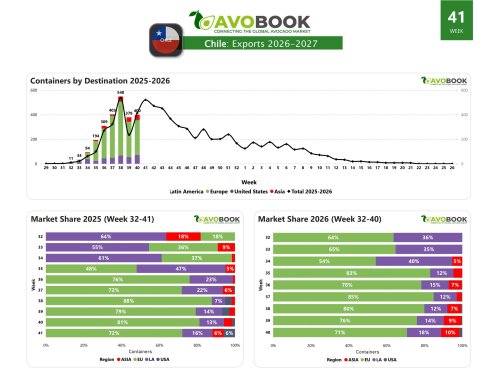
This positive trend was mirrored by other players in the Southern Hemisphere and surrounding regions; Brazil practically doubled its shipments, reaching 1,026 containers and injecting significant dynamism into the supply, while Chile grew by approximately 34%, accumulating 886 containers. Meanwhile, Morocco strengthened its presence with 702 containers, while South Africa, with 1,762, and Mexico, with 217, maintained moderate but remarkably stable growth.
The main exception to this upward trend was the Kenya and Tanzania bloc, being the only relevant origin that experienced a contraction in its port arrivals during the evaluated period, registering 789 containers.
During this first semester, the global landscape shows a European market under the undisputed leadership of Peru, where the acceleration of emerging competitors suggests that the race to respond to a demanding and permanent demand will continue to gain intensity.