Industrialization and processing
Colombia diversifies its avocado business with oil and guacamole
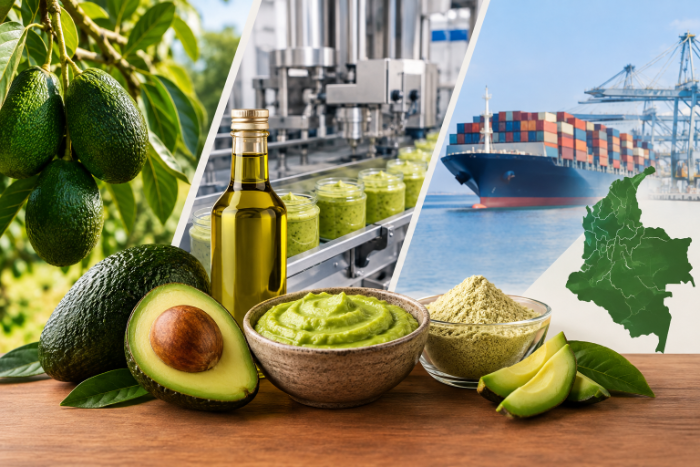
Colombia is driving the transformation of Hass avocados with 27 plants in operation, highlighting a strong leap in oil exports.
Monday, September 7, 2026
The growth of the Colombian avocado industry has opened new opportunities in international markets, but the development of the industry depends on more than just increasing fresh fruit exports. Diversifying sales channels is becoming increasingly important in the sector's strategy.
This was the argument put forward by Manuel Michel , managing director of the Colombia Avocado Board (CAB) , during his presentation at the 10th Jalisco Avocado Congress . Among the five key elements proposed for building sustainable demand, Michel highlighted the need to jointly develop exports, the domestic market, and processing, with the goal of placing different types of fruit on the market and reducing dependence on a single channel.
The strategy stems from an industry that already has a significant presence both within and outside of Colombia . In 2025, Hass avocados were the second highest-earning fresh fruit for the country, generating USD 375 million FOB.
A domestic market that complements exports
Unlike other producing countries primarily focused on the international market, Colombia also has a large domestic consumption base. According to Corpohass data presented by Michel, 97.5% of Colombians consume avocados, and more than 70% buy them at least once a week. Furthermore, 66% of households consume Hass avocados, although 34.5% still exclusively consume Papelillo or Criollo varieties.
This combination allows the sector to work across different demand channels. In addition to exports and domestic consumption, a third alternative is beginning to gain prominence: processing.
Colombia now has 27 avocado processing plants
The Colombian avocado industry currently has 27 processing plants, according to Corpohass data updated to 2025. Antioquia has the largest number, with 12 facilities, followed by Risaralda with six. Cundinamarca, Quindío, and Valle del Cauca each have three plants.
Diversification is also evident in the processed products. Oils account for 56%, while guacamole and fruit pulp represent 33%. Avocado powder makes up 4%, and the remaining 7% corresponds to other processed products.
This structure allows for expanding the commercial alternatives available to the sector and moving towards the objective set by Michel: developing different ways to place the fruit instead of depending exclusively on a single market.
Oil accelerates its export growth
Among processed products, oil shows one of the most significant evolutions in the data presented by the CAB.
In the first quarter of 2024, the companies identified by the sector recorded exports of approximately USD 389,000 and 74,956 kilos. After several fluctuations, the value reached USD 1.88 million in the third quarter of 2025 and subsequently jumped again to USD 5.66 million in the fourth quarter, when the volume reached 805,922 kilos.
The evolution of guacamole has followed a different trajectory. Exports considered in the presentation started at USD 1.41 million during the first quarter of 2024 and reached USD 2.61 million in the fourth quarter of 2025, totaling 744,462 kilos. Fluctuations were also recorded during this period, particularly a drop in the second quarter of 2025, followed by a recovery during the second half of the year.
The figures thus show a considerably greater acceleration in the oil during the last quarters analyzed, although the presentation does not attribute this behavior to a specific cause.
Furthermore, the data must be interpreted considering the methodology used. For oil, Corpohass and DIAN use as a reference those companies identified within the sector that register exports under the tariff heading corresponding to vegetable or microbial fats and oils. In the case of guacamole, they consider identified companies that export under the heading of prepared sauces, condiments, and seasonings.
Diversify to reduce dependence
The progress of this transformation is thus integrated into a broader strategy for Colombian avocados. Processing is not seen as a substitute for exporting fresh fruit or for the domestic market, but rather as a third channel capable of expanding the alternatives available to the sector.
This perspective is part of the five keys to sustainable demand proposed by Michel: maintaining quality and trust, having a supply available throughout the twelve months, strengthening business relationships through information and compliance, diversifying demand, and developing new ways to create value.
With a high-consumption domestic market, an expanding international presence, and a processing network that already includes 27 plants, the challenge for Colombia lies in growing these channels in a complementary way. The recent evolution of avocado oil and guacamole shows that industrialization is already part of that equation and opens an additional avenue for diversifying the Colombian avocado business.