Asian Market
China receives fewer avocados in August as it awaits new sources.
The decline in Peruvian supply marks the lowest point of the year in China, anticipating the arrival of Chilean fruit in September.
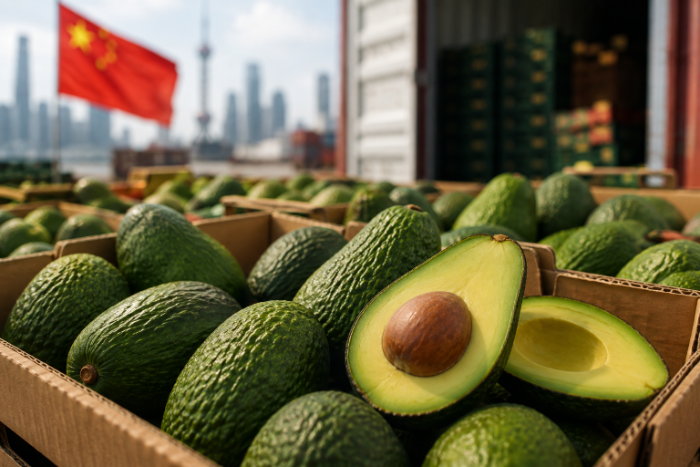
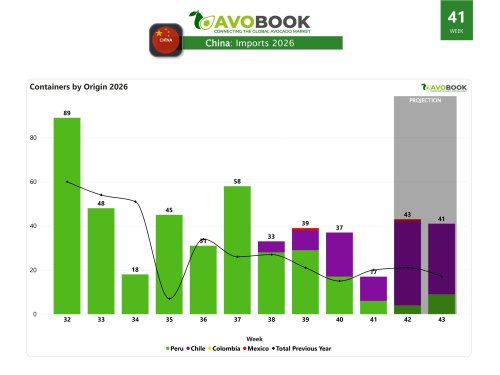
The Chinese avocado market is once again confirming a pattern that has been remarkably consistent in recent years. At the beginning of August, imports experienced a significant drop, which is due more to seasonal supply than to temporary changes in demand.
Historical data shows that this behavior has remained virtually unchanged between 2023 and 2026, consolidating August as the main transition period within the second half of the year.
A decline that repeats itself season after season
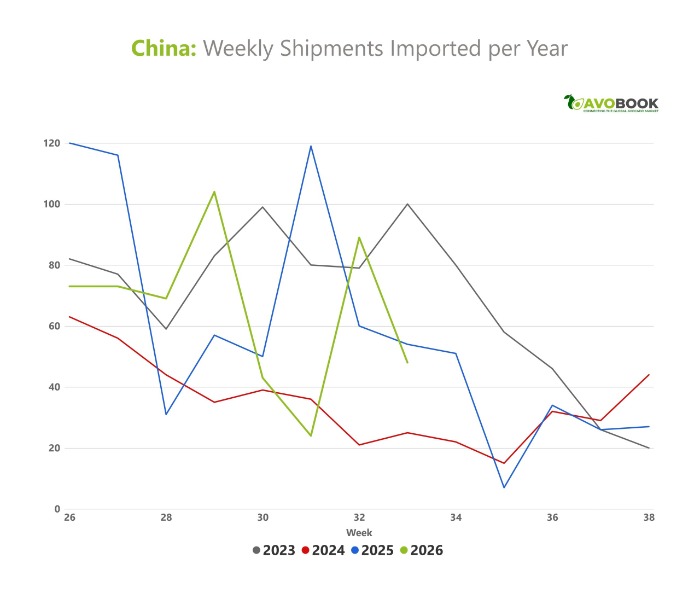
Weekly import analysis shows that fruit arrivals begin to decline sharply between weeks 31 and 35, coinciding with the beginning of August. This reduction corresponds to a clearly identifiable phase in the trading calendar. After reaching peak volume during the first half of the season, the market enters a period of lower activity before regaining momentum.
Peru explains the adjustment while 2026 repeats the trend
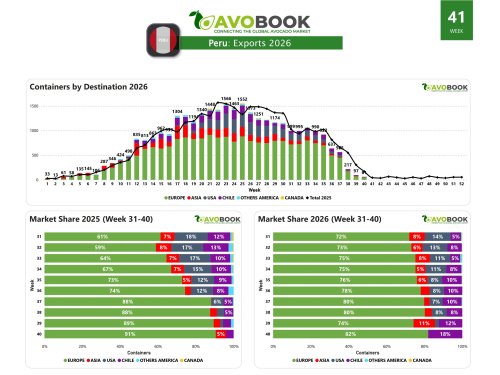
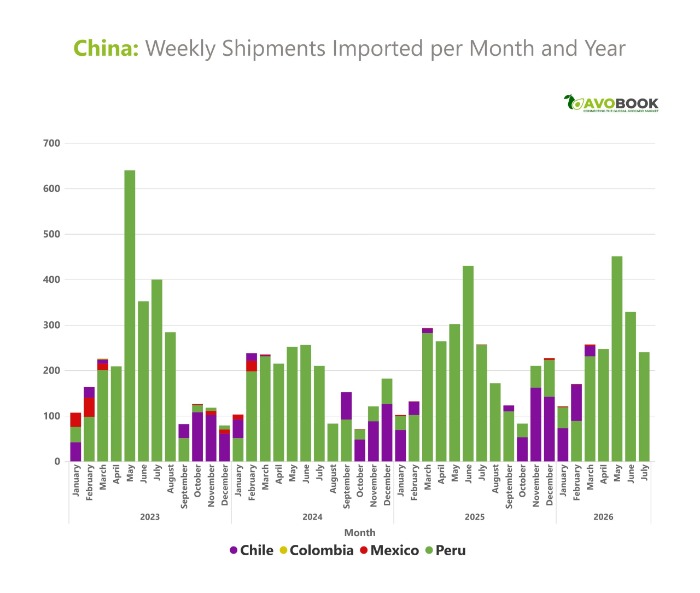
A monthly comparison between 2023 and 2026 shows that Peru remains, by a wide margin, China's main supplier, reaching its peak volumes between May and July. However, this same concentration explains the decline in August: as the Peruvian season winds down, the flow to China steadily decreases.
Although the 2026 campaign shows variations between weeks, the line follows the same downward trend as previous campaigns, alternating weeks of recovery with setbacks that respond to a structural pattern of the market.
Chile will gain prominence starting in September
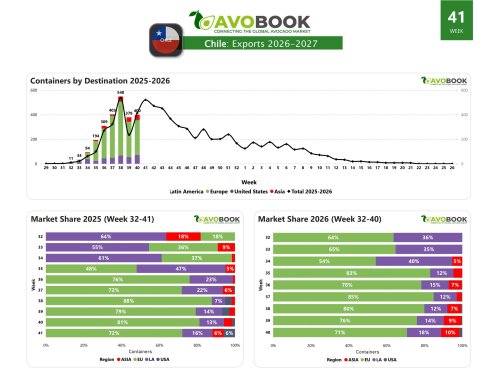
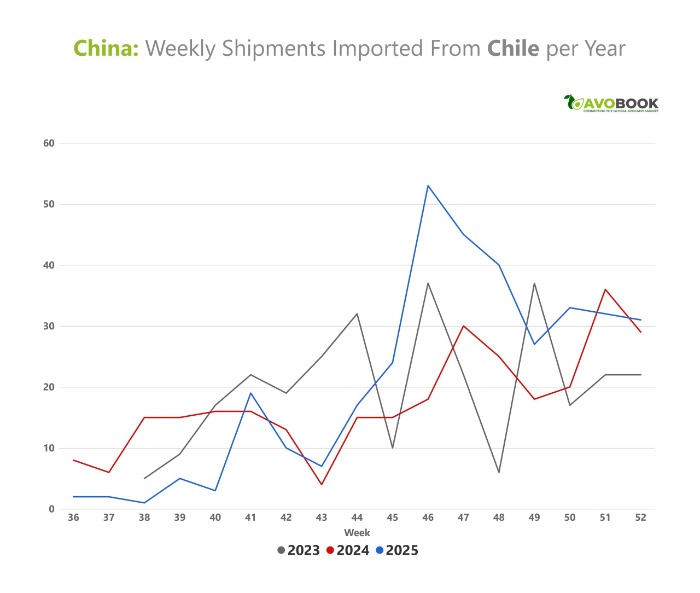
Historical import data from Chile suggests that Peruvian supply will eventually replace Chilean products. During August, Chilean imports remained limited and volumes remained low. More significant increases in shipments were only observed between weeks 36 and 38 (early September).
Growth accelerated in October and peaked between weeks 44 and 46 (November), at which point Chile became the dominant supplier. Meanwhile, shipments from sources such as Mexico and Colombia remained stable but complementary, insufficient to offset the decline in Peruvian exports in August.
A predictable transition towards the end of the year
Rather than reflecting weakening demand, August's performance confirms the strong seasonality of the Chinese market. The temporary reduction in shipments is due to Peru's natural decline and precedes the gradual entry of Chilean fruit, creating a transition window that will repeat itself in 2026.