Market transition
China prepares for the changing of the guard: Peru falls and Chile arrives in September
September marks the transition in China: supply from Peru falls and Chile begins shipments, generating less availability and firmer prices.

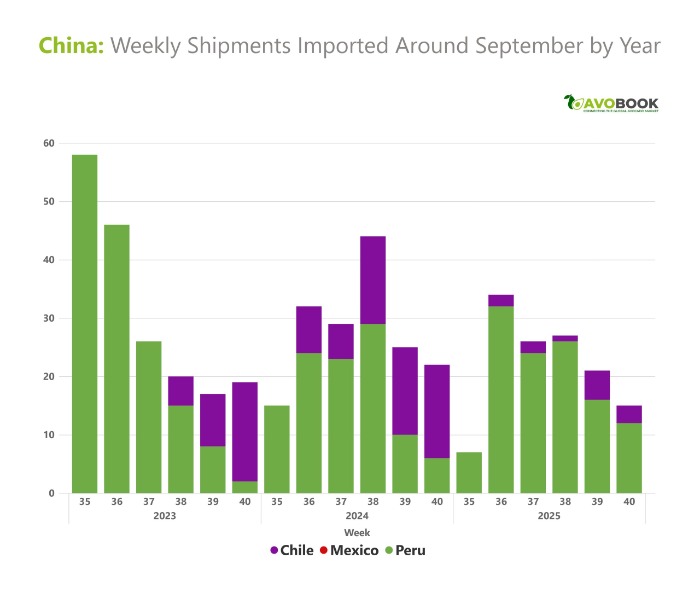
September typically marks a shift in the composition of avocado supply in the Chinese market. Avobook data for the 2023, 2024, and 2025 seasons show that during these weeks, shipments from Peru tend to decline, while the first volumes from Chile begin to appear.
Although the pace of this transition varies from season to season, the last two campaigns show that Peruvian shipments can approach levels of around 10 shipments by Weeks 39 and 40. Chile's entry, meanwhile, usually begins during the second half of September, but its initial volumes do not necessarily offset the decline in Peruvian supply immediately.
The result is a period of lower overall availability, which has historically coincided with firmer prices compared with the levels observed during the peak of Peruvian supply.
Peru Reduces Shipments to China at Different Rates Each Season
The decline in Peruvian volumes during September appears in all three seasons analyzed, although the trajectories differ.
In 2023, Peru began Week 35 with approximately 58 shipments to China. One week later, the volume had declined to around 46, and by Week 37 it stood at 26. The reduction accelerated thereafter, with records falling to approximately 15 shipments in Week 38, eight in Week 39, and just two in Week 40.
The 2024 season followed a different and more prolonged trajectory. Starting at approximately 15 shipments in Week 35, volumes increased during the following weeks, reaching around 29 shipments in Week 38. From that point onward, the decline began, with approximately 10 shipments in Week 39 and six in Week 40.
In 2025, by contrast, Peru recorded approximately seven shipments in Week 35 and reached nearly 32 in Week 36. Volumes subsequently stood at around 24, 26, 16, and 12 shipments between Weeks 37 and 40.
The differences between years show that there is no single trajectory for Peru's exit from the market. However, all three seasons converge toward a reduced Peruvian presence as September progresses.
Could Peru End September at Around 10 Shipments?
Historical data from recent seasons allow 10 shipments to be used as a reference point for the end of September, although not as a guaranteed level.
In 2024, Peru recorded approximately 10 shipments in Week 39 and six in Week 40. In 2025, the figures were around 16 and 12 shipments, respectively. The contrast comes in 2023, when the decline was considerably faster and volume fell to approximately two shipments by Week 40.
Therefore, a level close to 10 shipments is consistent with the two most recent seasons analyzed, but historical variability means that this figure should be considered a reference rather than an exact projection.
Chile Begins to Take Over China's Supply During the Second Half of September
The transition is also reflected in the gradual appearance of Chilean supply in the Chinese market as Peru reduces its presence.
The 2023 records show the first Chilean arrivals around Week 38, with approximately five shipments and a greater presence during the following weeks.
In 2024, Chile's entry was earlier and more significant. Chile reached approximately 15 shipments as early as Week 38 and maintained a relevant share thereafter.
The 2025 pattern was more limited. The first records appeared around Week 36, with approximately two shipments, while between Weeks 37 and 40 Chile's participation remained at levels of roughly two to five shipments.
The comparison shows that the second half of September typically marks the beginning of the transition, although both the exact timing and the intensity of Chile's initial arrivals can vary considerably from season to season.
Furthermore, the initial increase in Chilean supply does not necessarily replace all of the volume left behind by Peru. This creates several weeks during which combined availability may remain below the levels observed during the period of peak Peruvian supply.
Lower Availability and Firmer Prices in the Chinese Market
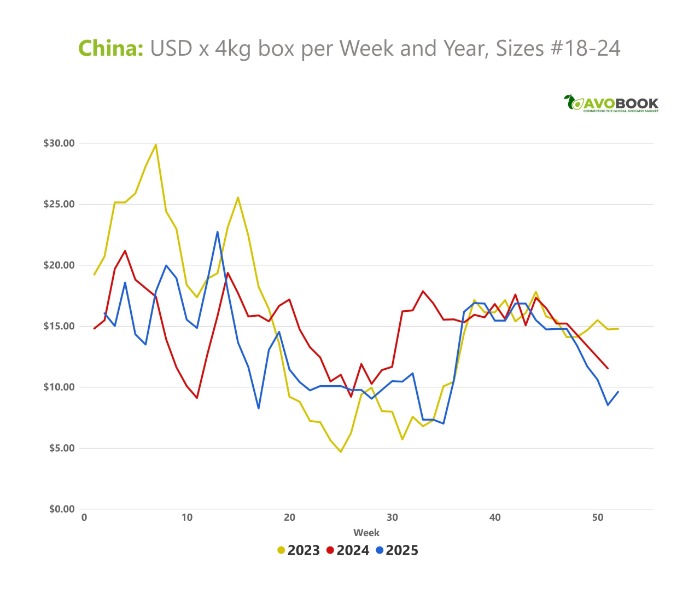
Price behavior follows this transition between origins.
During Weeks 35 to 40, prices for four-kilogram boxes of Sizes 18–24 have generally remained around USD 15 to USD 17 across the three seasons analyzed, showing greater stability compared with the fluctuations observed at other times of the year.
The difference is particularly evident when compared with the period of peak Peruvian supply. In 2023, for example, prices fell below USD 5 per box around the middle of the year before recovering to levels close to USD 15–17 during September. A similar recovery from lower price levels recorded earlier in the year can also be observed in 2024 and 2025.
According to Avobook's analysis, this behavior coincides with a period in which availability declines as Peru reduces its exports, inventories begin to tighten, and Chile is still in the early stages of its shipments.
Demand, meanwhile, remains relatively stable during this period. The combination of these factors supports a more balanced market with less supply pressure than during the peak of the Peruvian campaign.
Few Origins Available to Cover Peru's Exit from the Chinese Market
The transition becomes more significant because of the limited presence of other suppliers during these weeks.
The records analyzed show that Peru and Chile account for virtually all of the activity observed during September, while Mexico records minimal or no participation during the period.
Chile therefore becomes the main origin expected to progressively fill the space left by Peru. However, previous seasons show that this replacement does not occur immediately.
The decline in Peruvian supply can progress faster than the increase in Chilean shipments, temporarily resulting in availability below the levels recorded during the months when Peru's presence is at its highest.
A Transition That Repeats, but Not in the Same Way
The three seasons show a common pattern: September functions as a transition month between Peru's gradual exit and the beginning of Chilean supply to China.
However, the differences between 2023, 2024, and 2025 also show that the timing and magnitude of this transition can change significantly from one year to another. Peru has reached Week 40 with volumes ranging from approximately two to 12 shipments, while Chile's initial entry has also varied considerably between seasons.
The reference point of around 10 Peruvian shipments toward the end of September is consistent with the two most recent seasons analyzed, while Weeks 38 and 39 appear to be the period when Chilean supply has historically become more visible.
Until that volume increases, the market goes through a window of lower availability in which the reduction in Peruvian supply is not yet fully offset by Chile. Historical data show that it is precisely during this transition that prices have tended to regain stability compared with the period of peak Peruvian supply.