Market and Prices
Europe begins the relay between Peru, Chile and Colombia
Peru reduces arrivals to Europe while Chile accelerates its entry and Colombia defines the speed of supply.
Wednesday, September 9, 2026
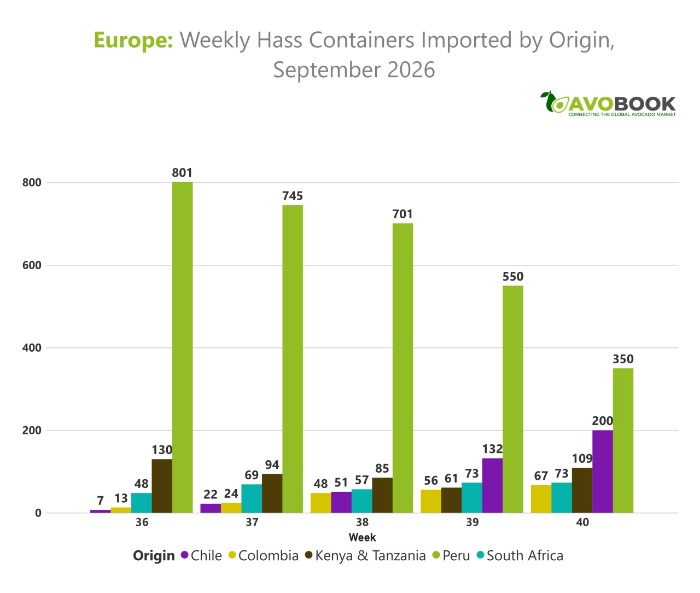
Europe begins September with Peru still the leading supplier of Hass avocados, but the scenario is changing rapidly as the month progresses. Avobook data show Peruvian supply declining from 801 containers in week 36 to 745 in week 37 and 701 in week 38, while projections point to a further reduction to 550 containers in week 39 and 350 in week 40.
At the same time, Chile is showing the fastest acceleration in supply: from 7 containers in week 36 to 22 in week 37 and 51 in week 38, with projections of 132 containers in week 39 and 200 in week 40. Colombia is also increasing its contribution, although at a more moderate pace, rising from 13 containers to a projected 67 during the same period.
For Víctor Ruete, advisor to Tropical Millenium, the key to understanding this scenario lies not only in the volume available, but also in how quickly new suppliers can offset Peru's decline.
“That is why I consider the speed of substitution more relevant than the absolute volume in any given week.”
Under his base-case scenario, Europe could begin September still above 20 million kilos per week, but approach 16 million kilos by the end of the month if Peru rapidly reduces its presence and Chile and Colombia fail to accelerate sufficiently. In addition, South Africa and Kenya are already entering the final stage of their usual export window.
Peru's Decline in the European Market Comes Earlier Than in 2025
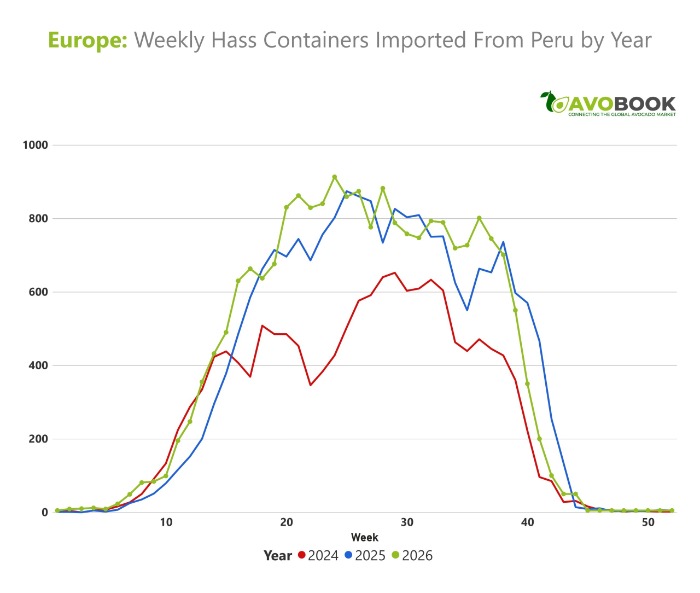
Peru's reduction becomes particularly relevant from week 39 onward. According to Avobook data, volume would fall from 701 to 550 containers, a decrease of approximately 22% from the previous week, before dropping further to 350 containers in week 40.
The year-on-year comparison also reveals differences in the pace of the decline. Compared with 2024, Peru is maintaining considerably higher volumes throughout September 2026. Compared with 2025, the country begins the month above the previous season, but projections place it below last year's levels in weeks 39 and 40. The sharp decline seen in 2025 occurred later, around weeks 43 and 44.
Ruete expects the decline to become clearly visible in shipments during weeks 38 and 39, although he cautions that there is still uncertainty regarding the exact timing of the turning point. September is typically a transitional period for the Peruvian campaign, with arrivals into Rotterdam potentially extending to approximately weeks 40 or 41.
Against this backdrop, he identifies one variable that remains difficult to determine: how much late-season fruit is actually still available for harvest in Peru. Rather than assuming an abrupt decline too early, he therefore proposes monitoring the actual evolution of shipments and the remaining fruit over the coming weeks.
Chile Accelerates Its Entry Into Europe
Chile's growth represents the other side of the overlap. For Ruete, exceeding 100 containers per week to Europe by the end of September is a reasonable scenario, and shipments could even approach 120–150 containers if European prices justify it.
However, the specialist qualifies the assumption that Chile will necessarily become the leading supplier throughout October. His base-case scenario points to Chile becoming one of the main Hass origins and possibly the leading supplier for a significant part of the month, particularly if Peru declines at the expected pace and Colombia remains behind schedule.
According to Ruete, the speed of this advance will depend on three factors: the pace of the Chilean harvest, prices available in alternative markets—including the domestic market and other destinations—and logistics.
Another factor becomes particularly relevant when interpreting the figures for the coming weeks: vessel delays while transiting the Panama Canal may alter the actual arrival dates of fruit originating from the west coast of South America.
Ruete therefore warns that it is necessary to distinguish between shipments leaving Chile and the fruit that will actually be available in Europe several weeks later.
Colombia Could Determine the Balance of the Overlap
Victor Ruete's base-case scenario has Peru supplying between 600 and 730 containers per week toward the end of September, compared with 50–80 from Chile and 20–35 from Colombia. By early October, Peru would decline to 300–400 containers, while Chile would increase to 150–250 and Colombia to 40–70.
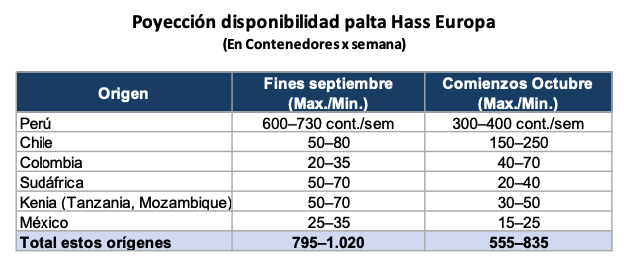
For Ruete, Colombian supply falling below projections represents “the market's main upside risk.”
“Chile can replace part of Peru's volume, but it will hardly be able to replace the entire decline on its own.”
If Colombia increases its presence more slowly than expected, Ruete believes Europe could shift from a well-supplied market to a tighter one. The impact could first become apparent in certain sizes and subsequently spread to the spot market and program prices, further widening differences between origins and quality levels.
In a more extreme scenario, he warns, the challenge could shift from price to the physical availability required to fulfill programs. However, there is also a commercial limit: excessive increases in consumer prices could reduce supermarket promotions and slow demand, particularly in European markets that are more price-sensitive.
Chile and Colombia Will Need to Complement Supply
Charles Auberge, Commercial Director at Soly Import, also expects Peru's decline to become clearly visible between weeks 39 and 40 and believes the reduction will not necessarily be linear.
Auberge agrees that Chile is entering a phase of strong growth and could become Europe's leading supplier during October. However, he also identifies Colombia as a necessary piece of the supply equation:
“October could see Chile as Europe's leading supplier, but it will not be able to replace all of Peru's volume on its own: Colombia will be necessary to complete the supply.”
If Colombia falls short of expectations, Auberge anticipates lower availability and greater price pressure, particularly for certain sizes. This could reduce promotional activity and, if the pressure persists, moderate consumption, although he clarifies that the scenario would not necessarily imply a general shortage of Hass avocados.
His assessment therefore aligns with the risk identified by Ruete, although from a commercial perspective of the European market.
The Transition Will Be Shared Among Several Origins
None of the other suppliers appears to have the capacity, on its own, to fill the space left by Peru.
Ruete considers Mexico to have the greatest theoretical capacity to react, although the United States continues to absorb a large share of its production, meaning Europe must compete with that market. He also points to the limitations posed by long transit times and quality variability when it comes to shipping large volumes by sea.
South Africa could partially extend its season through late varieties such as Lamb Hass, while Kenya and Tanzania could complement supply, although with risks associated with transit times and fruit condition.
Other suppliers will begin entering the market later. Ruete expects the first Israeli Hass shipments approximately at the beginning of October, while Morocco could contribute toward the end of the month, and Spain would begin with Bacon from October, ahead of a more significant Hass presence expected in November.
Auberge also identifies Kenya and Tanzania as important sources of support during the transition and places Israel's entry from week 42 and Morocco's from approximately week 44, although he notes that part of Morocco's volume has already been committed.
For Ruete, this diversification summarizes the structure of European supply during the overlap:
“The solution to the potential gap will not be a new ‘Peru,’ but rather the sum of Chile + Colombia + Mexico + remaining African supplies + Israel + Morocco.”
Europe's transition will therefore depend less on the ability of a single country to replace Peru and more on how quickly multiple origins can overlap during the coming weeks. Chile stands out as the supplier accelerating most strongly, but the evolution of Colombia, remaining African supplies and the subsequent arrival of other origins will determine whether this substitution is sufficient to keep the market supplied as the season changes.