Adilson Luis Penariol
Brazil's outlook after a record Hass avocado harvest
Brazil
November 3, 2026
In 2026, Brazil obtained its largest Hass avocado harvest ever, with a volume approaching 65,000 tons, more than double the just over 30,000 tons produced in 2025. This leap was made possible by the incorporation of new cultivation areas and favorable climatic conditions for flowering, fruit set, and fruit development, after several seasons of weather limiting production in different regions.
However, this magnitude of harvest also brought a challenge for the industry. In some areas, the volume of fruit yet to be picked led us to bring forward the harvest to mid-February, at the risk of the fruit not reaching the desired dry matter level.
This experience offers an important lesson for future campaigns: extending the marketing window is only valuable if we can offer fruit in good condition throughout the entire period.
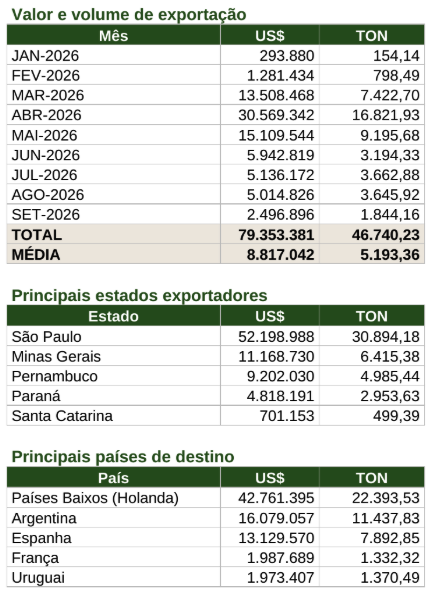
Through September 2026, Brazil exported 46,740 tons of avocados, valued at US$79.3 million. The highest volume was recorded in April, reaching approximately 16,822 tons. This year's result already significantly exceeds the annual average of previous seasons, which was around 25,000 tons.
An uneven set for 2027
At this stage of the production cycle, the situation varies considerably between producing regions. While fruit set is more advanced in warm areas, the process is slower in high-altitude, colder areas.
In the southeast, where more than 90% of Brazilian production is concentrated, abundant winter rains, strong winds and less available light affected the conditions in which the new campaign began.
In some orchards, the trees still held avocados from the previous harvest when the next one was just beginning to set. Harvesting had been delayed while waiting for better prices or space in the packing plants. This situation contributed, in some cases, to losses in fruit set.
While it's still too early to estimate the final volume for the 2027 season, a second flowering with good fruit set could help recover productivity. My impression, based on what we're currently seeing in the fields, is that the harvest could approach 40,000 tons, but everything will depend on how the fruit develops in the coming months.
More surface area and a larger window
It is estimated that Brazil already has some 11,000 hectares dedicated to Hass avocados, with more than 1,000 hectares being added each year. Producers who have been working with this variety for years have been joined by farmers from the citrus, coffee, and grain industries, as well as companies and investors. If this interest continues, the sector could reach nearly 15,000 hectares in the coming years.
The diversity of producing regions has also altered our calendar. Previously, the harvest was concentrated between April and June. Today, some areas begin in the second half of February, while the higher, cooler regions can extend the harvest into September or October. For European buyers, this opens up the possibility of having Brazilian fruit available for a longer period, provided we maintain the quality they expect.
Europe remains our primary market, and Argentina has been steadily growing as our second largest destination, thanks to its proximity and logistical advantages. We will begin shipments to Chile in 2026, and I see room for gradual growth as Brazilian fruit demonstrates its ability to meet the demands of that market.
Destinations like India and Japan are also on our radar, although they present logistical challenges. Opening access to the United States remains an aspiration for Brazil.
Growth can also come from home
In terms of the domestic market, avocado consumption is common, but primarily of tropical varieties and in sweet preparations. The Hass variety has a more limited presence, mainly in large cities in the south and southeast, where it is consumed with toast, in salads, and prepared as guacamole.
This year, approximately 13,000 tons of Hass avocados were offered to the domestic market. The availability and lower prices allowed regular customers to increase their consumption and others to try them for the first time. Even so, the average consumption of Hass avocados is 60 grams per person per year.
Another 5,000 tons were allocated to the production of avocado oil, an industry that is also growing.
By ensuring affordable prices, a consistent supply, and distribution in more regions, I see potential to double or even triple domestic sales. As the new plantations come into production, developing the Brazilian market will be just as important as opening international markets.
The 2026 harvest showed us how much Brazil can produce in a favorable season. The challenge now is finding buyers for that fruit and giving them reasons to choose it again.
Adilson Luis Penariol
Partner/Director AvoPrime Ftutas SA
adilson.luis@avoprime.com.br