Peru, Spain and Israel lead shipments
European avocado market: prices, imports and trends
Record in Europe: 21,500 containers of avocados enter in 23 weeks, putting downward pressure on large sizes and upward pressure on small sizes.
The European avocado market continues to show signs of expansion this year. However, the sustained increase in import volumes is also creating new challenges for the industry, particularly regarding pricing and the balance between global supply and demand.
According to data analysts at Avobook, during the first 23 weeks of the year, Europe received more than 21,500 containers of fruit, far exceeding the approximately 18,500 recorded during the same period in 2025. The difference equates to more than 3,000 additional shipments, maintaining a growth trend observed since the previous season.
The European market consolidates its position as the main destination for global avocado exports during the 2026 season.
Avocado imports increase in Europe
This trend aligns with the view of David Reynau, Sales Account Manager at Everest Fresh BV , who points out that the total volume imported during the first half of 2026 shows an increase of nearly 15% compared to the same period in 2025. Considering that last year Europe had already exceeded one and a half million tons imported, the growth is particularly significant.
The increased supply has not gone unnoticed by industry operators. At various points during the season, the high availability of fruit has led to temporary saturation, forcing price adjustments to facilitate rapid product turnover.
According to Reynau, this situation has been particularly noticeable with large avocados, whose abundance during May led to a gradual decrease in prices on the European avocado market . Medium-sized avocados also saw price adjustments, although to a lesser extent. In contrast, small avocados behaved differently due to more limited availability at ports, which drove their prices upward.
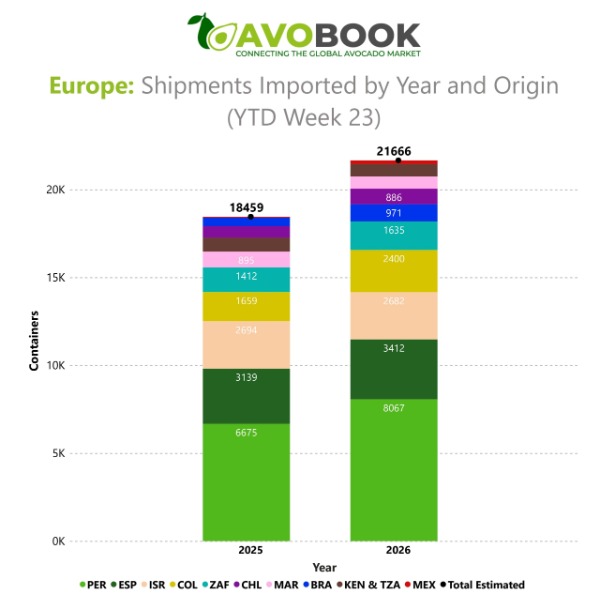
Evolution of total accumulated volume and distribution by origin in the European market (YTD Week 23, 2025 vs 2026)
Peru, Spain, and Israel continue to dominate in Europe.
Prices observed during May 2026 were slightly lower than those recorded in May 2025. Although European consumption continues to grow, the increase in retail demand is still not fully absorbing the sharp rise in available volumes.
The data analyzed shows that Peru, Spain and Israel continue to be the main suppliers of avocados for the continent, a situation that Reynau also highlights when analyzing the behavior of the markets of origin.
Peru continues to hold a dominant position , controlling nearly 60% of the European avocado market share for much of the season. Other significant exporters include Spain, Israel, Colombia, South Africa, Chile, Morocco, Brazil, Kenya, Tanzania, and Mexico.
Comparing shipments between January and May 2026 with the same period in 2025, most countries saw increases in their exports. The main exceptions were Morocco and Kenya, whose volumes decreased due to weather conditions, while Israel maintained figures similar to the previous year.
From a data perspective, some of the largest relative increases were observed in Brazil, which practically doubled its shipments compared to 2025, and Mexico, which even more than doubled the volume exported during the same period, although it still represents a smaller share within the continent.
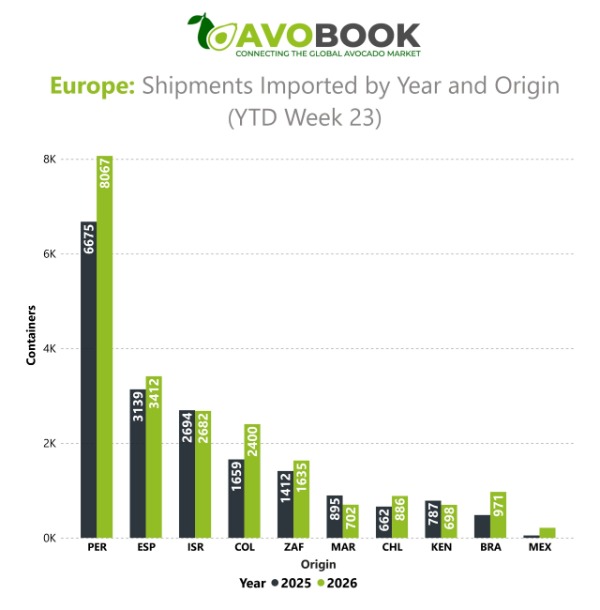
Comparison of avocado container imports to Europe by supplier country in week 23 (2025 vs 2026).
How does record avocado shipments impact prices in Europe?
The European avocado market is experiencing record growth in 2026, exceeding 21,500 containers imported in just 23 weeks. This increased supply is putting downward pressure on prices for larger sizes, while smaller sizes are trading higher due to limited availability.
The growth in imports is partly due to continued strengthening demand in various markets across Europe. France remains the leading consumer of avocados in Europe, with consumption exceeding two kilograms per person per year. Germany and Spain follow, two markets that have also shown some of the most significant increases in consumption in recent years.
Italy is also showing positive growth. Although its per capita consumption remains below one kilogram per year, the Italian market continues to expand and offers excellent medium-term growth opportunities for exporters. This trend is encouraging for the sector, as it confirms that fruit continues to gain ground in everyday eating habits.
Projections for the second half of the year indicate that the growth trend will continue. Both market data and expert opinions agree that the eurozone will end 2026 with a higher import volume than that recorded in 2025.
Reynau anticipates that price pressure could persist throughout July and August due to the high availability of fruit in cold storage. Regarding origins, Peru will continue to lead supplies until the end of August, at which point Chile will begin to play a more prominent role. Subsequently, Colombia, Israel, Morocco, and Spain will assume a more significant part in the supply.