International market
Europe deepens decline in large calibers since week 16
The 2026 season has shown narrower price differences between sizes compared to previous years. However, Europe is beginning to show increased pressure on larger sizes, while the United States maintains a more balanced pricing structure.
The 2026 international avocado market season has shown a different dynamic than that observed in previous years. For much of the season, the price difference between sizes remained considerably narrower in both Europe and the United States, even in weeks marked by a sharp increase in supply.
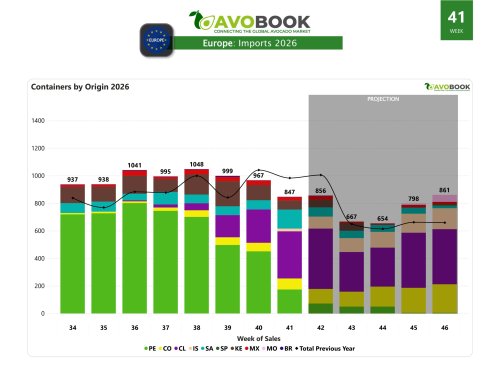
According to Avobook's data team analysis, at the start of the European season, size differences fluctuated only between USD 0.30 and USD 0.50/kg, reflecting a much more aligned market across sizes. However, this trend began to change in weeks 15 and 16, coinciding with the sharp increase in Peruvian exports to Europe.
Since then, the pressure has focused particularly on larger sizes. Currently, size #12 is trading in the range of USD 2.8-3.0/kg, while medium sizes like #16 and #18 continue to move between USD 3.4 and USD 4.0/kg in Rotterdam. This has created price gaps of more than USD 0.70/kg between sizes, something that was not clearly visible until a few weeks ago.
Avobook's data team explains that sizes #12 and #14 are currently the most affected by the increased Peruvian supply, registering the steepest declines in recent weeks. At the same time, smaller sizes are also beginning to show pressure due to the greater influx of fruit from Colombia, South Africa, Kenya, and Brazil.
Despite this, medium sizes continue to show greater commercial stability. Sizes #16 and #18 remain the most resilient to increased shipments, maintaining relatively solid price levels within the European market and consolidating their position as the most in-demand formats for supermarkets and retailers.
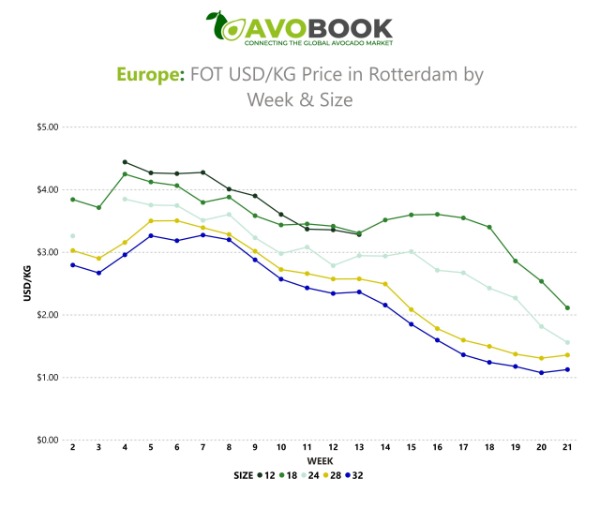
Europe is starting to differentiate sizes more.
Although the separation between sizes is becoming more visible in Europe, the season continues to show less price dispersion compared to previous years. The market remains highly concentrated around medium sizes, especially sizes #48 and #60, which are equivalent to international trade standards.
Europe appears to be moving towards a more dynamic pricing strategy based on availability and seasonal promotions. During the Peruvian window—between May and September—there is a high availability of larger sizes at lower prices, creating promotional opportunities for European supermarkets. Subsequently, when the Peruvian supply decreases, these sizes tend to quickly recover their value.
European consumption patterns also reflect a much more fragmented structure. The UK maintains a greater preference for medium sizes, Italy has a stronger demand for large sizes, and Spain exhibits a more varied consumption pattern. This diversity means that changes in supply have different impacts depending on the size and the country.
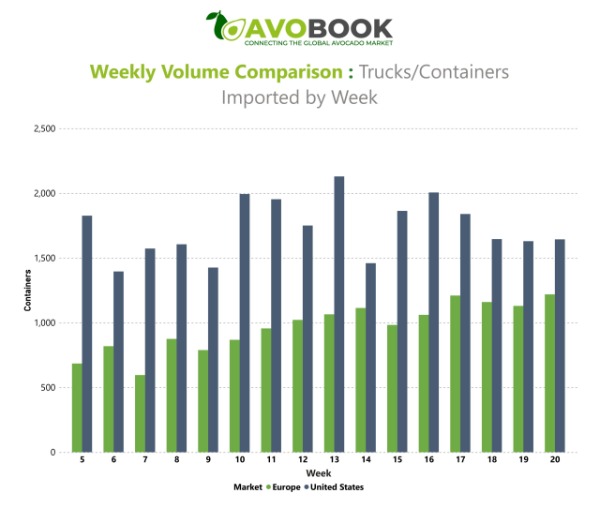
The United States maintains a more balanced curve
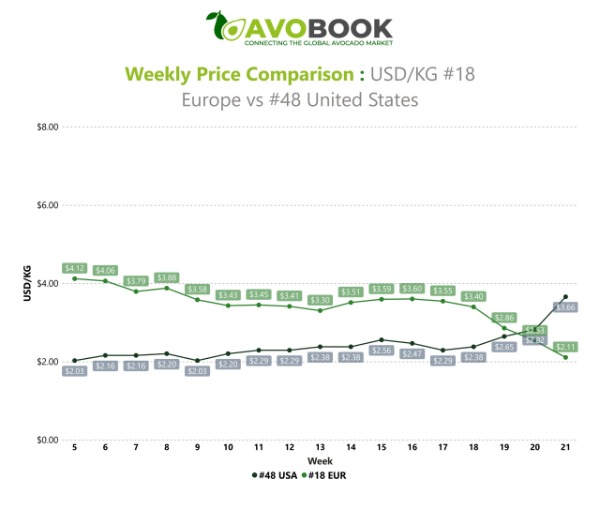
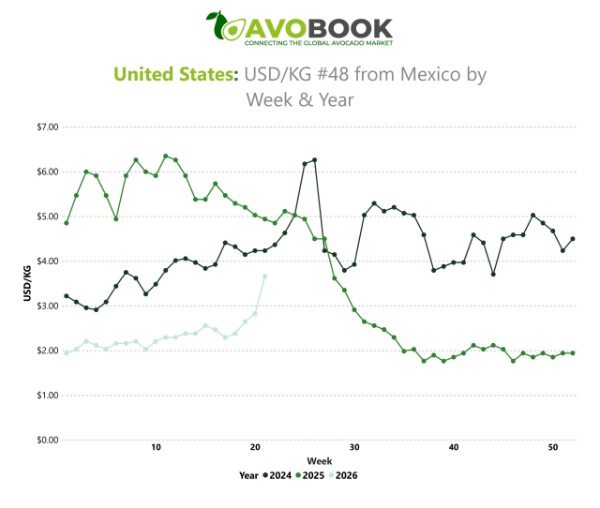
In contrast, the United States continues to show a more homogeneous price curve across sizes. Although Europe maintained higher prices for much of the season, the US market has seen a significant recovery in recent weeks.
In week 18, for example, the European #18 size reached approximately USD 3.40/kg, while the #48 size in the United States was around USD 2.38/kg. However, by week 21, the North American market showed a significant recovery: the #48 size reached USD 3.66/kg, clearly surpassing the European #18 size, which remained close to USD 2.11/kg.
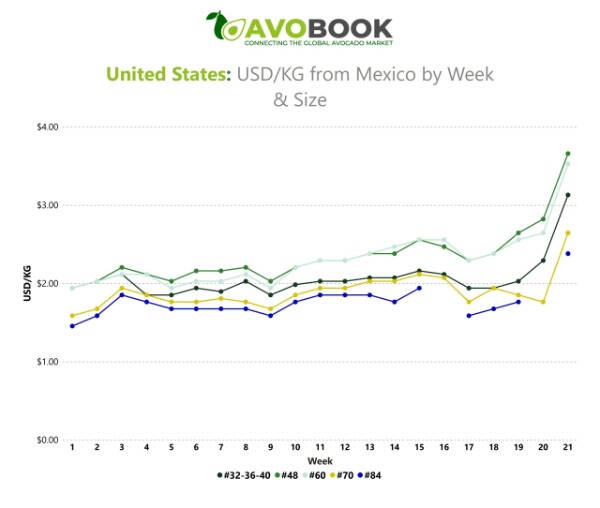
According to Avobook's analysis, smaller sizes continue to command better relative prices in the United States. Sizes #48 and #60 have remained fairly aligned, trading between USD 3.5 and USD 4.1/kg for the past few weeks, reflecting stable demand from supermarkets and retail chains.
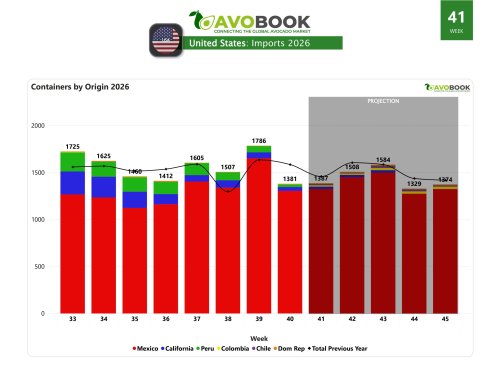
Unlike Europe, where the simultaneous arrival of multiple origins leads to more abrupt price fluctuations between sizes, the United States maintains a much more stable and organized supply structure, primarily based in Mexico. This allows for less price dispersion between sizes and more consistent market behavior for much of the season.