Avocado in China, Japan and South Korea: a market where suppliers are reorganizing
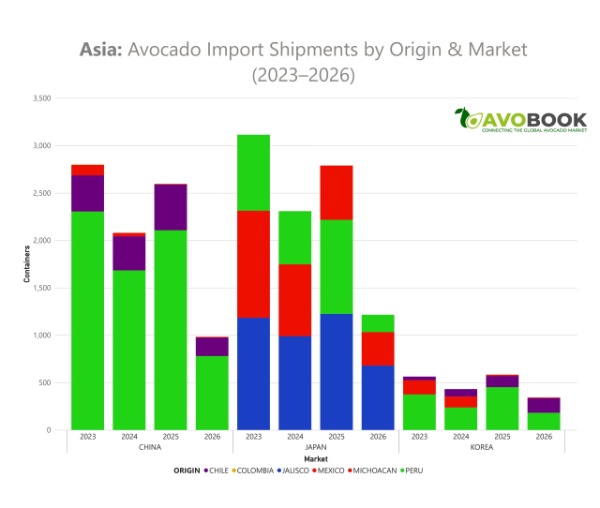
While Peru maintains a strong hold in China, Japan is experiencing a structural change with Jalisco's rise over Michoacán, and Chile continues to gain ground in South Korea in a season marked by strong variations in avocado arrivals and a growing redistribution among suppliers.
For years, Asia was viewed by the avocado industry as a slow-growing market, with consumers still learning and logistics far more complex than those in Europe or the United States. And it is. But the 2026 season is beginning to reveal a different reality: the continent has transformed into a space where the main producing countries are seeking to consolidate their long-term positions.
The word that best describes this scenario is "reorganization." This is the conclusion drawn from the explanation of Tomás de la Cuadra, market analyst at Avobook, who warns that this year's performance should be analyzed with caution, considering that it corresponds to the first few weeks of the year.
“The Asian avocado market is entering 2026 with a different scenario than in previous seasons. Japan, China, and South Korea show redistribution trends among origins that are worth reading carefully, although it should be noted that the 2026 data only corresponds to the initial part of the season, up to week 21,” he explains.
China deepens its dominance of Peru's avocado market
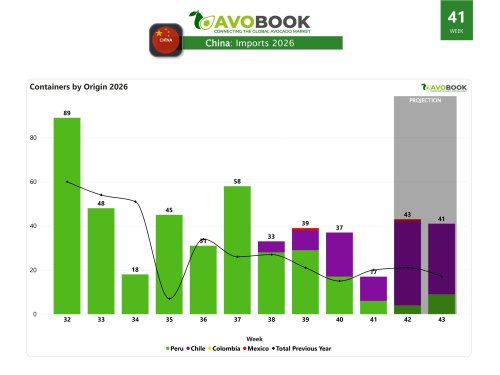
In China, the competition seems to have fewer and fewer players. Peru continues to consolidate its position as the dominant origin, and according to data observed at the start of the season, no other country appears close to seriously challenging that position.
“In China, the dominance of Peruvian avocados is the clearest of the three main Asian markets. It has remained consistent throughout the entire period analyzed. Chile appears as the only other relevant player, while Mexico has a practically marginal share, and Colombia and Kenya no longer register a presence in the most recent records,” reveals the Avobook analyst.
What is striking is that, with less than half of the season completed, Peruvian volumes already show a significant base, "although it will be necessary to wait until the end of the year to compare with previous full seasons."
Avocado in Japan: Jalisco displaces Michoacán
While China exhibits concentration, Japan displays the exact opposite: a permanent diversity of origins.
Historically, that market has seen avocados arrive from Mexico and Peru. But within that competition, a silent phenomenon began to occur that is now clearly reflected in Avobook's numbers: Jalisco began to displace Michoacán as the main Mexican origin in a process that has been underway for 3 years.
“Japan is the largest and most competitive market for avocados in Asia. One of the most significant changes during this period is the sustained rise of Jalisco over Michoacán, which has been consistently losing market share since 2023. By 2026, Jalisco is already positioned as the leading Mexican source for this market, suggesting a structural shift within the Mexican supply that will likely continue,” analyzes Tomás de la Cuadra.
The transformation is especially relevant because Japan is considered one of the most sophisticated and demanding markets in Asia, both in terms of quality and stability of supply.
Chile is quietly making progress in South Korea.
South Korea is the smallest of the three Asian markets analyzed. There, the most striking phenomenon comes not from Peru or Mexico, but from Chile.
Avobook's data shows that Chile went from an almost marginal presence in 2023 to steadily gaining market share each year.
“While Mexico has practically disappeared as a relevant supplier, Peru remains the main source, but the gap with Chile has been narrowing season after season,” explains the Avobook analyst.
Chilean growth also reflects a strategy increasingly focused on premium niches and markets where competition is nowhere near the saturation levels seen in the United States or Europe.
Avocado in Asia between 2023 and 2026
Beyond the specific changes in each country, Asia is beginning to show a common trend: competition is reorganizing. This is illustrated in the chart, which shows the figures for that restructuring, observed up to week 22.