Technology to care for trees
Sensors and AI transform avocado management
AI processes sensor data in orchards to predict situations of water stress, nutritional stress or diseases weeks before they become visible.
For years, much of agricultural management has been based on reacting only when problems are already visible. This approach contrasts sharply with current trends in precision agriculture, where early detection and prevention are playing an increasingly important role.
New Agtech technologies are opening the door to a much more proactive approach, capable of detecting signals in trees even weeks before obvious symptoms appear in the orchard.
According to Renzo Canepa, from Agro Canepa SpA , there are currently various precision agriculture tools that allow monitoring the physiological state of plants and anticipating problems related to irrigation, nutrition and even the development of phytosanitary diseases.
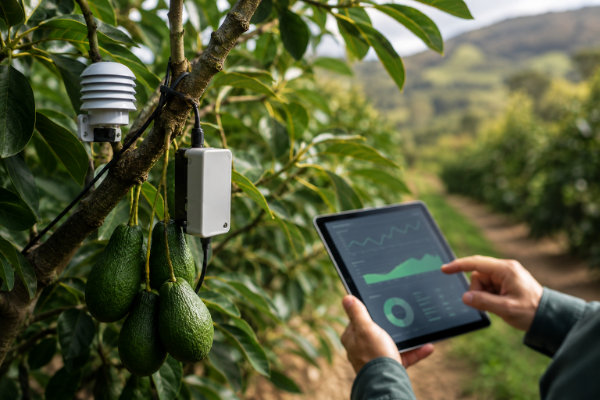
The use of sensors and artificial intelligence can help anticipate water and nutritional stress before the signal tree becomes visible.
Sensors and dendrometers: Anticipating water stress.
One of the most innovative alternatives involves analyzing the behavior of growing fruit. Using instruments such as continuous measurement dendrometers, it is possible to identify problems associated with water stress early on and, indirectly, aspects related to nutrition or pruning practices.
Added to this is the constant monitoring of pests and diseases, a factor that, in the specialist's opinion, usually receives less attention than it deserves in the field.
"Pests and diseases are one of the biggest indicators of problems with photosynthesis, nutrition and irrigation," Canepa points out, noting that these organisms often act as true biological indicators of the overall condition of the crop.
Another key source of information is found in the plants' own sap. Through analyses carried out in specialized laboratories, it is possible to predict potential nutritional deficiencies or problems related to water supply up to two weeks in advance.
Tools such as refractometers also provide valuable information by indirectly measuring the concentration of mineral salts and sugars present in the sap. Similarly, devices known as "olive gauges" can be used to assess the presence of certain minerals critical to orchard performance.
How can artificial intelligence help in avocado management?
The ability of these technologies to optimize avocado management depends largely on the quality of the samples obtained and the correct interpretation of the results. In this regard, Canepa emphasizes that no single tool works in isolation. Accuracy increases when information from different sources is analyzed holistically, allowing for a broader view of what is happening in the crop.
Artificial intelligence optimizes avocado management by processing large volumes of data from multiple sensors in the orchard. This allows growers to predict water stress, nutritional deficiencies, or diseases weeks before visible symptoms appear.
However, the specialist is emphatic in mentioning that the analyses generated by artificial intelligence depend on human judgment to interpret the signals that the trees may give.
Low-cost Agtech: easy-to-acquire technology.
One of the most attractive aspects of these innovations is that some of them can be implemented with relatively low investments. Instruments such as refractometers or certain mineral measurement devices are affordable for medium and even small producers looking to improve avocado management. However, Canepa emphasizes that the real challenge lies not only in acquiring the technology, but in using it correctly.
Sampling, selection of appropriate plant material, and interpretation of results are factors that can significantly impact the quality of the information obtained. Therefore, training remains essential to harnessing the full potential of these tools.
Faced with growing challenges such as water scarcity, rising production costs, and the need to maintain orchard productivity, the specialist believes that these technologies have the potential to generate a major impact on agriculture in the coming years.
The future of precision agriculture: Prevention rather than reaction.
However, he insists that its implementation must be accompanied by technical expertise and local knowledge. Factors such as soil type, water quality, sun exposure, and the specific characteristics of each property remain crucial for making sound decisions.
As monitoring systems become more accessible and artificial intelligence improves its analytical capabilities, the industry seems to be moving toward a model where early detection and prevention are gaining ground over reaction. In this scenario, trees could indeed begin to show signs long before they become diseased.