Agricultural innovation
Baika Colombia is committed to assisted pollination in 450 hectares
The company, together with Biopollen, implemented a pollen application program in its fields in Colombia to improve fruit set and increase the productivity of the Hass avocado crop.
In 2016, Baika Colombia launched an assisted pollination program in partnership with Biopollen, a pollination technology company affiliated with San José Farms, to increase fruit set and improve the productivity of its Hass avocado orchards in Colombia. The strategy involves applying pollen to 450 hectares across the company's various properties.
Ricardo Botero, Production Manager at Baika Colombia, explained that the implementation of this technology responds to the need to continue seeking tools that will increase the yield of Colombian orchards. He indicated that, despite the progress achieved through the use of pollinators and beekeeping, the country has not yet reached the expected levels of productivity.
The agreement, signed in January 2026, covers both technology transfer and access to high-quality pollen for direct application to the crop. The company emphasizes that Biopollen already has successful experience in various countries, which spurred the joint development of this program in Colombia.
Training, monitoring and adaptation in the field
Implementing the system involved significant technical work in Baika Colombia's fields. One of the main challenges was identifying the flowers at the optimal time for extracting quality pollen and applying it at the right moment.
To achieve this, Biopollen teams worked directly with Baika Colombia staff on training, monitoring, and process verification. The company explained that they developed new internal skills related to recognizing the female flower and understanding that flower opening does not always occur at fixed times, but rather depends on climatic and physiological variables.
In total, between 25 and 30 people participated in the implementation and monitoring of the program in the various fields. Furthermore, this season's weather conditions added complexity to the process due to the rain and low solar radiation recorded during flowering.
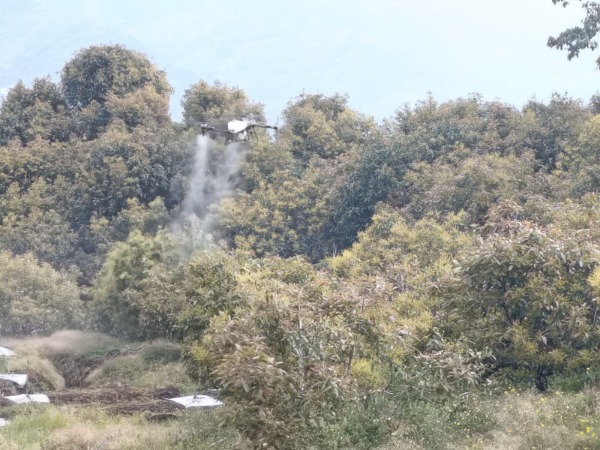
Work began on January 24th in Genoa, the field that took over pollen production and preservation, as well as inventory control. Subsequently, workers from Salamina were trained on the same site to replicate the system in other company fields.
The application schedule was determined by the natural flowering cycle. Fields at lower altitudes flowered first and were treated before those at mid and high altitudes. The strategy involved three applications per plot, spaced approximately one week apart, aiming to reach as many female flowers as possible.
Baika Colombia also had to adapt refrigeration systems to maintain the pollen's cold chain and preserve its viability throughout the process.
Drones and manual applications for measuring results
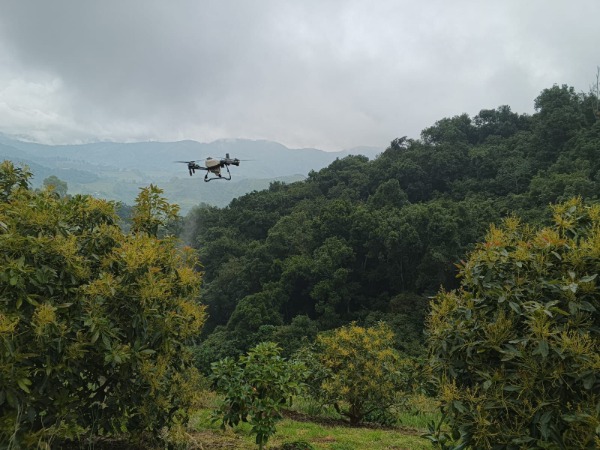
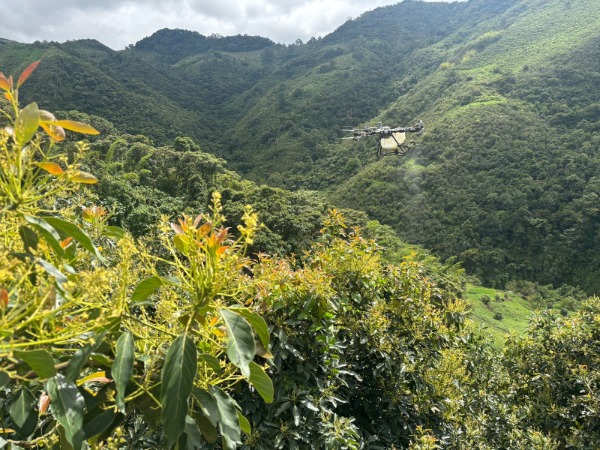
Currently, the company is using both drones and backpack sprayers to apply pollen in the field. In the case of drones, applications are carried out following technical parameters defined by Biopollen, such as droplet size, flight altitude, speed, and level of wetting on the tree canopy.
For manual applications, operators were specifically trained in application distance and selection of nozzles suitable for handling pollen.
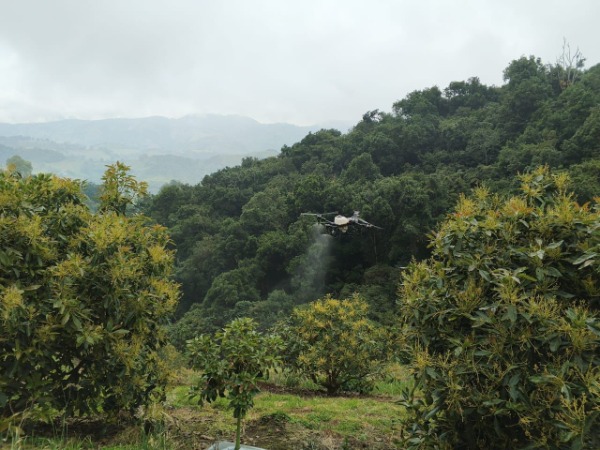
The use of both methods aims to compare which delivers better fruit set results. However, the company acknowledges that the use of drones offers significant advantages in Colombia due to the complex topography of many of its fields, allowing for faster and more efficient application.
So far, Baika Colombia has completed about 95% of the scheduled applications and has already begun to observe a great improvement in fruit set, especially in low and medium plots where more advanced development is occurring.