Market behavior
New signs of consumer spending in China
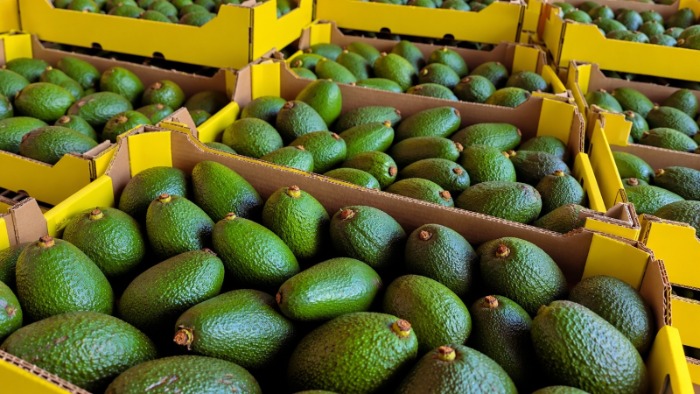
The Chinese market shows greater segmentation by size and format, driven by ready-to-eat avocados and large fruit.
September 25, 2026
The Chinese avocado market is beginning to show a more pronounced differentiation in terms of quality, size, and presentation. In this context, the increased acceptance of larger fruit and the expansion of ready-to-eat formats are emerging as potential opportunities for suppliers.
The signal was recently raised by Ben Ying, director of the Chinese market for Darling Group, a New Zealand company seeking to expand its presence in the country. As he explained to FreshPlaza, the company has observed greater acceptance of large avocados and a growing presence of ready-to-eat fruit during 2026.
Darling Group's assessment offers insights from a New Zealand supplier's experience. Avobook's data, meanwhile, places these observations within a market where results increasingly depend on fruit quality, size, presentation, and availability.
Size, quality, and availability redefine the market
The greater acceptance observed by Darling Group does not necessarily mean that all shipments of large fruit will perform better. Commercial response also depends on the quantity available, the quality, and the market's capacity to absorb each size.
The data from July illustrates this complexity. In his analysis of the Chinese market, André Vargas noted that premium fruit was scarce and managed to better defend its value, while 18/20 size fruit faced oversupply, slower turnover, and commercial pressure.
This behavior does not rule out greater acceptance of larger fruit. It does, however, demonstrate that such acceptance alone does not guarantee better results: when the availability of a particular size exceeds the market's absorption capacity, its value can decline even in an environment favorable to other sizes or qualities.
Rather than a confirmed shift towards larger sizes, the data shows a market that is beginning to segment. The outcome of each transaction increasingly depends on the combination of quality, size, format, and volume available upon arrival.
South American dominance: Peru accounts for nine out of ten containers
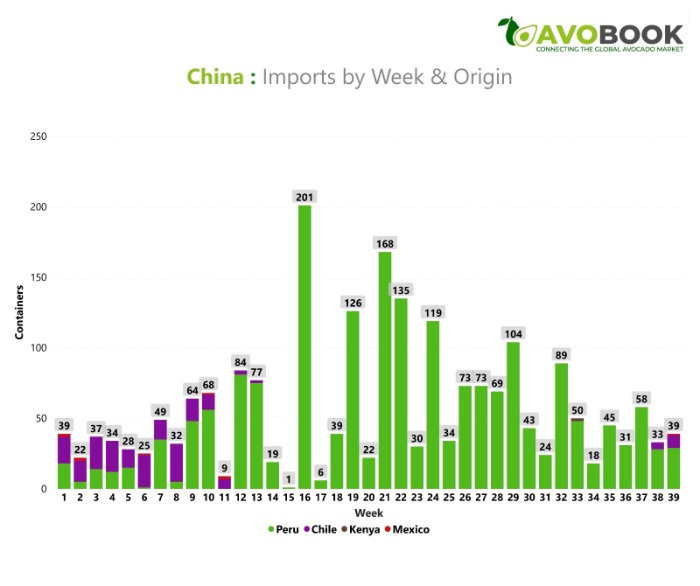
So far in 2016, Peru maintains a significant lead over Chinese avocado imports. According to Avobook records up to week 39, the country accounts for 1,997 containers out of a total of 2,217, representing approximately 90.1%.
Chile ranks second with 209 containers and a market share of approximately 9.4%, while Mexico registers nine and Kenya two. The composition of the supply changed throughout the year; Chile had a more visible presence in the first few weeks, but the increase in Peruvian shipments since the start of their season ultimately concentrated the market on that origin.
Price evolution: Value peaks driven by volatility and scarcity
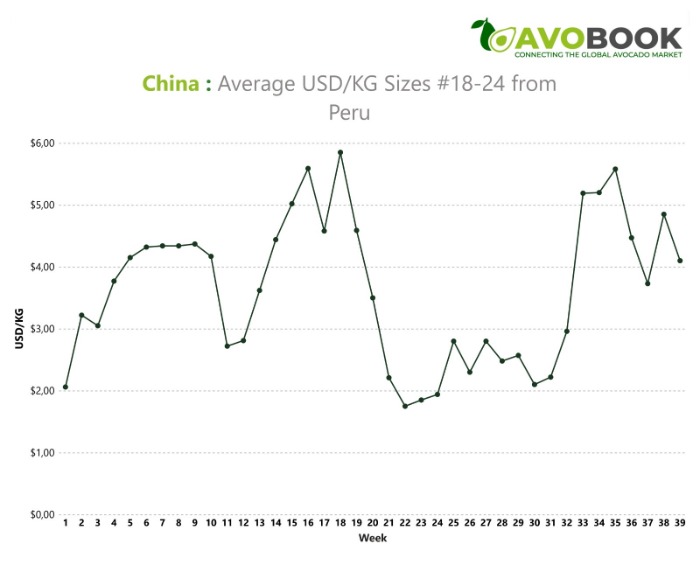
The price trends for Peruvian 18–24 gauge avocados reflect the volatility that has characterized the season. The average price started near US$2.06 per kilogram in week 1 and reached approximately US$5.85 in week 18. Four weeks later, it fell to around US$1.75.
From that low, prices began a new recovery and exceeded US$5 per kilogram between weeks 33 and 35. Subsequently, they corrected again and closed week 39 at around US$4.10 per kilogram.
André Vargas 's analysis of the Chinese market's behavior in August reveals what led to this recovery. During the first weeks of the month, available inventories fell to minimal levels, with 4 kg boxes reaching prices of up to RMB 140–150 and 10 kg presentations reaching RMB 300. In week 33, the high prices coincided with rapid turnover and the depletion of a large portion of the inventory.
However, as prices continued to rise, the rate of sales began to slow. According to Vargas, this behavior showed that scarcity could drive up prices, but also that there was a point beyond which buyers began to resist. The recovery, therefore, was primarily due to reduced fruit availability and not necessarily to a structural expansion of demand.
This trend confirms that the analyzed sizes reached high values at different times of the year, but it does not in itself demonstrate a growing preference. The price also responds to availability, the timing of arrivals, inventory levels, and the condition of the fruit.
The "ready-to-eat" format as a gateway to new consumers
The expansion of ready-to-eat formats is a second sign mentioned by Darling Group. Its development could reduce one of the barriers facing avocados in China, namely the still limited knowledge about ripening and the optimal time for consumption.
Offering fruit in a predictable condition can facilitate the shopping experience and make the category more appealing to consumers less familiar with the product. From Darling Group's perspective, a greater availability of these options can help reduce the barriers associated with a lack of knowledge about ripening.
For now, the development of this format appears to be an opportunity identified through the company's commercial experience. Its evolution will be a key element to watch as Chinese retailers expand their offerings and strengthen their direct relationship with consumers.
Conclusion: A mature market that demands greater strategic precision
The signs for 2026 suggest that China is moving away from behaving as a market where simply analyzing total available volume is sufficient. Premium fruit can remain strong even while certain sizes face oversupply, and the same week can yield different results depending on the size, presentation, and condition of the product.
The increased acceptance of larger sizes and the rise of ready-to-eat formats are signs worth watching. Above all, because rather than confirming a definitive shift in consumption patterns, they show a market that is beginning to more precisely differentiate the quality, size, presentation, and condition of the fruit it receives.