Advances in supplies and technology
Sensors and AI to classify avocado maturity
A study explores a wearable device for classifying avocado ripeness. Advances and challenges of NIR and AI technology in fruit.
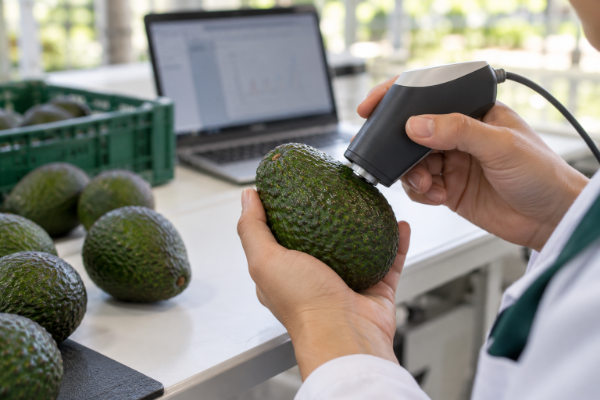
Image for reference only, does not represent the original device developed
October 16, 2026
How to evaluate an avocado without opening it? The research Ripeness Evaluation Using Near-Infrared (NIR) Spectroscopy and NLP for Interpretability , published in January 2026 in ECTI Transactions on Computer and Information Technology, explored that possibility using a low-cost portable scanner and machine learning.
The team conducting the study, comprised of researchers from institutions in Thailand and Japan, worked with 120 kilograms of Buccaneer avocados from the Royal Project in Thailand. They compared three models for classifying ripening stages based on the signals captured by the device.
Light as a source of information: How does NIR technology work?
Near-infrared spectroscopy, known as NIR, takes advantage of the interaction of light with the components of a product. The recorded signal contains patterns that researchers analyze using models to estimate characteristics of the fruit.
Using this methodology, the team does not obtain a photograph of the avocado's interior nor directly observe all its attributes. The estimation depends on the relationships established between optical signals and reference measurements or classifications.
This is why sample selection and data processing are an essential part of the investigative method.
Algorithms and machine learning to predict maturity
In the experiment, the sensor recorded data in 18 bands between 410 and 940 nanometers, encompassing visible light and part of the near-infrared. The researchers processed the signals before training the models.
According to the study, Random Forest achieved the best result, with 78% correct classifications, followed by XGBoost, with 74%. The system also incorporated descriptions in understandable language, with the aim of presenting results to the user.
However, this device remains a prototype. The researchers identified confusion between categories and calibration needs. They also acknowledge that working with a single variety and seasonal data limits generalizability. Therefore, the results cannot be automatically applied to Hass avocados.
Implications and validation for the Hass avocado industry
Studies like this one aim to obtain information while preserving the integrity of the fruit. To evaluate tools like the scanner presented, the practical questions are what attributes it can estimate, with what margin of error, and under what conditions it was validated.
Current evidence suggests looking beyond the device itself. Its usefulness also depends on calibration and ensuring that the samples are representative of the fruit being analyzed. This trial provides a concrete exploration, while previous studies with Hass avocados demonstrate why each application requires its own validation.