Orchard management
Keys to pruning in avocado orchards according to the climate
Gonzalo Vargas analyzes how, in the face of rain, heat waves, or water scarcity, pruning and wood renewal are key to the health and size of the tree.
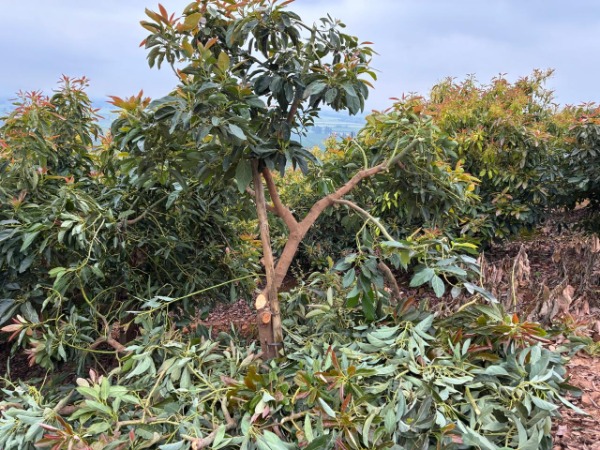 Gonzalo Vargas analyzes how pruning and wood renewal are key to tree health and fruit size
when facing rainfall, heatwaves or water scarcity.
November 25, 2026
When forecasts call for heavy rainfall or a heatwave, part of the preparation in avocado orchards has already taken place. According to Gonzalo Vargas, an agricultural engineer at Allpabio and an independent advisor, a tree’s ability to withstand these events depends on its year-round management. He places particular emphasis on the amount of light reaching the inside of the canopy, how much old wood has been renewed and how much foliage the tree needs to sustain.
In an interview with Avobook, the expert highlights the importance of pruning in maintaining a healthy orchard and explains how priorities change depending on the climatic conditions. He also points to a common mistake he has observed around the world: leaving long periods between pruning cycles.
What should growers look at before deciding where to prune?
“If there is no light, there is no flowering. If there is no flowering, there is no fruit. Where there is light, there is fruit,” says Gonzalo Vargas.
The agricultural engineer recommends assessing how much light reaches the center of the canopy and the lower branches. He warns that when avocado trees are allowed to grow for several years between pruning cycles, these areas become shaded and fruit production becomes concentrated in the upper part of the tree, increasing harvesting costs. This is why part of his approach involves opening up the canopy and renewing old wood as part of regular orchard management.
What should pruning aim to achieve in areas with frequent rainfall?
In these conditions, Gonzalo Vargas recommends opening up the canopy and removing old wood to improve light penetration, focusing particularly on dense, shaded orchards, especially in humid and coastal areas. During spring rainfall, foliage remains wet for longer, increasing the risk of problems such as anthracnose, which can affect avocado fruit quality upon arrival at its destination market.
“When foliage remains wet, the presence of the fungus will be greater,” he says, referring to the risk of anthracnose and warning that rots can compromise avocado quality upon arrival at destination markets.
If water accumulates in low-lying or clay-heavy areas, Vargas emphasizes the importance of drainage. In these locations, the main risk he identifies is root suffocation caused by waterlogged soil.
What changes when an orchard faces high temperatures and limited water availability?
When water access is limited, his recommendation is to adjust canopy size and remove some of the plant material responsible for transpiration. The aim is to retain the necessary foliage while maintaining an open canopy, he explains. He also highlights the benefits of chipping pruning material and using it as ground cover, a technique that reduces evaporation and protects surface roots from excessive heat.
Vargas emphasizes that pruning is part of an overall management strategy that also includes irrigation and fertilization. He warns, for example, that excessive nitrogen promotes softer, more tender tissues which, in his experience, dehydrate more quickly during heatwaves.
He also links heat and water stress to the appearance of symptoms associated with what is commonly known as wood fungus. “The branch dries out rapidly and starts producing smaller fruit sizes,” he explains.
The problem can also affect fruit quality. As Vargas describes it, “The fungus present in the wood becomes active in hot weather, reaches the small branches and moves down through the pedicel, the structure that supports the fruit.” The agronomist links this progression to rot problems that can become evident upon arrival at destination markets.
What does Vargas recommend when dealing with wind and frost?
In the face of strong winds, Vargas highlights wood renewal and good light penetration throughout the canopy as important measures to incorporate into regular orchard management. Regarding frost, he warns that excessive nitrogen promotes softer tissues that are more susceptible to cold damage. This is why he stresses the importance of allowing avocado tree tissues to mature during autumn.
What changes in an orchard exposed to coastal winds?
Vargas observes that along the Chilean coast, cold temperatures and wind make fruit set more difficult. In the inland valleys, by contrast, he identifies greater light availability and increased pollinator activity. In this context, he highlights the contribution of biodiversity to orchards experiencing fruit set difficulties.
How much should growers prune, and what should they aim for in the following harvest?
Vargas recommends pruning on an annual basis. The objective is to maintain continuous renewal of productive wood while ensuring that light reaches the center of the canopy and lower branches. When trees grow without this type of management, problems arise, such as fruit production shifting toward the upper parts of the tree, he explains.
For the following season, there is a direct link between wood replacement and the renewal of branches that will support future flowering. Based on Gonzalo Vargas's experience, working with younger wood helps improve fruit size. However, the effect of pruning on the next harvest also depends on how much potentially productive wood is removed, a factor that should be carefully assessed before recommending pruning intensity.
What mistakes should growers avoid?
“In many orchards, they either don't prune, prune too little, or only prune every two or three years,” says Vargas.
He also warns against trying to compensate for an aging, shaded canopy by applying more water or fertilizer. In orchards with limited water availability, he recommends prioritizing pruning to adjust the amount of foliage the tree needs to sustain.
🥑 Was this news article useful to you?
Follow us on Instagram → @avobook.avocado
There, we share the most important developments in the global avocado market: industry news, figures and trends.
You can also follow us on LinkedIn or join our WhatsApp channel to receive key news as soon as it is published.