100th anniversary of the variety
One hundred years of Hass beef, from California to the world market
Planted in 1926 and patented in 1935, the Hass avocado went from being a discovery in California to representing almost nine out of every ten shipments of avocados in Europe.
 November 26, 2026
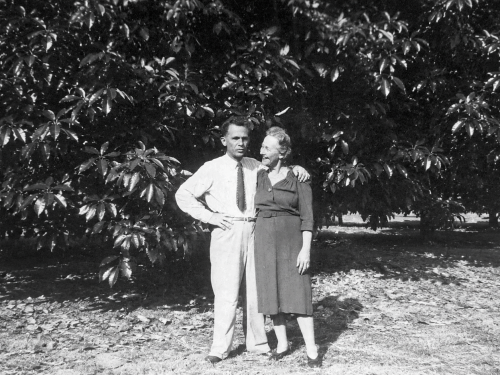
In 1926, American mail carrier and horticulturist Rudolph Hass planted an avocado tree in La Habra Heights, California. This tree became the source of one of the avocado varieties that is now among the most widely grown worldwide.
Although the original mother tree died in 2002, the variety bearing his surname continued to spread. Today, a century after the first planting, its global significance is evident. In Europe, for example, Hass accounts for 88.1% of the shipments recorded in Avobook's import data series.
The Tree That Was Never Grafted
Rudolph Hass (1892–1952) worked as a mail carrier and also grew avocados. According to the University of California, Riverside, he had purchased seedlings intending to graft them with the Lyon variety. His plan was to allow the plants to become established in the ground before grafting.
The university's account mentions that Rudolph Hass's children were the first to draw their father's attention to the fruit produced by the tree. Impressed by the avocado's quality and the tree's high productivity, Hass patented the variety in 1935.
Hass was patented in 1935, nine years after the original tree was planted in La Habra Heights, California.
On August 27, 1935, he was granted US Plant Patent No. 139. The document identifies the original tree as a Guatemalan-type seedling of unknown ancestry and records that the variety had already been successfully propagated through grafting. That same year, Hass reached an agreement with nurseryman H. H. Brokaw to propagate and promote the variety.
From an Unfamiliar Skin to a Commercial Advantage
Acceptance of this new variety was gradual. Buyers were accustomed to the green skin of Fuerte and had to become familiar with Hass's dark, rough exterior.
However, this new avocado offered creamy flesh, an extended harvesting window and characteristics that made storage and transportation easier.
The change in skin color during ripening provided buyers with a visual signal when selecting avocados.
Another advantage was the change in skin color as the fruit ripened, giving buyers a visual indication of when to select the avocado. In 1957, Hass accounted for 15% of California's avocado crop. By 1972, it had surpassed Fuerte in marketed volume, and by 1990, it represented 83% of the state's production.
From Quillota to the First Major Shipments to Europe
In Chile, grower Roger Magdahl planted the country's first Hass orchards in 1949 in San Isidro, Quillota, according to agronomist Francisco Gardiazábal. The expansion of the variety in Chile was also gradual.
In 1974, Hass covered approximately 431 hectares, representing close to 10% of the country's commercial avocado-growing area, while Fuerte accounted for almost one-third. From 1988 onwards, export growth, mainly to the United States, encouraged new plantings. By 2001, Hass already represented 67% of Chile's national commercial avocado-growing area.
In 1993, Chile carried out its first large-scale avocado export to the European market, shipping more than 2,400 tonnes. Gardiazábal recalls that Chilean Hass arrived in good condition after a 33-day sea voyage, illustrating why its ability to withstand long journeys was important to the variety's commercial expansion.
In the same region where Chile's first Hass orchards were planted, the 2025 Fruit Census conducted by Odepa–Ciren recorded more than 16,300 hectares of Hass.
One Variety, Different Export Calendars
Internationally, the expansion of Hass is reflected in its export calendar. Avobook's analysis covers 15 producing origins. Among them, Mexico and Colombia stand out for maintaining an export presence throughout the year. Chile and Peru, meanwhile, have supply windows that overlap during August and September.
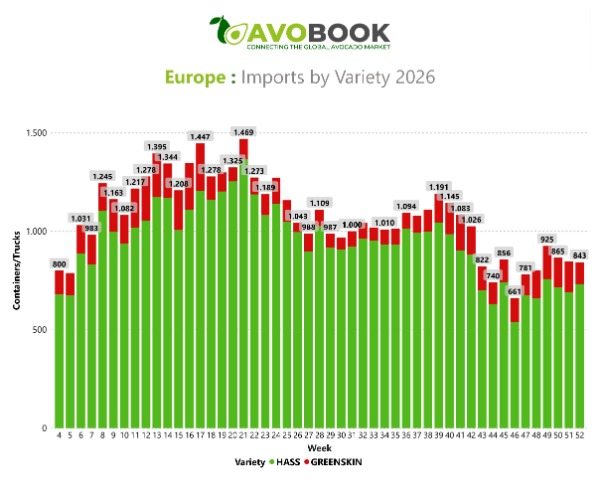
In the European avocado market, Hass accounted for 88.1% of shipments between weeks 4 and 52 of 2026, totaling 46,388 shipments compared with 6,253 for Greenskin, a category that groups green-skinned varieties.
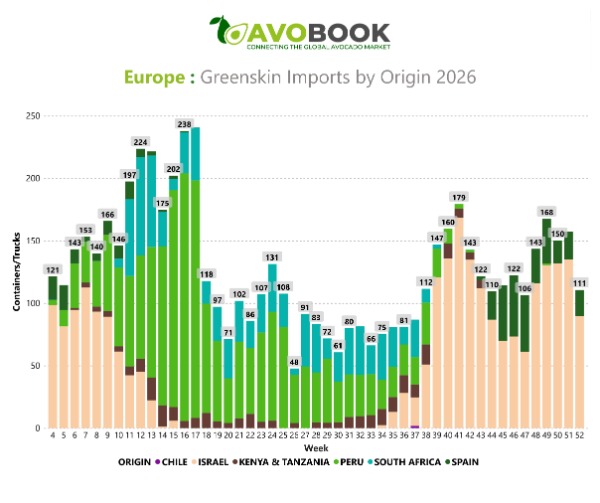
Imports of green-skinned varieties recorded higher volumes between weeks 11 and 17, reaching a peak of 241 shipments in week 17. Volumes subsequently declined to 48 shipments in week 26, before recovering from week 38 and reaching 179 shipments in week 41.
The composition of supply within this group also underwent changes. Israel had a significant presence at the beginning of the year and regained market share between weeks 38 and 43.
Meanwhile, Peru accounted for a substantial share of shipments during the period of highest volumes, particularly between weeks 11 and 18, while South Africa gained ground during several weeks of the middle period. Spain increased its participation towards the end of the series.
Although Hass's expansion began with individual plantings, following an agreement with Rudolph Hass, H. H. Brokaw propagated the variety through grafting. According to UC Riverside's historical account, strong sales eventually exhausted an annual production of between 3,000 and 10,000 trees.
A century after the original mother tree was planted in California, Hass now has an export calendar encompassing 15 origins and accounts for nearly nine out of every ten avocado shipments in Avobook's 2026 European import series.
Was This News Article Helpful?
Follow us on Instagram → @avobook.avocado
There, we share the most important developments in the global avocado market: news, figures and industry trends.
You can also follow us on LinkedIn or join our WhatsApp channel to receive key news as soon as it is published.