Industry evolution
Oil and frozen avocado complement the return to the producer
The development of freezing and oil transforms the return to the producer, allowing the use of fruit that does not qualify for fresh export.

The growth of the avocado industry no longer depends solely on how much volume can be placed on the fresh market. As processing capacities increase, freezing, pulp, and oil are creating new alternatives for a portion of the crop that historically had fewer commercial options.
For Omar Díaz, general manager of Westfalia Fruit Peru and Colombia, this diversification doesn't change the producer's priorities, but it does allow them to utilize a larger proportion of the fruit. He explains that around 90% can be destined for the fresh market, depending on the characteristics of each batch. Of the remaining volume, in an operation that has both industrial options, approximately 70% can be frozen and 30% can be used for oil.
“Fresh fruit takes priority, followed by frozen fruit, and then oil ,” he explains. Smaller fruit or fruit that doesn't meet the necessary conditions for freezing can thus find a final commercial outlet in oil production.
An alternative that transforms the return to the producer
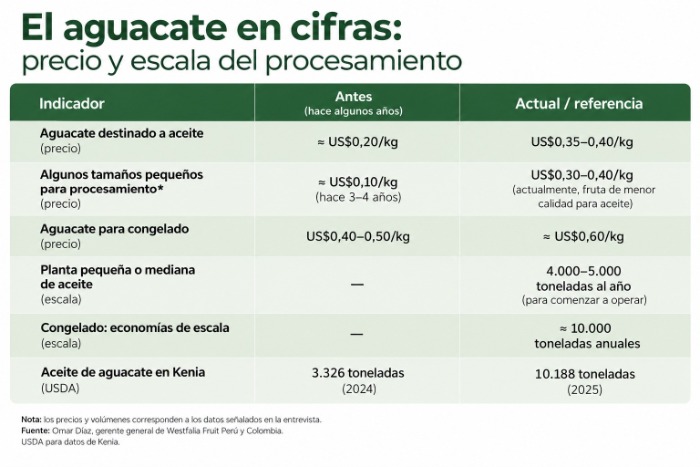
The effect of this diversification is beginning to be seen in the value of the raw material. Díaz points out that, a few years ago, a producer could receive around US$0.20 per kilo of avocados destined for oil. Currently, he places that value between US$0.35 and US$0.40, with an average close to US$0.35.
A similar trend is observed in frozen products: prices previously hovered around US$0.40–0.50/kg, but are now closer to US$0.60/kg. Díaz attributes this trend to increased processing capacity and greater competition for raw materials between the two industries.
“ That’s definitely a help to the producer ,” he maintains. As an example, he recalls that three or four years ago some small sizes could be bought for processing at around US$0.10/kg, while currently he places the value of lower quality fruit that can be sold for oil at between US$0.30 and US$0.40.
However, this doesn't make processing a substitute for fresh. The decision can vary depending on the size, the time of year, and market conditions. Díaz explains that there are weeks when certain small sizes, and even large sizes when there is a high supply, can be a better alternative to freezing than exporting fresh.
Frozen and oil: two models with different requirements
Industrial alternatives for avocados also do not require the same raw materials or infrastructure.
Díaz describes freezing as a process with stricter control requirements, especially regarding microbiology. Oil production is comparatively more flexible and allows for the use of lower-quality fruit, although it also requires controls during processing.
The difference extends to scale. According to their estimates, a small or medium-sized oil plant requires around 4,000 to 5,000 tons of raw material per year to begin operations, while a freezing facility needs approximately 10,000 tons annually to achieve economies of scale.
This difference also helps to explain why the development of a processing industry depends not only on having fruit outside the fresh market, but also on having sufficient volume and continuity of supply.
Analysis by origin: Peru, Mexico, Kenya, and Colombia
From Díaz's perspective, Peru and Mexico currently exhibit greater development in the avocado processing sector. Mexico combines its production scale with a frozen and oil industry strongly linked to the US market , while Peru has a greater diversity of destinations for fresh avocados and has expanded its industrial capacity in recent years.
Kenya shows a different trajectory. Díaz identifies the African country as an example of how the logistical difficulties of the fresh market can increase the attractiveness of processing: the more complex the transit times, he argues, the greater the opportunities for alternatives such as freezing.
This progress is also seen in oil. USDA data shows that Kenyan avocado oil production increased from 3,326 tons in 2024 to 10,188 tons in 2025, in a scenario where logistical disruptions in the Red Sea also affected shipments of fresh fruit.
In Colombia , industrial development is still on a different scale. A study on the Hass avocado supply chain in Cauca identifies a smaller number of actors involved in processing, although it does record fruit destined for products such as guacamole, sauces, and oil. Furthermore, fruit that doesn't meet export standards has another important alternative: the domestic fresh market.
These differences show that industrialization does not necessarily serve the same function in every origin. While in some markets it allows for capturing value from off-specification fruit, in others it can complement domestic consumption or provide an alternative when it is more difficult to get fresh produce to its destination.
The fresh market will remain the priority
Despite the growth of these alternatives, Díaz does not foresee processing displacing fresh produce. On the contrary, he believes that the development of frozen products and oil should be understood as a way to complement the supply chain and make better use of the available volume.
“Frozen products and oil are alternatives to make better use of your available volume, but you can’t expect to run a profitable business solely with frozen products or oil. You have to have fresh products available anyway,” he states.
The challenge, then, lies in building a supply chain capable of finding the most suitable commercial destination for each part of the harvest. According to Díaz's analysis, fresh produce will continue to generate the highest returns, but the growth of processing is enabling fruit that previously might have fallen outside the commercial circuit to find new ways to capture value.