Gary Clevenger
Heat and humidity raise risks as California approaches 330 million pounds
USA
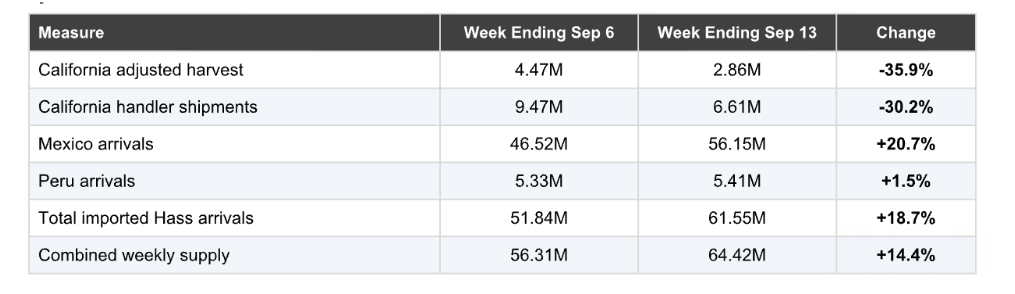
California's adjusted crop fell 35.9% to 2.86 million pounds , while cumulative volume reached 328.75 million pounds , just 1.25 million pounds shy of the 330 million pound forecast. Mexico increased its weekly arrivals by 20.7% , reaching 56.15 million pounds . Recent heat and unusually humid conditions are raising concerns about the quality and handling of the remaining fruit in California, although AMRIC data does not indicate that the weather was the direct cause of the crop decline.
Market overview:

California £1.25 million short of forecast
The adjusted harvest fell from 4.47 million to 2.86 million pounds . Hass production decreased by 38.2% to 2.60 million pounds , while Lamb Hass production increased to approximately 164,000 pounds . GEM production remained unchanged.
The adjusted cumulative volume now totals 328.75 million pounds , equivalent to 99.6% of the California Avocado Commission's estimate. At the current pace, the state should exceed the forecast in the next weekly report, although the final margin could be relatively small.
Handlers continue to move end-of-season fruit
California growers shipped 6.61 million pounds during the week, a 30.2% decrease from the 9.47 million pounds shipped the previous week. Shipments exceeded the adjusted harvest by 3.74 million pounds , indicating that growers are continuing to work with existing fruit in the system as field volume declines.
Mexico expands its leadership in the fall
Mexican arrivals rose from 46.52 million to 56.15 million pounds , an increase of 20.7% . Peru contributed 5.41 million pounds , a rise of 1.5% , bringing total Hass import arrivals to 61.55 million pounds . Mexico accounted for 91.2% of that volume.
California's adjusted harvest, combined with imported Hass avocados, increased 14.4% to 64.42 million pounds , despite the decline in California's production. This increase came almost entirely from Mexico, confirming that the fall market is being defined by Mexican supply.
Heat and humidity increase quality risks at the end of the season
Southern California experienced unusually wet conditions this summer. Historical records show that Ventura and Santa Barbara counties had their highest average dew point since 1895, while San Diego recorded its third wettest summer on record. Recent heat added stress in the final weeks of the season.
Heat can increase water stress in trees, burning exposed leaves and branches, and causing sun damage to the fruit. If a tree loses enough foliage, its ability to move water and cool itself decreases, leaving more fruit and wood exposed. Severe stress can contribute to fruit drop and limit additional size at the end of the season.
Humidity alters the risk, but does not eliminate it. Humid air reduces water loss compared to dry, windy conditions, but it also limits evaporative cooling, and warm nights offer less recovery after hot days. Furthermore, humidity becomes a risk factor for disease when dew, fog, or rain keeps leaves and fruit wet for extended periods.
What should producers and managers monitor?
-
Exposed fruit : check sizes and branches facing south and west for possible sun damage or late heat injury.
-
Adjusted watering : adapt watering to the actual state of the canopy and soil moisture; heavily defoliated trees can use less water and suffer from overwatering.
-
Avoid heavy pruning : Do not perform heavy pruning immediately after heat damage, as the remaining foliage helps to shade branches and fruit.
-
Harvest in cool periods : harvest at cooler times and move the hot fruit quickly to the cooling chain to protect firmness and ripening consistency.
Weekly movement
Conclusion
California is practically at its harvest forecast, but the remaining fruit is moving in a market dominated by a much larger Mexican supply. Heat and humidity warrant attention, as they can affect exposed fruit, tree recovery, and post-harvest performance. Weather should be considered a quality and handling risk, rather than a proven explanation for this week's crop decline.
Gary Clevenger
Freska Produce International, LLC
gary@freskaproduce.com