Competitive advantages and crop physiology in the tropics
Avocado production in Ecuador: impact of continuous flowering
Ecuador's stable climate allows for overlapping blooms, offering a window of continuous supply but with greater technical challenges.
When analyzing the potential impacts of El Niño on the global avocado industry, it is often assumed that all Pacific coast producing countries face identical challenges. However, Ecuador's agroclimatic and production conditions present significant structural differences compared to other established avocado-producing regions, such as Peru and Chile.
As our columnist Santiago Pinto explains , one of the lesser-known technical aspects of Ecuadorian coffee production is that the trees have the physiological capacity to maintain different production cycles simultaneously. This botanical characteristic is directly linked to the relatively stable climatic conditions and photoperiods that prevail in the equatorial zone for much of the year, preventing the plants from entering a pronounced winter dormancy.
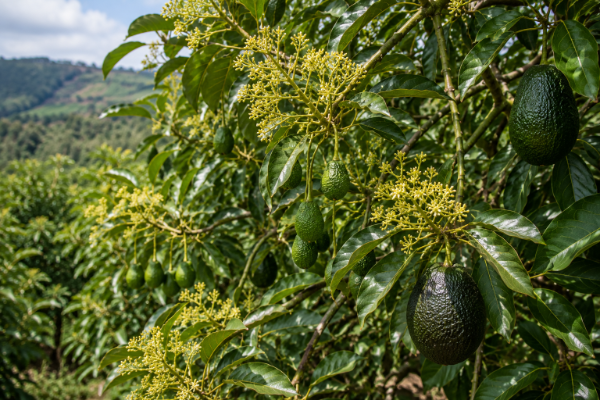
Avocado tree in Ecuador simultaneously showing flowers, developing small fruit, and ripe fruit ready for harvest.
While in countries with Mediterranean climates or coastal valleys, such as Chile and Peru, commercial production is primarily based on a single main flowering period that defines the export window, in Ecuador the situation is continuous. In a single orchard, and even on the same tree, it is perfectly possible to find up to three simultaneous production processes going through different stages of phenological development.
“We can have three pregnancies at the same time, but at different stages,” Pinto explains, using this analogy to describe the dynamic behavior of the crop in Ecuadorian lands.
This remarkable characteristic allows the first bloom to progress steadily toward fruit formation and development, while a second or even a third bloom begins to burst open and develop on adjacent branches. As a direct result of this overlap, the tree maintains uninterrupted metabolic and productive activity, theoretically allowing Ecuador to have fruit available for international markets for much of the year, breaking the traditional seasonality of the Southern Hemisphere.
A highly complex agronomic management ecosystem
The presence of multiple simultaneous phenological stages on the same tree is not only a supply advantage, but also presents significantly greater technical management challenges for growers and field advisors. Monitoring an orchard where flowering, fruit set, and ripe fruit coexist demands surgical precision in fertilization and pest control programs.
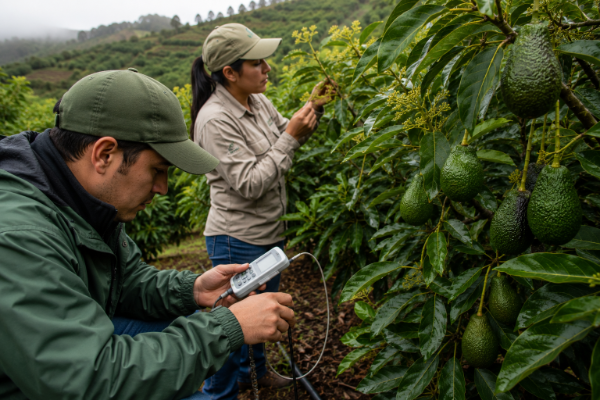
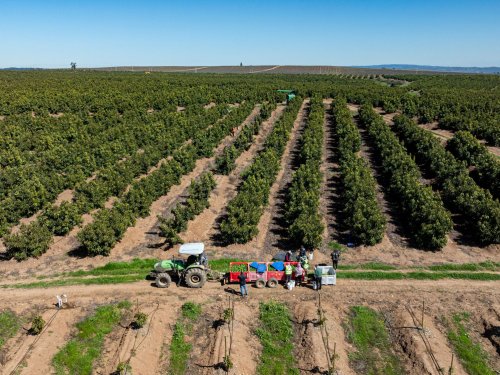
Agricultural technicians performing phytosanitary monitoring and humidity control in an avocado orchard.
According to Pinto's analysis, the first critical step in protecting the business from the imminent arrival of extreme weather events is to rigorously adhere to the controls and applications corresponding to each stage of development separately. Omitting nutritional management, relaxing fungicide applications, or delaying irrigation decisions can exponentially increase the risk of losses when the most critical climatic periods for the crop hit.
“You skip a step in the field strategy and, when you reach the critical moment of the weather, you have a high probability of facing severe problems of discarding or fruit falling,” warns Pinto.
Adding to the complexity of daily management is the urgent need to design dual contingency plans. Ecuadorian producers must be prepared both to face potential prolonged droughts in certain highland areas and to mitigate scenarios of severe excess moisture and flooding in the lowlands, depending on how the intensity of the weather phenomenon evolves during the coming months of the growing season.
Mitigation and resilience: Preparing before the problem arrives
Given the increasing likelihood of a moderate to high-intensity El Niño event this season, Ecuadorian producers are no longer simply reacting to the situation; they are currently implementing measures to strengthen the root structure of their orchards and ensure the integrity of their irrigation infrastructure. The primary objective is to guarantee the availability and strategic storage of water to sustain the trees during periods of abnormal dryness.
Furthermore, the sector's technical working groups are implementing new and stricter post-harvest protocols. These guidelines are aimed at reducing the risks associated with fungal diseases, such as anthracnose, whose incidence tends to increase with rising temperatures and humidity, affecting the fruit's condition during maritime transit and its subsequent marketing stage at destination ports.
For Santiago Pinto, the key to commercial success lies in understanding that the results and quality of the fruit in the export box depend on agronomic decisions made several months in advance . Therefore, constant satellite monitoring of the orchards, continuous foliar analysis, and strict adherence to integrated management programs have become fundamental tools for a successful season.
Join our WhatsApp channel and receive the latest news from the international avocado market every week:https://www.whatsapp.com/channel/0029Vb81Exv1yT2Eff1Hjo2w