Climate impact
How will Super Niño affect avocados in South America?
The weather phenomenon will disrupt harvests in Peru and Colombia, while Chile projects greater water availability for its orchards.
The Super Niño phenomenon has once again become a major concern for the avocado industry in South America. However, its impact will not be the same for all producing countries. While some regions could face problems with flowering, fruit size, disease, and logistics, others could have the opportunity to improve their water availability and even benefit from a more favorable market environment internationally.
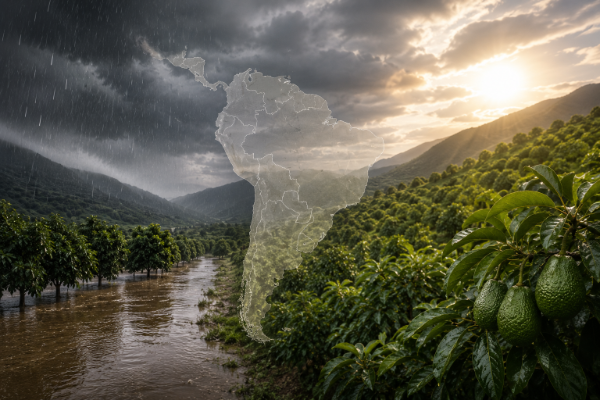
Avocado field divided by the climatic effects of Super Niño in South America.
What risks does Super Niño pose to production in Peru?
In Peru , one of the main risks associated with Super Niño is the disruption of floral induction . Higher temperatures can lead to more extensive and uneven flowering, affecting the uniformity of orchard production. A prolonged period of this disruption can result in lower productivity and greater variability between orchards, where technical management will be a determining factor.
This is compounded by a critical logistical risk that extends beyond the fields. Heavy rains, floods, and mudslides can disrupt roads and highways , hindering the transport of fruit to packinghouses and export ports. Furthermore, increased humidity and high temperatures promote the spread of diseases, exacerbating post-harvest problems.
Marco Mattar, an international consultant on subtropical fruits and an expert in avocados and citrus , states that the conflicts would be seen in transportation: "In Peru, I see more risk in logistics than in production. The real problem may be getting the fruit out of the field."
Why is Colombia emerging as the country most vulnerable to drought?
The main risk for Colombia would be the lack of rain. A prolonged reduction in rainfall could affect fruit set, increase avocado drop, and reduce the final size of the crop, compromising the potential observed in the current blooms, especially for the end-of-year harvest.
"The most worrying situation is Colombia. If the expected rains don't arrive, we could see fruit drop and smaller sizes," Mattar warns.
Furthermore, water stress conditions favor the emergence of wood-decay fungi, one of the most complex health problems for the Colombian industry. In scenarios of prolonged drought, producers may be forced to carry out severe pruning and intensive orchard recovery programs.
What water opportunities and challenges will Chile face?
For Chile, the outlook could be different and more favorable in terms of resources. Increased rainfall would contribute to the recovery of reservoirs, aquifers, and soil profiles , especially in the north-central region, where water scarcity has been a major constraint on productive development over the past decade.
"In Peru, El Niño is a catastrophe; in Chile, it can be transformed into a productive and commercial opportunity," says Avobook columnist Gonzalo Vargas .
However, experts warn that strategies will need to be implemented to prevent excessive vegetative growth that could hinder flower induction, requiring adjustments in fertilization, nitrogen management, growth regulators, and practices such as girdling. From a commercial standpoint, a potential decrease in Peruvian supply could open a favorable window for Chilean fruit at the beginning of the season , generating more attractive price conditions in the global market.
“If Peruvian supply decreases and consumption continues to grow, Chile could start the season with very attractive prices,” Vargas mentions .
What are the most common health threats to fruit quality?
Although regions like Chile benefit from greater water availability, persistent rainfall in coastal areas, with their higher humidity and lower ventilation, presents a challenge. Prolonged rainfall during the spring could exacerbate fruit condition and post-harvest issues , particularly affecting orchards located in areas with frequent fog. Experts recommend strengthening preventative disease control programs and carefully monitoring soils to avoid pathogens associated with excess moisture.
Will the climate effects extend beyond one season?
Beyond the immediate effects, experts agree that the Super Niño phenomenon could influence avocado production for several growing seasons . Therefore, the ability to adapt agronomic practices, strengthen infrastructure, and respond quickly to the new climatic conditions will be crucial to minimizing risks and capitalizing on the opportunities this scenario may present for the South American industry.
Join our WhatsApp channel and receive the latest news from the international avocado market every week: https://www.whatsapp.com/channel/0029Vb81Exv1yT2Eff1Hjo2w