Emerging origins
Tanzania and the avocado export challenge in Africa
Tanzania is promoting a quality plan to export avocados, while Kenya and Rwanda are strengthening their export capacity in East Africa.
October 7, 2026
According to data from Avobook, combined avocado shipments from Kenya and Tanzania to Europe total 2,261 containers in the available data for 2026. This figure already surpasses the 2,147 containers recorded in all of 2025, although it remains below the 2,890 containers shipped in 2024. In this context, Tanzania is promoting a plan to improve the quality of its fruit and strengthen its export capacity.
Tanzania has agreed on a plan to improve the quality of its avocados and strengthen its export capacity. The measures include improvements in nurseries, orchard management, harvesting, and packing. The priorities were defined at a meeting convened by the Ministry of Agriculture and the FAO , held in Njombe from August 26 to 28, 2026, as part of the One Country, One Priority Product (OCOP) initiative.
The plan focuses on factors that influence market access: uniformity of size, maturity at harvest, quality of plant material, and post-harvest handling. The initiative raises a question that isn't unique to Tanzania: How can East Africa consolidate its presence in the international avocado trade?
Quality plan in Tanzania: Precision agriculture and post-harvest
Among the agreed actions is the introduction of precision agriculture in selected training orchards, with support from Chinese specialists and Tanzanian institutions. The goal is to improve pruning, nutrition, water management, and fruit load to achieve more uniform fruit sizes.
Models will also be developed that combine field data and dry matter content to identify harvest windows by zone. In addition, support will be provided to a plant nursery, and a semi-automated production line for a local packing plant is being proposed. These are planned interventions whose implementation and results will need to be evaluated.
East Africa: Kenya's projections and agricultural expansion in Rwanda
Kenya provides a reference point for an already established export industry. A report by the Foreign Agricultural Service of the United States Department of Agriculture (USDA) , published in April, placed its avocado exports at 121,000 tons for 2025 and projected 130,000 tons for 2026. This forecast applies to all of its international destinations.
The same document warns that increased production comes with post-harvest and logistical limitations. For routes to Europe and the Middle East, it notes that maritime diversions around the Cape of Good Hope can increase transport times and costs, affecting the fruit's competitiveness.
Rwanda is also boosting its export capacity. The National Agricultural Export Development Board (NAEB) outlines a project to establish grafted avocado orchards on 800 hectares, involving 1,600 small-scale farmers in five districts. This area represents a program target, not plantations already in production.
In parallel, the institution promotes compliance with export guidelines regarding harvesting, grading, packaging, cold chain management, and traceability. These efforts demonstrate that regional development involves both expanding production and preparing the fruit to meet buyer requirements.
Shipments to Europe: Seasonal analysis of containers from Kenya and Tanzania
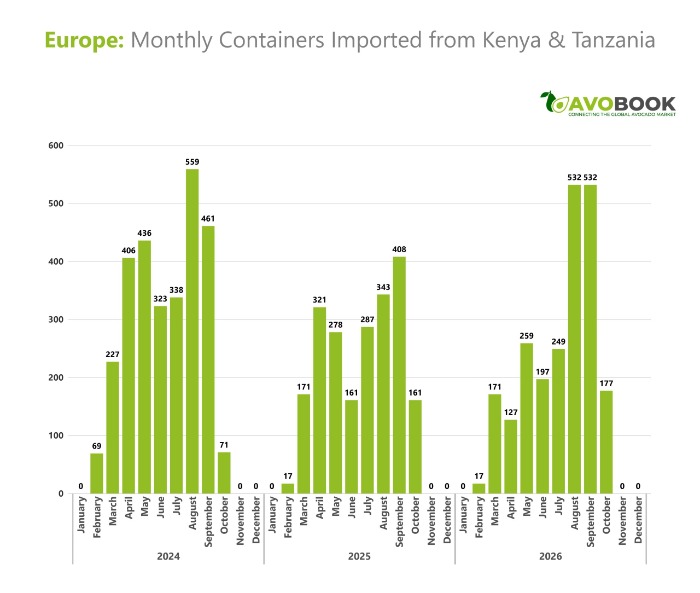
Avobook's data shows the combined arrivals from Kenya and Tanzania to Europe, without separating each country's contribution. In 2024, they totaled 2,890 containers, while in 2025 they reached 2,147, a decrease of approximately 26%.
By 2026, the available cumulative total stands at 2,261 containers: already exceeding the total recorded in 2025, although remaining below 2024. As the year is still ongoing, the figure should be understood as a partial record.
The data shows a marked concentration of arrivals between March and October. In 2026, August and September stand out with 532 containers each, becoming the months with the highest volume in the observed period. Together, they represent approximately 47% of the total available.
These records confirm a commercial presence in Europe, but do not allow us to attribute its evolution to Tanzania separately or to extend the conclusions to all of East Africa.
The East African challenge: Quality, traceability and export logistics
The initiatives of Tanzania and Rwanda, along with Kenya's export track record, offer signs of a region seeking to strengthen its international participation. However, the background information consulted also identifies areas for improvement in quality, maturity, traceability, and logistics.
For buyers, the development of these origins must translate into fruit that meets their requirements and arrives in consistent condition. The Tanzanian plan is precisely aimed at achieving these capabilities; the upcoming results will allow us to assess how much it contributes to consolidating the country's position within the regional supply.