Technological advances in the industry
Avocado harvesting robots: advances and limitations
A prototype two-armed aerial robot is exploring avocado harvesting in California, opening the debate about its future commercial viability.
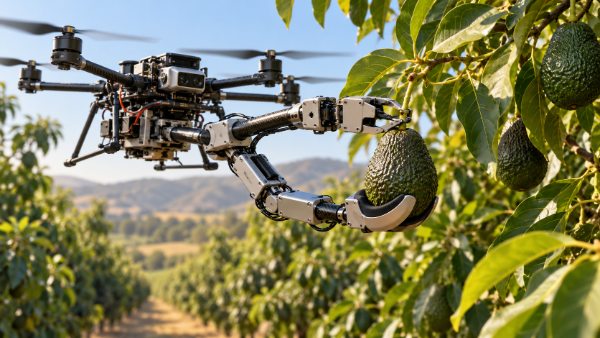
Reference image, does not exactly correspond to the prototype made.
October 12, 2026
As part of a research project exploring the future of harvesting, a team from the Department of Electrical and Computer Engineering at the University of California, Riverside, has unveiled a prototype two-armed aerial robot designed for avocado harvesting. The study , first published on May 27, 2025, in Advanced Robotics Research , demonstrates experimental progress, although its commercial application still requires further development and evaluation.
The development of this tool stems from the difficulties encountered by ground-based robots due to conditions such as terrain geography, tree arrangement, and fruit height. The proposed aerial machine is based on bringing the harvesting mechanism closer from the air to avoid the potential disadvantages faced on the ground.
Grip and precision mechanism in aerial harvesting
The robot, developed in California, uses a camera to estimate the avocado's position and orientation. Then, one arm holds the stem (the stalk that attaches the avocado to the tree) while the other rotates and grasps the fruit to detach it from the tree. The arm holding the stem helps stabilize the robot during the rotation, preventing its flexibility from hindering the avocado's removal.
The initial tests were conducted by keeping the robot on a fixed platform and using real avocados in the orchard. For the flight demonstration, the drone was positioned manually, and artificial fruit was used for the trial.
Technical limitations: Autonomy, stability, and computational vision
Currently, the prototype has two main operational limitations. First, the wind can move the avocado and make it difficult for the robot to grasp it. Second, the technology focuses on fruit located on the outer part of the tree canopy, so it is not yet possible to harvest the entire avocado crop.
Furthermore, the system still estimates the pendulum's location rather than detecting it visually. It also has weight limitations and a limited energy output, which should be considered when planning operating hours.
Commercial viability and profitability of robotic harvesting
The study presented by Riverside does not include an estimated date for the robot's commercialization. However, before considering its use, growers should reflect on aspects such as the potential harvest volume, how frequently it would successfully complete the operation, the handling of the fruit after harvesting, the effects on its condition, and the costs of operating and maintaining the equipment.
The prototype opens a path for exploring aerial avocado harvesting, although further work is needed before its commercial application can be evaluated. For growers, the key will be determining whether it can operate reliably in the orchard, preserve the fruit's condition, and achieve a harvest rate that justifies its cost. For now, the research shows experimental progress, with no set timeline for its market launch.